



Muted launch for South-east Asia's largest railway station
Bangkok
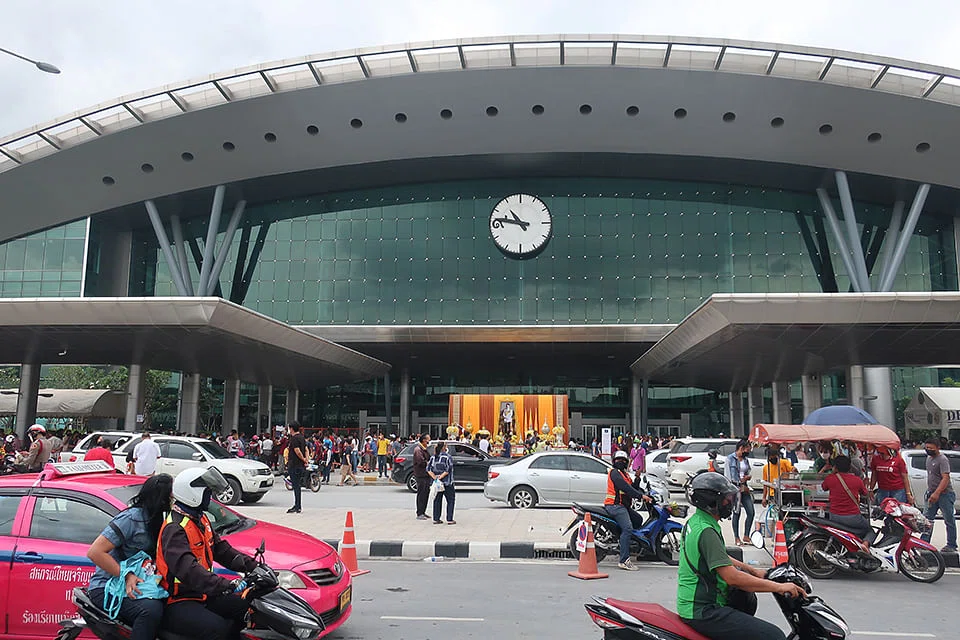
BANGKOK'S massive Bang Sue Grand Station - billed as the largest railway station in South-east Asia - is scheduled for a very soft opening on Monday, to be witnessed by thousands of Thais receiving their Covid-19 vaccinations on the site.
The Red Line, 40 km of elevated tracks, will launch a free trial passenger service to the public that links Bangkok's western and northern suburbs to the 290,000 square metre Bang Sue Grand Station, which is still largely vacant and will remain so for the foreseeable future.
"This is the soft opening. We hope to have an official opening in November, but the date is not fixed yet," said Kumpol Boonchom, deputy chief of special projects at the State Railway of Thailand (SRT).
The Red Line, owned by the SRT, is a crucial part of the US$3 billion Bang Sue project.
Bang Sue Grand Station, which was completed last year, has been put to use temporarily as a vaccination centre during the third and more virulent wave of Covid-19.
Thailand on Saturday reported a daily record of 18,912 new cases and a record of 178 new deaths, bringing total accumulated cases to 597,287 and 4,857 fatalities.
The ongoing pandemic has arguably taken much of the steam out of the mega-project launch.
"It is an unfortunate situation for Bang Sue," said Sumet Ongkittikul, transport and logistics expert at Thailand Development Research Institute (TDRI). "When it opens later this year it will be pretty empty, with no commercial space and no one selling food and stuff like that."
The SRT has held three bids for a public-private partnership to operate the commercial space at Bang Sue terminal but each time there were no bidders.
"The Covid situation has made it very tough," Mr Kumpol said. "I think the private bidders don't see the demand yet. Maybe after we open the Red Line, they will see the demand."
That is perhaps wishful thinking. The Red Line is expected to have a ridership of about 10,000 passengers per day in its initial months, well below the break-even level.
All of Bangkok's mass rail systems have seen a dramatic decline in ridership since Covid-19 first hit last year, as international tourists disappeared, daily commuters opted to work from home and casual trips dried up thanks to lockdowns and social distancing.
Prior to the pandemic, the Green Line (Skytrain) was enjoying 800,000 passengers per day, while the Blue Line (subway) was managing 400,000 passengers daily and the rail link to Suvarnabhumi Airport about 120,000 commuters a day.
The Red Line is expected to see daily ridership of between 120,000 and 200,000 in the post-Covid period, as the route is mostly serving residential, suburban areas.
There are actually two Red Lines, comprising the Dark Red Line from Bang Sue to Rangsit in northern Bangkok, and the Light Red Line from Bang Sue to Taling Chan in western Bangkok.
The Red Lines are the first mass rail systems to use Bang Sue as their central station, and their launch marks the first step of transforming the station into the Thai capital's main rail transport hub.
Officially launched in March 2007, Bang Sue Grand Station was designed to replace Hua Lamphong Station (built in 1916) as the main hub for the railway's 4,508 km of track.
In the future, the four-storey Bang Sue station will play a more pivotal role as it provides a rail link to Don Mueang Airport, Thailand's main terminal for domestic flights.
Further down the line, Bang Sue will also be the main Bangkok station for the high-speed-railway linking U-Tapao, Suvarnabhumi and Don Mueang airports (part of the Eastern Economic Corridor scheme) and the Thai-China high speed rail link linking Bangkok and Laos.
"In the future after Covid, with the Red Line opened, and once the three-airport rail link is serving Suvarnabhumi and Don Mueang, then Bang Sue will be very attractive as a transportation hub," said TDRI's Mr Sumet.
"And because of Don Mueang, which is for domestic flights, the Red Line will become more popular for people travelling upcountry and for tourists."
TRENDING NOW

He built the Vingroup empire. Now South-east Asia’s richest man is handing some key roles to his sons
32 companies, 6 individuals bag accolades at Singapore Corporate Awards 2026
Can a first-time homebuyer couple earning S$18,000 a month afford a new EC unit?
Floods compound Philippine growth woes from public-works scandal

