



Thailand sees mixed returns from China’s pandemic slowdown
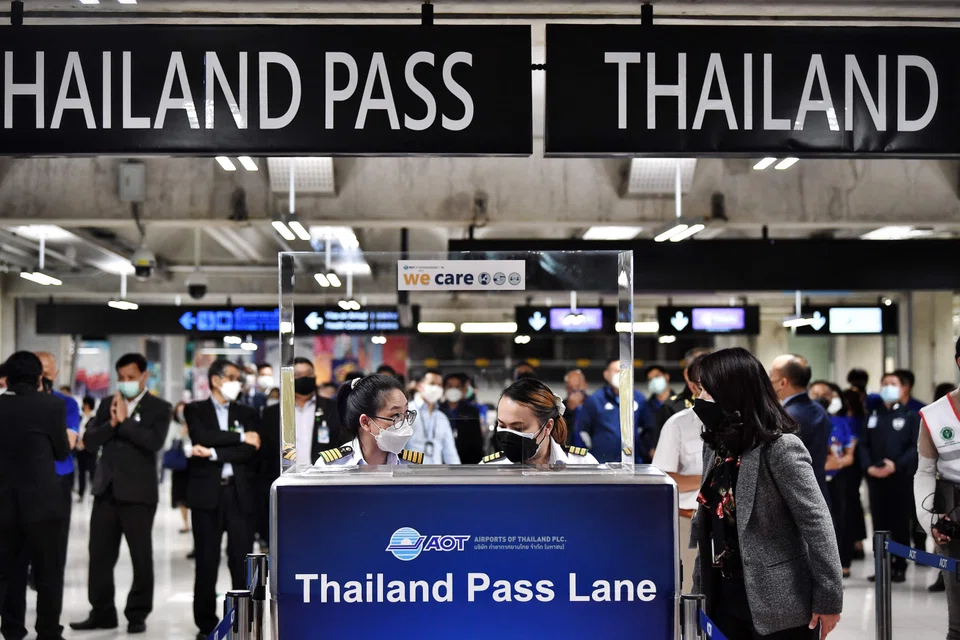
AS LONG as China continues to pursue its zero-Covid policy, with lockdowns and onerous quarantine requirements for its own citizens when they return from abroad, the chances of Thailand seeing a speedy economic recovery to pre-pandemic levels remain slim, economists say.
In 2019, Thailand attracted 39.8 million foreign tourists. They spent an estimated 2 trillion baht (S$80.7 billion), accounting for 12 per cent of the country’s gross domestic product (GDP) that year. Of that total number of visitors, nearly a third - or about 11 million - were from China.
“With a limited return of Chinese tourists, it would be almost impossible to get back to the pre-Covid levels seen in 2019,” said Charl Kengchon, executive chairman of the Kasikorn Research Center, a Bangkok-based think tank.
Thailand will have trouble filling that gaping 12 per cent hole in its economy left by the absent tourists, especially if Beijing continues to make international travel increasingly difficult for its own citizens.
Chinese nationals, provided they have a valid passport, are allowed to visit Thailand but must endure 21 days of quarantine upon their return.
These strict travel restrictions, however, do not seem to have stopped wealthier Chinese from buying condominiums and other properties in Thailand. According to Thailand’s Real Estate Information Center, Chinese nationals accounted for 60 per cent of the condominium purchases during the first 9 months of 2021, despite the Covid-19 pandemic.
This trend is nothing particularly new. Of the 1.4 million condo units purchased by foreigners over the years, some 730,000 were bought by Chinese, or nearly 52 per cent, according to government figures.
It is not clear whether an economic slowdown in China would be net gain or loss for Thailand. While the lockdowns in Chinese special economic zones might disrupt certain supply chains in the automobile and electronics sectors, which are 2 of the important export earners for Thailand. China’s Covid-led slowdown could also help Thailand’s on the inflation front, which was close to 6 per cent in February and March after the breakout of the Russia-Ukraine war.
“People are talking a lot about China slowing down, so demand for energy, for wheat, aluminium and fertiliser will not be as high as we initially thought. Prices should soften in the second half of 2022, maybe lower than in the first half, but not as low as before the Ukraine war started, said Kirida Bhaopichitr, Director of the Economic Intelligence Service, at the Thailand Development Research Institute.
She thinks the Covid-19 lockdowns in China and the Ukraine conflict will hasten the decoupling of foreign direct investment (FDI) from mainland China, a process that already started a few years ago with the US-China trade war.
“Many companies from Japan, Taiwan, the US, South Korea have shifted their FDI to countries like Thailand and Vietnam,” said Kirida. “Most of the companies coming to Thailand over the past 2 to 3 years were Japanese and Taiwanese, plus Chinese. They want to decouple from China and move to South-east Asia,” she said.
The figures seem to back her up. In 2021, Thailand enjoyed a net inflow of FDI of US$11.4 billion, with Japan accounting for US$3.2 billion, followed by China/Hong Kong (US$2.1 billion) and the United States (US$1.1 billion), according to Bank of Thailand (BOT) figures.
At the Board of Investment (BOI), which grants tax incentives to FDI and local projects, China topped the list of applications in 2019 with US$8.6 billion worth of projects, pipping Japan for the first time in Thailand’s investment history.
China’s list of projects that year included the billion-dollar high speed train to link Bangkok to the Eastern Seaboard, which will be built as a joint venture with Chinese firms.
In 2020, Japan returned to the top slot with US$2.2 billion in BOI project applications, while Chinese projects were second with US$920 million. In 2021, Japan was top again with US$2.35 billion in BOI applications, with China second at US$1.12 billion.
Chinese automobile manufacturers Great Wall Motors and MG have set up plants in Thailand in recent years, with a keen interest in electric vehicle production which has been heavily promoted by the Thai government.
“I expect a positive trend of Chinese FDI in coming years, especially in the auto and auto-related businesses,” said Charl from . Kasikorn Research Center. “Chinese car manufacturers do have real potential to get into Thailand’s domestic markets as well as others in South-east Asia,” he said.
TRENDING NOW

OCBC mobile, online banking services restored after Friday afternoon disruption

SGX CEO Loh Boon Chye to step down; succession planning under way

Waymo founder predicts ‘landslide’ robotaxi adoption in Singapore, driven by high car costs

Vietnam’s northern provinces, not Hanoi or Ho Chi Minh City, are powering near 10% GDP growth

