

Banks, MAS urge switch to e-hongbao
Message this year to encourage safe-distancing, along with added experiences on electronic transfer platforms
Singapore
POPPING open a bright-red hongbao and pulling out crisp new bank notes has been a traditional Chinese New Year (CNY) experience for many people across Singapore, but that's due to change this year.
As Phase 3 of Singapore's reopening remains in effect, groups will need to limit themselves to eight people for social gatherings, or eight visitors to a household at a time.
Long queues at banks to collect new notes might also pose a higher risk of exposure to the virus. So, banks have had to create a mix of options to accommodate safe-distancing and manage crowds at branches.
DBS, OCBC, and UOB are implementing compulsory pre-orders of bank notes online, except for those aged 60 and above and persons with disabilities, who will be allowed to walk in. OCBC will be deploying more staff to manage crowds. Maybank and Standard Chartered are encouraging customers to make their reservations for notes online.
The Monetary Authority of Singapore is also urging Singaporeans to switch to e-hongbao, promoting them as both safer and more environmentally sustainable.
It said carbon emissions generated by the production of new notes for each Chinese New Year are estimated to be about 330 tonnes now.
That's equivalent to the emissions from charging one smartphone for every Singaporean resident for five days.
Large retail banks here will allow remote gifting of digital hongbao through PayNow, a funds transfer service.
These banks will also allow users to add CNY greetings through their WhatsApp and SMS notifications and in most cases, include a CNY-themed graphic.
Some banks also provide e-hongbao gifting through their own funds transfer platforms, such as DBS PayLah! and OCBC Pay Anyone, with added experiences like digital games and lucky draws.
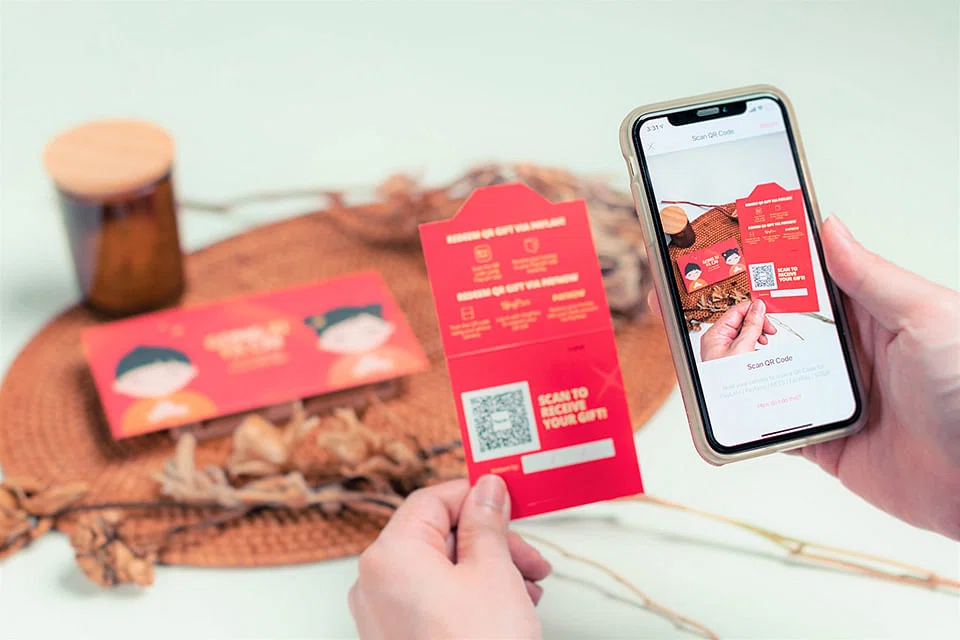
DBS said on Friday it will be sending its "QR Gift" cards by mail - for free - to customers who order them online from now to Jan 26.
DBS QR Gift, where users scan a physical QR Gift card to send and receive a virtual angbao, was introduced in 2019.
The number of DBS QR Gift cards used during CNY in 2020 tripled from the previous year, with the amount of money loaded on them in the same period nearly doubling to S$2.8 million, DBS told The Business Times. This year, DBS will be introducing a customisable expiry date feature allowing users to return unredeemed amounts to their accounts up to eight weeks after they send their e-hongbao.
Now in greater spotlight due to Covid-19 constraints this year, e-hongbao began to gain traction as far back as 2014 in China, when the most popular chat messenger there, WeChat, launched its virtual service.
Users could give an amount directly to a recipient, or to members of a chat group. They could also choose to give chat group members a randomised amount of money, from a sum dispersed among them, and let them see who would get the most.
Tech giants such as Alibaba and Baidu soon followed with competing e-hongbao services.
Banks in Singapore have also worked to limit the environmental impact of printing hongbao. OCBC collected 4,000 kilogrammes of red packets to make pulp for cardboard boxes in 2020. UOB has also cut the number of hongbao printed by about 30 per cent this year.
Still, whether e-hongbao will receive the same enthusiasm in Singaporeans remains to be seen. As polled by BT, some 80 per cent of 22 respondents receiving hongbao believe that they are somewhat or very unlikely to receive e-hongbao from relatives they do not visit.
DBS said its eGift service is most widely used by those aged 21 to 30. Although UOB said the use of PayNow on its app has become more popular among those aged between 51 and 70, those aged 21 to 40 still make up the bulk of PayNow users.
Cassie Ong, 23, an engineer, is prepared for a 50 per cent drop in hongbao money this year.
While she might have met up to 60 family members in a day during the CNY celebrations in the past, her plans are set to change significantly this year.
"The people I receive hongbao from won't use e-hongbao," she said. "They don't even have PayLah!"
Others had other things to say on the significance of receiving physical hongbao.
"When you're given the hongbao, you're supposed to receive it with both hands to show respect, and you need to respond with New Year blessings," said 21-year-old pre-school teacher Cheong Yoke Leng.
Homemaker Charine Yeap, 48, concurred, calling e-hongbao "too robotic", adding that she would stagger planned visits instead.
"If I don't feel a need to see their face, I won't feel a need to send them an e-hongbao," she said.
TRENDING NOW
LTA proposes combining car COE categories, adding rebate-surcharge system
StarHub to acquire MyRepublic’s mobile business amid ongoing telco consolidation

DBS, OCBC, UOB rout lops billions off STI as inflation, rate concerns spook investors

Grab CEO’s wife Chloe Tong on life with Anthony Tan and finding her purpose

