

Beijing's devaluation seen as means to fully liberalise yuan
Actions by Beijing authorities are actually clear signals of its resolve to stabilise growth
Singapore
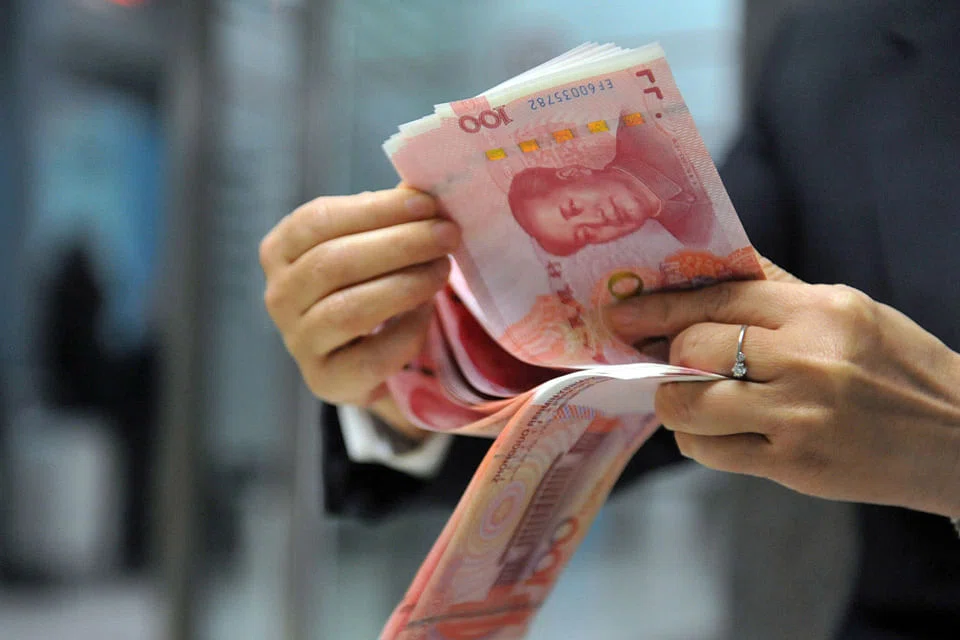
BEIJING's recent depreciation of the yuan is actually an understandable approach towards the full liberalisation of the currency that is ultimately aimed at boosting growth in China, said a Singapore-based senior analyst on Friday.
This is a logical step to take to calm nerves, as China faces a maelstrom of negative market forces shaking the country's financial stability now, Heng Koon How, foreign exchange strategist at Credit Suisse, told The Business Times.
"The gas needs to be let out in terms of renminbi overvaluation so they let the currency depreciate a little bit in line with market forces, and that reduces the pressure for outflows," said Mr Heng.
"Then they can cut interest rates actively to rejuvenate the economy; it's a three-step process," he added.
Mr Heng was speaking to BT on the sidelines of a business outlook forum on Friday, co-organised by the Singapore Chinese Chamber of Commerce and Industry (SCCCI) and Credit Suisse.
Much ink has been spilled since the start of this year over the mixed signals that Beijing is sending out on its commitment to market reforms as the country tries to meet growth targets.
Beijing has been struggling to reach its economic growth target of around 7 per cent this year, despite a raft of policy-easing steps in recent months.
The start of 2016 got Beijing busier. The State Administration of Foreign Exchange (SAFE) launched a "supervision system" on Jan 1 to monitor individual foreign currency buying. Each individual is permitted to buy a maximum equivalent of US$50,000 of foreign currency per year.
The People's Bank of China (PBOC), the Chinese central bank, then weakened the onshore trading range midpoint for the yuan on Monday to 6.5032 yuan to the US dollar, the lowest in five years. The same day, the Shanghai market greeted the first trading day of the year with a vertiginous 7 per cent chute.
Circuit breakers, put in previously by the China Securities Regulatory Commission (CSRC), halted trading for the rest of the day.
The PBOC then stepped in the next day, pouring 130 billion yuan (S$28.3 billion) as short-term funds into money markets to soothe nerves. It also led to speculation that it was trying to prop up the yuan.
The central bank surprised markets again on Thursday to devalue the yuan by 0.5 per cent to 6.5646 per US dollar, the lowest since March 2011.
Spooked investors pulled out; stock markets were then suspended again for the day less than half an hour after the open.
The ire turned to the circuit breakers, with many saying that they exacerbated the situation.
"When the stock market approaches the levels, some market participants panicked and traded ahead of it, which exacerbated the decline. It's a form of self-fulfilling prophecy," said Singapore-based IG market analyst Bernard Aw.
CSRC then promptly announced late on Thursday that circuit breakers would be suspended starting Friday.
Mr Heng said that it was understandable the Chinese regulatory triumvirate did what it had to to allay fears.
The PBOC has a mandate to have the yuan float freely by 2020. SAFE is required to stem large capital outflows, as this would be disruptive for asset classes in China. As for the CSRC, it has to clamp down on leverage in China's financial systems.
With the chief focus on stemming capital outflows, Mr Heng noted that Beijing had to work on the yuan in order to achieve this goal, as market drivers of stability are currently overwhelmingly negative.
"The key message is: do not be surprised to see the renminbi weaken," he said earlier at the forum. "It is no longer a controlled currency, it will move more and more towards a freely traded currency."
READ MORE: Asean offers S'pore SMEs more openings than China: SCCCI official
TRENDING NOW
US dollar falters after Iran’s offer to reopen Hormuz sends oil lower

He built the Vingroup empire. Now South-east Asia’s richest man is handing some key roles to his sons

Floods compound Philippine growth woes from public-works scandal

Tokyo reverses baby bust with AI matchmaking and generous subsidies

