

BT Explains: Banks in Singapore rejig physical space for a pandemic, and more
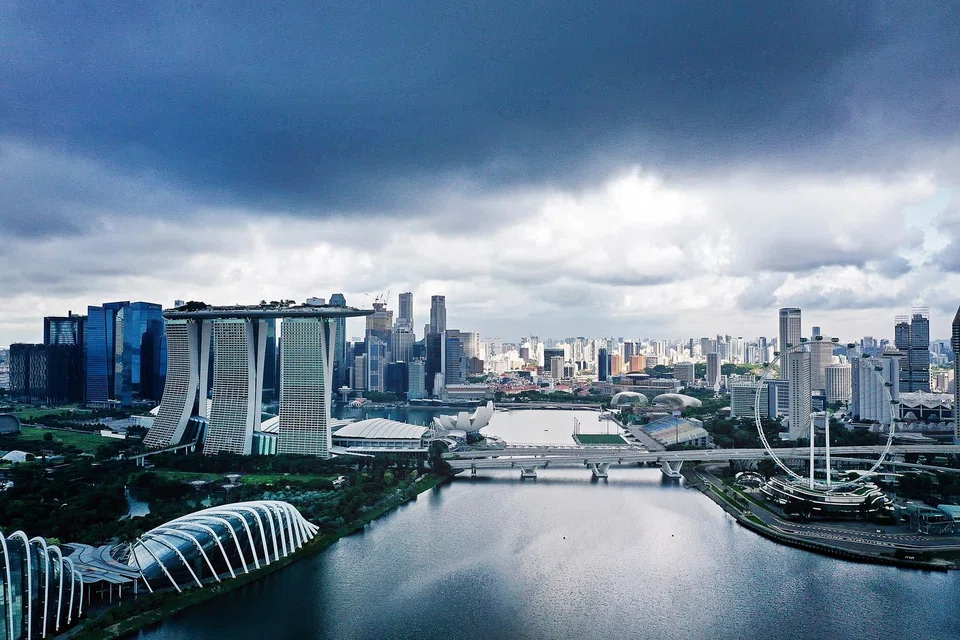
DBS is reportedly expected to shed office space in Singapore, joining other banks in rethinking their physical real estate given the impact from Covid-19.
What are the implications for both the banking industry, and office rental? The Business Times dives in.
Anchor tenants
DBS is reportedly giving up two and a half floors, or 75,000 square feet, in Singapore's Marina Bay Financial Centre (MBFC) Tower 3 in December, Bloomberg first reported. Singapore's largest bank is the anchor tenant there, occupying more than a dozen floors in the building located in the central business district (CBD).
It reportedly also wants to give up space in Hong Kong.
Standard Chartered is likewise thinking of letting go of space in MBFC when its lease is up, according to BT sources. It is an anchor tenant at MBFC Tower 1.
Elsewhere in the CBD, ANZ Singapore is said to be giving up a floor in Ocean Financial Centre this year.
Banks around the world are also making plans to trim office space in central locations.
Not so clear-cut
Still, Singapore is tapping on burgeoning growth in Asia. Business expansion plans mean taking more space.
HSBC just moved its head office in Singapore from Collyer Quay to become the anchor tenant of MBFC Tower 2. It also upgraded its other office at Mapletree Business City, but released one floor there.
Citi told BT there are no further changes to its physical footprint in Singapore, after it gave up several floors in 2020 to Amazon. It also just opened in Singapore the Citi Wealth Hub, the bank's largest wealth advisory hub in the world.
There is a unique Singapore quirk to note as well: OCBC and UOB own their headquarters in Raffles Place. So predictions of a mass shedding of office space may be overstated.
Post-GFC story
The shuffling of physical networks has been going on since the Global Financial Crisis (GFC) in 2009. Banks have rejigged operations amid changes in strategy, and to save costs.
Consultants noted that large banks have already moved back- and middle-office positions from the more expensive CBD to Changi Business Park and Mapletree Business City.
Some have also moved operations out of Singapore.
A DBS report said the banking sector here will see a 30 per cent reduction in office space over the next few years as office leases are due.
But this is likely to happen in phases, as some banks are cautious about overcutting staff. Otherwise, they end up being stranded for talent when the economy bounces back.
Andrew Tangye, executive director and head of office leasing advisory at real estate consultancy Jones Lang LaSalle (JLL), observed too that after other crises, banks would give up space to reduce costs.
"But as the economy picks up again, it is also those firms that have tended to start expanding again."
Office market's uncertainty
Data from the National University of Singapore's Institute of Real Estate and Urban Studies (IREUS) showed that the office price index for the Central Area shrank 10.8 per cent year on year in Q4 2020. This is faster than the 9 per cent contraction in the office rental index for the Central Area.
Why is this significant? Typically, rents are more sensitive to market shocks than office prices - so this is a reversal of typical trends.
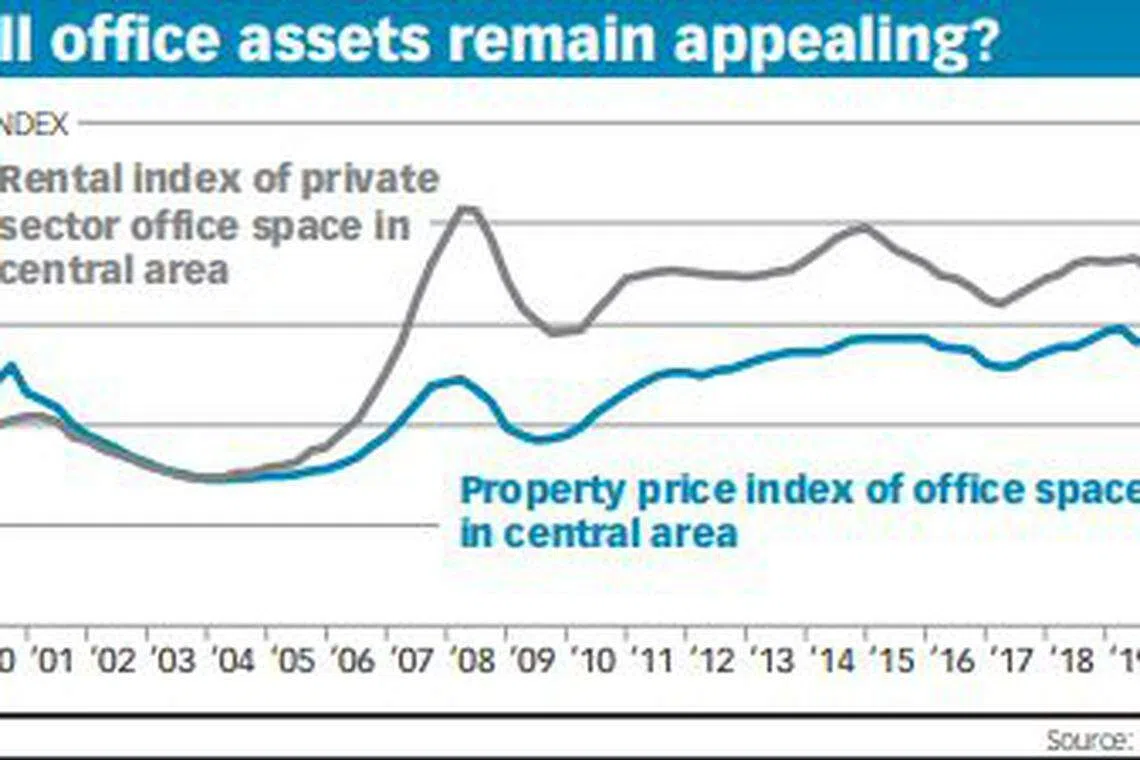
The prices of office buildings often reflect the sum of net discounted rental income.
This income is derived from applying an estimated rate of return - that is, a discount - to work back how much an office building should be worth now, in order to hit future expected rental income. The office price index - which should reflect rental impact over a longer term on the price of the physical asset - is now falling quicker than the index of the current rental market.
This points to uncertainty, IREUS deputy director Lee Nai Jia had earlier told BT.
To be sure, preliminary estimates for the office market showed some signs of recovery in Q1 2021, with positive net absorption of 0.13 million square feet, said CBRE Research.
CBRE's Grade A (Core CBD) basket showed office rents were stable quarter on quarter at S$10.40 per square foot (psf) per month; Grade B (core CBD) rents slipped 1.3 per cent to S$7.80 psf per month.
Office properties in Singapore, particularly Grade A offices, have typically attracted funds and investors. This points to solid yields and lower risk relative to other assets, such as retail.
As bank staff gradually return to the office in Singapore and get reacquainted with colleagues and the workspace, said JLL's Mr Tangye, it will be easier for the banks to be more precise about what space will be needed in the medium to long term.
Smaller supply
Still, the space shed by banks over recent years is just a small part of overall office occupancy.
Most of the vacated space is taken up by other sectors such as tech or by new market entrants.
Mr Tangye said despite Covid-19, demand has been relatively stable. The volume of surrendered space by banks has not yet been as much as in 2009, he said.
To add, the supply pipeline for the next five years is about 50 per cent less per annum than that of the past decade. Redevelopment will further trim supply.
"So supply dynamics are helping to offset some of the current weakness in the market from banks wanting to give up space."
Future-proofing
A pandemic, the rise of remote work and technology have all forced a bigger rethink of banks' physical networks.
With Covid-19 and the growing acceptance of hybrid work models, banks will still be evaluating their office space in Singapore. DBS and UOB are already giving staff the flexibility to work remotely up to two days a week.
And all three local banks are looking to reconfigure offices to become more open and collaborative. DBS has said as well it will see more use of satellite offices.
Some banks will consider a front- and back-office split to enhance business continuity planning arrangements in the event of another pandemic, said JLL's Mr Tangye. This creates flexibility - bringing jobs closer to people's homes and saving costs in the long run, he pointed out.
But the workspace still has a role to play in the competition for talent, he added.
"Cost has always been a major factor for banks, but what has become increasingly more important is designing a workplace that can deliver a great occupier experience with a strong emphasis on sustainability and wellness."
READ MORE: Slower net absorption may affect recovery in office rents
TRENDING NOW

Singapore updates renewable energy certificate standard to tackle greenwashing; unveils new solar efforts
Director of PR firm sacked for secretly recording internal meeting loses wrongful dismissal claim

Indonesia says gas export cuts to Singapore remain within contract terms
Time for MAS, SGX to scrutinise issue managers

