
China starts to pull cash in pivot from crisis policy easing
 Add BT as a preferred source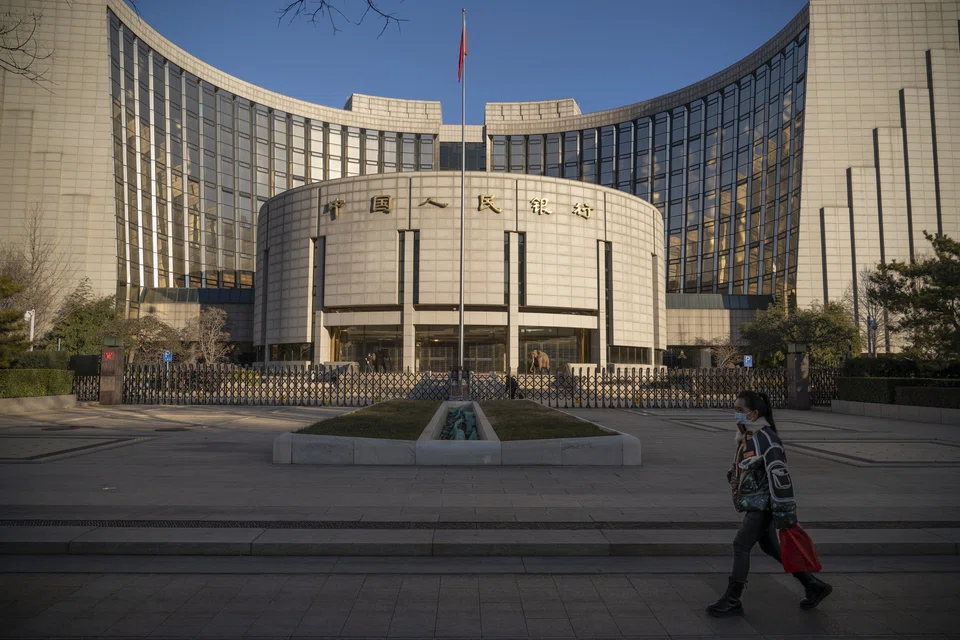
CHINA'S central bank looks set to withdraw cash from the financial system in a sign that it's moving toward normalising monetary policy as major global peers are forcefully raising interest rates.
The People's Bank of China (PBOC) slashed its daily short-term liquidity operation to 3 billion yuan (S$628 million) this week, the smallest amount since January 2021. At this pace it's likely to remove more cash in the first 5 days of this month than it injected toward end-June.
"The PBOC is shifting its monetary policy from a crisis mode to a normalisation," Ming Ming, chief economist at Citic Securities, wrote in a note. The central bank tolerated the low money market rate levels in the second quarter when Covid outbreaks disturbed economic growth, but that might be coming to an end, he wrote.
The shift in PBOC's liquidity stance has already pushed up bonds yields and threatens to lift money-market rates that have anchored China's wide-ranging efforts to restore its Covid-hit economy. Analysts now see tighter financial conditions in the second half of the year as the central bank removes more cash while credit demand should pick up as data last week showed the first expansion in manufacturing activity in 3 months.
The PBOC is among the few major central banks that's still on an easing track as China's Covid zero policy acts as a drag on the economy. It added cash to the banking system in the first half of the year via tools including the medium-term lending facility, a reduction in the reserve requirement ratio as well as by transferring its profits to the government.
Despite the recent cash drain the overnight repo rate, a measure of interbank borrowing costs, dropped to 1.2 per cent, the lowest since Jan 28, highlighting the extent of excess liquidity in the banking system. Zhang Jingjing, an analyst at China Merchants Securities said the PBOC may try to bring the overnight repo rate closer to its 7-day rate of 2.1 per cent.
Navigate Asia in
a new global order
Get the insights delivered to your inbox.
At the current rate of liquidity withdrawals the PBOC could drain a net 428 billion yuan (US$64 billion) of cash in the first 5 days of July, more than the 400 billion it net injected before June end.
Fading Supply
The peaking out of Chinese local government bond issuance has also reduced the urgency for the PBOC to keep funding rates low in July, said Chen Xi, an analyst at Pacific Securities. Regional governments sold a record 4.04 trillion yuan bonds in the first 6 months of the year, leaving only 330 million of the quota for the remaining year, Bloomberg data show. The central bank may guide bond market leverage lower and steer more cash to the real economy, Chen said.
The front-end of China's sovereign bond curve is already pricing in tighter cash. The yield on 1-year China government bonds rose to 2.01 per cent on Tuesday, the highest since Jun 17, while the 1-year onshore interest rate swap touched 2.23 per cent this week, the highest since March.
Still, investor caution on the economy is reflected in the long end of the curve where yields have eased over the risk of recurring Covid outbreaks. A jump in infections across Shanghai has raised the spectre of another lockdown. The government bond yield curve may flatten with back-end sovereign bonds finding more support as risks to economic recovery linger, Qin Han, analyst at Guotai Junan Securities, wrote in a note.
The PBOC last week reiterated its pledge to provide stronger support for the economy. Monetary policy may prioritise credit expansion over interest reduction in the coming months, according to economists including Xiangrong Yu at Citigroup, who still expect a 25 basis points reduction in reserve requirement ratio on a discretionary basis to facilitate fiscal and semi-fiscal efforts. BLOOMBERG
Decoding Asia newsletter: your guide to navigating Asia in a new global order. Sign up here to get Decoding Asia newsletter. Delivered to your inbox. Free.
Share with us your feedback on BT's products and services

