

CIMB eyes doubling Singapore SME banking share by 2021
Singapore
CIMB Bank is looking to power up its small- and medium-sized enterprise (SME) banking business in Singapore, with plans to double its market share from 3 per cent to 6 per cent by 2021.
The Malaysia-headquartered bank, which is relatively new in the SME space here with 10 years of history, believes that there is still room for a smaller player, even in an extremely competitive SME banking landscape.
CIMB's head of commercial banking Yong Jiunn Run told The Business Times that revenue contributions from the SME segment grew by 50 per cent in the past five years.
To maintain this momentum, the regional bank intends to expand by playing to its strengths via revamped product offerings, partnering businesses to expand in Asean, and leveraging on Islamic financing solutions to help SMEs break into China's halal market.
The bank recently refreshed its current account offering for businesses, also known as CIMB BusinessGo (BizGo), to fill a gap in the market. It was first launched in January 2017.
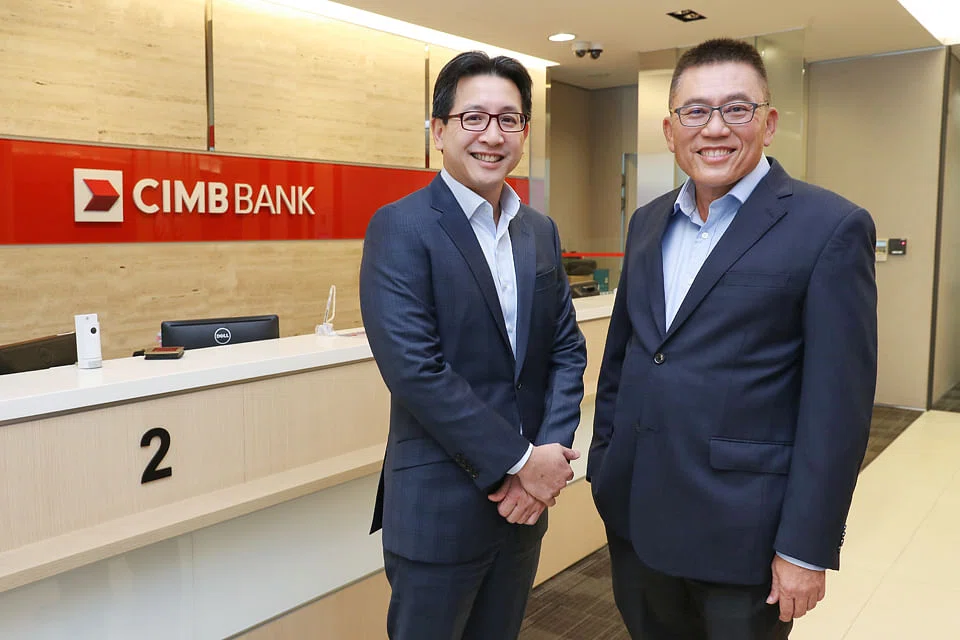
Ian Chan, CIMB Bank Singapore's co-head of transaction banking and regional head of digital banking, said that the new offering aims to address SMEs' needs in the market that are not being met by the current incumbents.
New features include free FAST (Fast And Secure Transfers) transactions, best forex rates guaranteed for transfers to Malaysia, and interest rates of up to 1.88 per cent per annum, said to be among the most competitive in the market.
"It's a product we revamped for two reasons - first and foremost, it's CIMB's 10-year anniversary in Singapore," Mr Chan explained.
"Secondly, we also want to shout out to the market that we want to grow our SME segment and help our clients to expand their businesses into Asean."
Over the past year, the revamped account has seen a surge in sign-ups of over 40 per cent.
With more SMEs onboard, the next step is to help them expand into the region by using CIMB as a springboard, especially in countries where the bank is particularly strong, such as Malaysia and Indonesia, said Mr Yong.
As Singapore's economy slows due to the external environment, it has become an even bigger imperative for businesses to expand overseas where there are more attractive growth opportunities.
"Among the segments that we see, a lot of cross-border SME regional flows are manufacturing and trade, F&B (food and beverage) including the halal market, and the agricultural commodity sector," he added.
In line with its efforts to help more SMEs venture abroad, CIMB launched its Asean-China Halal Corridor initiative last year, which is a trade network linking halal businesses across China and the region. China's halal sector is expected to reach US$1.9 trillion by 2021, and there is a potential customer base of 266 million in Asean and China.
The initiative - which encompasses agribusiness, cosmetics, food and beverage, fashion and pharmaceuticals - has seen growing interest among SMEs here, with strong participation in a recent CIMB halal corridor workshop, according to Mr Yong.
The bank is also focusing on potential growth opportunities for Islamic banking in the SME business. For CIMB since 2014, the take-up rate among SMEs for Islamic financing has grown by more than 48 per cent per annum in the past five years.
One opportunity is in the growing number of F&B companies obtaining halal certification, said Mr Yong. The companies then proceed to obtain Islamic financing to tap potential Muslim investors, giving a lift to the SME banking segment.
Even as the bank pushes ahead with its plans, it is up against various challenges, including geopolitical uncertainty, the fight for talent to grow the business, as well as competition from digital bank challengers.
CIMB is also mulling an application for the digital banking licences that are up for grabs in Singapore. "Like many of our peers, we are currently evaluating what that would bring to our business and we are exploring that option," said Mr Chan.
But he cautioned against vying for a digital bank licence for the sake of it. "If you want to go into the digital bank arena, what customer painpoints are you trying to solve? That's very key as it goes back to basics," he said. "If those basics can be achieved without going digital, then what do you really want to achieve?"
He said he welcomes competition as it offers more options to clients, forcing banks to be innovative in their product offerings. "I'll keep a watchful eye, but I'm kind of excited to see what is the competition out there," Mr Chan added.
TRENDING NOW

Once staunchly pro-China, Malaysian Chinese businesses are now distancing themselves from Beijing

Stocks to watch: HPL, Aims Apac Reit, Zico, Advanced Systems Automation, ComfortDelGro

‘How many will survive?’: Bubble fears arise as China’s humanoid robotics face reality check

Smaller board lots can’t fix a market run by three banks

