

Climate change raises questions on insurers' capacity to insure risks
Among non-life insurers, it was the No 3 concern, and among reinsurers No 2; problem particularly worrying in emerging Asia where insurance penetration is low

Singapore
CLIMATE change has become a top concern among global insurers and reinsurers, as the rising frequency and severity of natural catastrophes raise questions on their ability to anticipate and capacity to insure the risks.
The PwC Insurance Banana Skins 2019 report, undertaken by the Centre for the Study of Financial Innovation, finds that climate change is now seen as a much more urgent threat to the industry than in previous years.
In the latest report, it was ranked sixth among top 10 concerns overall. It would have ranked higher but for life insurers who did not cite it as a top concern.
Among non-life insurers, however, it was the No 3 concern, and among reinsurers No 2.
Global warming and the increased incidence of natural catastrophes are a particular worry in emerging Asia where insurance penetration is among the world's lowest.
Lloyd's 2018 underinsurance report estimates a global insurance gap of US$162.5 billion, of which the lion's share - US$160 billion - is in the emerging markets and only US$2.5 billion in developed markets. Of 18 nations with the largest gaps, half were in the Asia-Pacific, led by Bangladesh. The list included China and even Japan.
The Swiss Re Institute has found that total economic losses from disasters globally came to US$165 billion in 2018, of which natural catastrophes accounted for about 94 per cent. This was less than half of US$350 billion of losses in 2017, due to the "absence of a very large event occurrence". Of the 2018 losses, North America accounted for US$80 billion and Asia US$55 billion.
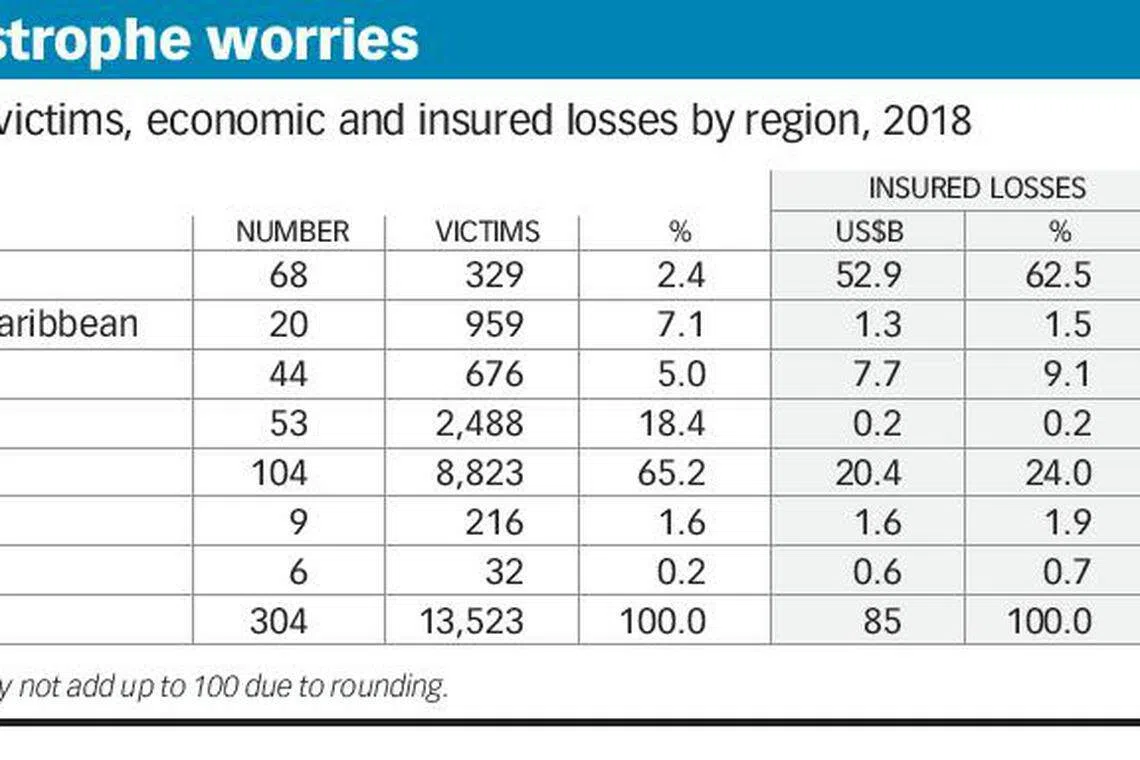
Insurance covered about half (US$85 billion) of economic losses last year. The combined insurance payout for 2017 and 2018 was US$219 billion - the highest ever for a consecutive period.
Insurers in the Banana Skins survey expressed concern that climate change may make risks difficult or even impossible to insure. One unnamed respondent suggested that a 3-degree (Celsius) world may not be insurable.
In the Paris Agreement, some 187 countries agreed to efforts to temper the rise in global temperatures to 1.5 degrees Celsius.
But a recent report by the United Nations sounded an alarm that unless countries cut their greenhouse gas emissions drastically, global temperatures may rise by 3-5 deg C, raising the spectre of extreme weather and higher sea levels.
The PwC study cites Lisa Guglietti, chief operating officer of P&C Manufacturing at The Co-operators in Canada, who said: "The escalation in trends and volatility will challenge the sustainability of traditional insurance products unless we start putting more focus on prevention as opposed to indemnification.
"Many clients are unable to afford the risks that they are exposed to, and more alarmingly many of these same clients are unaware that they have this exposure.''
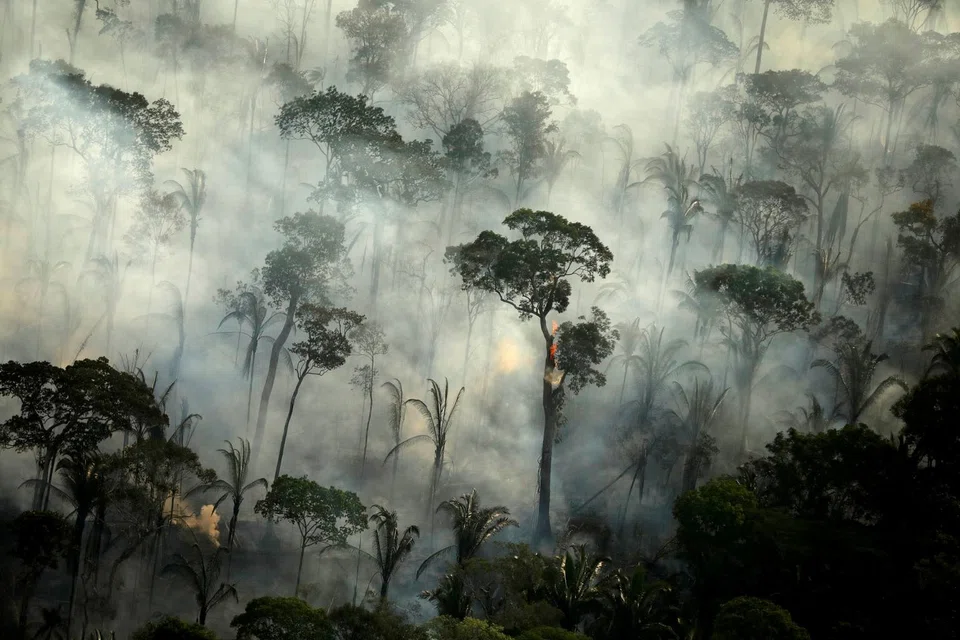
Already the fear of elevated risks is borne out in California wildfires. The New York Times reported that the wildfires have grown so costly and damaging that insurance companies have taken to cancelling policies in fire-prone areas.
California has imposed a one-year moratorium to prevent insurers from dropping customers. While wildfires may be sparked by a number of factors, hot and dry conditions brought on by climate change exacerbate the fires.
In the UK, the Prudential Regulatory Authority has added a climate risk component for the first time on an exploratory basis, to the biennial stress testing for general insurers.
Swiss Re Institute's research, however, says the industry is well capitalised to absorb the global "all-catastrophe'' protection gap in 2017 and 2018 of US$280 billion. It estimates that total capital in the non-life re/insurance market totalled over US$2 trillion at end-2018.
"The main explanations for the underinsurance are lack of consumer risk awareness and poor understanding of catastrophe insurance covers, and on occasion hesitation to provide cover where risk assessment is uncertain,'' it said.
For now - due to the rising incidence of catastrophic events such as storms, floods and earthquakes - insurers warn of higher future premiums in products such as property and casualty insurance.
Winston Chua, MSIG senior vice- president of risk management & technical services, said: "As a region, different countries are more susceptible to climate change and where countries are affected by natural catastrophes, we do expect it is only a matter of time before higher premiums will inevitably be charged where losses occur."
Sharon Joanne Ooi, Swiss Re managing director and head of property and casualty underwriting (Asia, Australia and New Zealand), said: "Premium levels need to move in tandem with increasing exposure levels in order for insurance to be a viable proposition. As the frequency and severity of nat cat (natural catastrophe) losses increase, there will be an impact of insurance pricing also increasing.''
Angela Kelly, Lloyd's Singapore chief executive and country manager, said availability of and access to weather data are essential to achieving resilience against adverse climate developments.
There is an extensive network of meteorological data centres globally which predict rainfall and monitor weather patterns, she said. "However many developing parts of the world, especially in Asia, may find that they have inadequate or insufficient networks to collect this vital data.''
Lloyd's has a number of initiatives to deepen the understanding of climate risk. Lloyd's City Risk Index, for instance, helps to underscore Asia-Pacific's vulnerability to climate change. The Index has found that 54 per cent of the region's risk exposure arose from natural catastrophes over the past 10 years. Tropical windstorms are the largest threat to the GDP of 92 cities in the region, causing an estimated total loss of US$59.1 billion a year.
Ms Kelly said in 2018 Lloyd's market saw major claims costing £2.9 billion (S$5.2 billion) from catastrophes such as hurricanes Florence and Michael in the US, and the California wildfires. The claims were significantly higher than the long-term average claim of £1.9 billion.
"As extreme weather events become more frequent and severe the insurance industry must continue to adapt,'' she said.
A group of Lloyd's syndicates has launched the Disaster Risk Facility which pools US$450 million in capacity along with expertise to develop reinsurance solutions for natural catastrophe risks in emerging countries.
Singapore plays a central role in the region to facilitate risk transfer and risk pooling against natural disasters. It established the Southeast Asia Disaster Risk Insurance Facility, for instance, with support from Japan and World Bank, to provide flood risk pooling and beef up the region's resilience against disasters. It has also sought to establish itself as a venue for insurance-linked securities to provide alternative capital to hedge against catastrophes.
Last year, the Monetary Authority of Singapore launched the ILS Grant Scheme to fund upfront issuance costs. The World Bank recently issued two tranches of cat bonds totalling US$225 million to provide the Philippines with up to US$75 million for losses from earthquakes, and up to US$150 million for losses from tropical cyclones.
TRENDING NOW

Britain’s mansion tax shows the difficulty of targeting wealth

Once staunchly pro-China, Malaysian Chinese businesses are now distancing themselves from Beijing

The only common thing in S-E Asia is that we all eat rice: Cisco’s Asean president

Singapore data centre operator DayOne opts for US IPO at likely US$20 billion valuation

