Competition for funds driving up fixed deposit rates
Investors also turning to alternative instruments as banks seek to lock in funds

Singapore
THE fight for fixed deposits is heating up as financial institutions are dangling higher rates to lock in funds before interest rates rise further, with alternative instruments also offering attractive options.
Finance company Sing Investments & Finance (SIF) noted that retail investors are constantly on the hunt for higher yields in a rising interest rate environment and they are spoilt for choice.
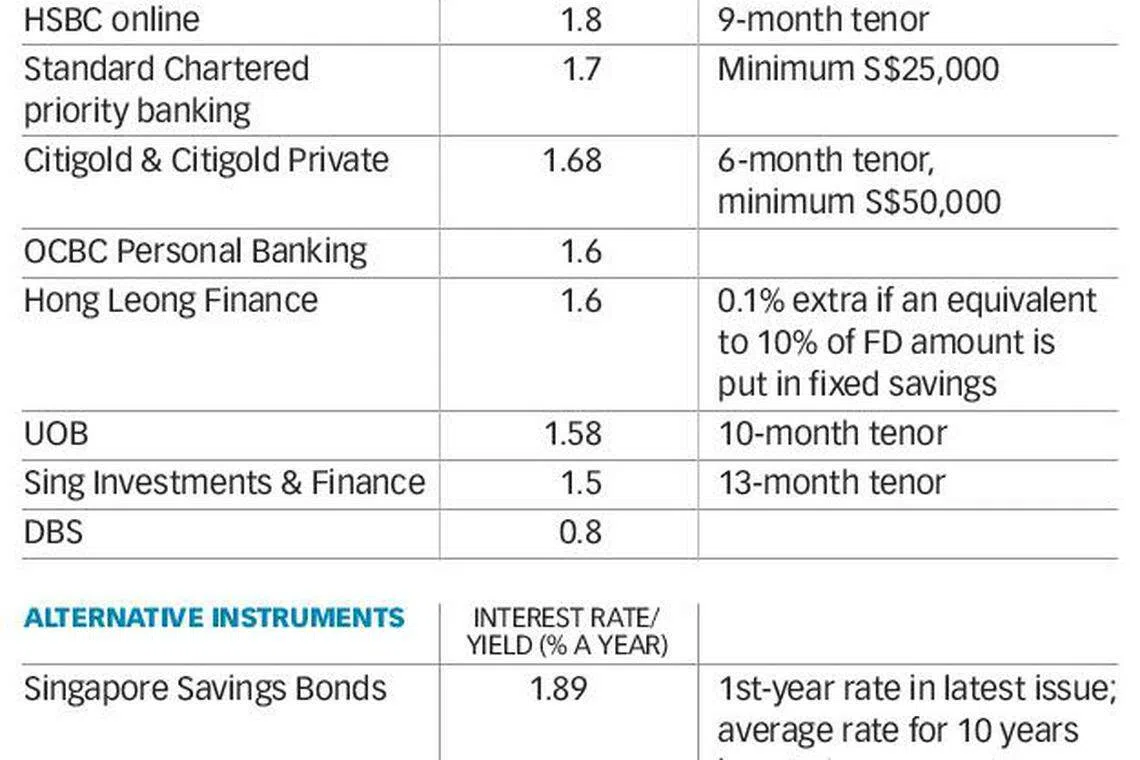
The mainboard-listed lender is one of the financial institutions (FIs) having promotions for fresh funds placed in fixed deposits (FDs), with its rates going as high as 1.85 per cent for S$100,000 that is locked in for two years.
SIF's head of branches & treasury Vivian Teng said: "Alternative instruments like the Singapore Savings Bonds (SSB) and other short-term papers are enticing retail customers/investors to switch from fixed deposits over to these instruments as they offer high-yield payouts. We can't ignore this environment and have launched FD promotions to attract new and retain existing customers."
The company is anticipating continued loan growth and rising interest rates, so the FDs collected will help fund its loan portfolio as well as prepare it for the next interbank rate hike.
SIF's FD rates track the Singapore interbank offered rate (Sibor), and they rose substantially in 2015 but declined in 2016. The Sibor has been on an upward trajectory this year, with the three-month rate hitting a 10-year high at 1.76849 per cent on Nov 19. This trend reflects rising costs that banks have to bear.
Sibor in turn tends to move in tandem with the the US Federal Reserve's funds rate. The Fed raised its rate by 25 basis points to a 2-2.5 per cent range in September in a move to normalise its ultra-loose monetary policy, which was introduced to jump-start the moribund economy in the wake of the Great Recession in 2008.
Pundits are expecting another Fed hike in December and three upticks in 2019.
Besides considering the interbank rate and the swap offer rate (SOR) - which is usually used to price commercial loans and reached a ten-year high at 1.93245 for the three-month edition on Nov 22 - CIMB Bank Singapore also takes into account factors such as funding needs and competition when setting its fixed deposit rates. The bank is offering 1.9 per cent per annum for online placement of fresh funds of at least S$10,000 in 12-month FDs.
CIMB Bank Singapore's head of consumer banking Josandi Thor, explaining why the bank is offering one of the highest rates on the market, said: "We have fewer branches and ATMs (automated teller machines) than most of competitors, so we try to pass on the savings we get from having fewer branches and ATMs to our customers in the form of better interest rates."
At Hong Leong Finance (HLF), FD rates have been going up. Between Nov 8 when The Business Times downloaded the FD promotional rates from its website and on Nov 14 when HLF president Ang Tang Chor provided BT its latest promotion, rates for S$20,000 to less than S$50,000 FDs crept up by 0.05 per cent for 12-month and 15-month tenors.
And depositors would earn up to 1.8 per cent per annum if they place at least S$200,000 for a 15-month period. It further sweetens the deal with an additional 0.1 per cent for 12-month fixed deposits if savers also put an equivalent of 10 per cent of their fixed deposit amount in fixed savings account bundled with the FDs.DBS equity research analyst Lim Rui Wen wrote in a recent report that Singapore-dollar fixed deposit rates have continued to inch up in the last quarter, and HLF has locked in its funding requirements for at least a year in advance as its deposit base is mainly made up of fixed deposits of up to one year.
"We believe there should be minimal impact on HLF in FY18 in the current rising loan yield environment. However, HLF's profitability may be impacted if loan yields fail to catch up with rising deposit costs in FY19F and beyond."
DBS chief executive officer Piyush Gupta at the bank's third-quarter results briefing earlier this month noted that the local current account, savings account (CASA) market has been shrinking because people are moving from CASA into fixed deposits as well as Singapore government or Temasek bonds.
"We don't lose as much as the overall market because we are the main transaction account for most people. The bigger pressure has been from higher fixed deposit rates," Mr Gupta then said. The bank's deposits were unchanged from the previous quarter at S$388 billion. Savings deposits were stable but current accounts declined moderately, which were offset by an increase in FDs.
SGD CASA deposit costs for DBS were stable but rate-sensitive fixed deposit costs were higher, resulting in a 10 basis-point increase in overall deposit costs during the quarter.
UOB had said that it was building up deposits in the third quarter "in anticipation of a more challenging environment in the fourth quarter".
At OCBC, the ratio of CASA deposits to total non-bank deposits was 47.5 per cent as at Sept 30, 2018, slightly below 47.7 per cent in the previous quarter as there was some migration of CASA balances to FDs and structured products, including single premium products offered by its subsidiary Great Eastern Holdings during the quarter.
Phillip Securities Research investment analyst Tin Min Ying said that banks need to retain their share of funds amid competition both from their peers and other instruments in a rising interest rates environment.
"Also, due to market volatility, investors are increasingly in a risk-off mode, backing away from the equity and bond markets and possibly looking for other safer avenues with decent yields to earn more on their deposits. "
She said banks with insurance arms "are selling single-premium savings plans to diverge some of the outflows from their CASA base into possibly their insurance products".
Moody's Investors Service Singapore senior analyst Simon Chen said not all deposits are equal. He noted that unlike FDs, CASA deposits do not enjoy higher rates.
This is because banks with strong CASA deposit bases, such as the three domestic banks in Singapore, are in a much better position to handle the pricing pressure, because CASA deposits tend to be linked to the saving and transactional activities of retail and corporate depositors, and are less tied to investment needs. Consequently, CASA deposit movements are less sensitive to interest rate movements. Another analyst's take is that CASA is sticky as these are usually used to pay bills, so account-holders are unlikely to go through the hassle of moving their balances to another bank, especially when CASA interest rates are so low and the banks offer about the same rates.
She said the way for banks to attract deposits, therefore, is to raise the rates for their FDs to lock in some of their required funding now, rather than later.
READ MORE: Where to park your funds? Well, it depends