DBS misses profit target as O&G inflicts fresh deep wounds
Q3 gain dives 25% to S$802m as group almost doubles specific provisions; income reaches quarterly high of S$3b
Singapore
STRONG business momentum helped push DBS Group Holdings' Q3 income to a quarterly high of over S$3 billion, but it did not quite take the sting from the bank's near doubling of bad loan charges for its oil and gas support services exposures.
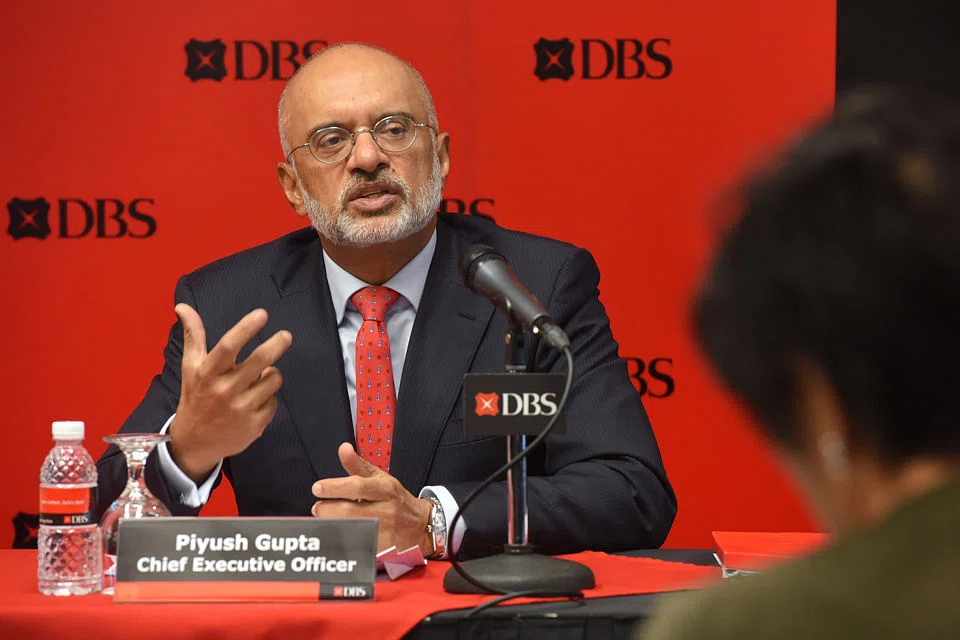
Business momentum has been strong, said DBS chief executive Piyush Gupta on Monday at the bank's Q3 news briefing, as he tried to "refocus" investors on its operating performance and digitalisation agenda.
Loans are expected to grow 7-8 per cent this year and in 2018, and income growth is likely to be around 3 per cent this year and double-digit next year, he said.
As South-east Asia's biggest bank, DBS will reap the benefits of stronger economic growth in the region.
But first the not-so-good news.
DBS' earnings fell 25 per cent for the third quarter from a year ago to S$802 million, as the bank almost doubled its specific provisions for bad debts.
Excluding one-time items such as a S$21 million ANZ integration cost, net profit stood at S$822 million, 23 per cent lower from the preceding period. DBS bought the Asia retail business of ANZ last year.
Specific allowances for credit and other losses jumped to S$815 million, 87 per cent higher than the S$436 million a year ago as DBS decided to clean up its books for the oil and gas support services exposure.
The group's exposure to the sector is S$5.3 billion, less than 2 per cent of its overall loan portfolio.
DBS accelerated the recognition of S$1.7 billion in residual weak cases as non-performing loan assets with a commensurate increase in specific allowances, Mr Gupta said.
At the same time, the impending implementation of Financial Reporting Standard 109 (a new accounting standard) which comes into effect on Jan 1, 2018, gives the bank an opportunity to draw S$850 million from general allowance reserves, resulting in a net allowance or bad debt charge of S$815 million for the quarter, he said.
DBS' actual general provision (GP) of 1.4 per cent or S$3.5 billion is over the 1 per cent regulatory requirement. So on Jan 1, 0.4 per cent must be transferred to its capital, but DBS already has too much capital, he said. That gives the bank an opportunity to draw S$850 million from the GP account.
The step removes uncertainty over asset quality, enabling investors to refocus on operating performance and the bank's digitalisation agenda, DBS said.
"I can say with high confidence that we've cleaned the book. We're highly unlikely to take more in the book," said Mr Gupta.
DBS' non-performing loan ratio surged to 1.7 per cent for the quarter, up from 1.3 per cent a year ago and 1.5 per cent on quarter.
"It's kind of peak," said DBS chief financial controller Chng Sok Hui, when asked if the NPL rate could go even higher.
Another surprise was the fall in net interest margin (NIM) to 1.74 per cent from 1.77 per cent a year ago and 1.74 per cent in Q2 2017 given that wholesale interbank rates had risen in the period.
Mr Gupta said it was due to the bank getting more deposits which the bank "can't lend out fast enough".
Of the S$21 billion increase in deposits, some S$10 billion came from ANZ, bringing the loan-to-deposit ratio down to 86.8 per cent from 89.5 per cent a year ago and 88.4 per cent in the previous quarter.
Loans rose 4 per cent on quarter, including S$6 billion from ANZ. Underlying loans were up S$8 billion, or 2 per cent on quarter; and S$16 billion, or 6 per cent year-to-date.
Singapore home loans accounted for half of the growth, he said.
DBS' home loan market share rose to over 30 per cent from 27 per cent last year. For the third quarter, the lender booked a record S$3.9 billion of new home loans, and expects its mortgage book to end the year up S$4-4.5 billion.
He expects the home loan market share in 2018 to be stable, adding that the en bloc fever adds a little bit of uncertainty. That's because home owners who have sold en bloc, will be paying off their mortgage.
Total income in the quarter rose to S$3.06 billion, up 4 per cent from a year ago. Net interest income increased 9 per cent year on year to S$1.98 billion, while net fee and commission income rose 12 per cent to S$685 million.
Some analysts liked the clean-up and noted DBS' strong operating performance.
Morgan Stanley said the Q3 results showed strong core profit with the oil and gas overhang removed.
Goldman Sachs said it was a decent set of underlying results and the "kitchen sinking should see DBS to start next year with a clean slate."
DBS closed Monday down 18 cents to S$22.79.
READ MORE: Singapore banks may be past worst of O&G battering