DBS to buy Citi's Taiwan consumer banking business
The transaction will see DBS paying Citi cash for the net assets of the business plus a premium of S$956 million
Michelle Zhu &
Claudia Tan HS
Singapore
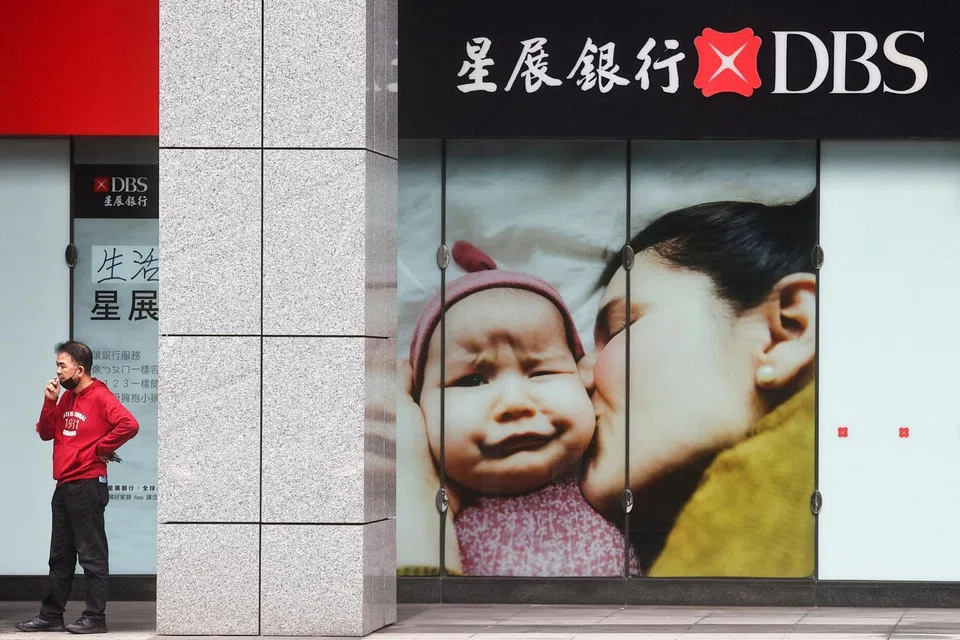
DBS is acquiring the consumer banking business of Citigroup in Taiwan, Citi Consumer Taiwan, via a transfer of assets and liabilities. The transaction will see DBS paying Citi cash for the net assets of the business plus a premium of S$956 million, said Singapore's largest lender on Friday (Jan 28) morning.
As at end-September 2021, Citi Consumer Taiwan had an earning asset base of S$20.3 billion and total deposits of S$15.1 billion - of which 70 per cent are sticky low-cost deposits.
DBS also intends to make offers of employment to all 3,500 employees of Citi Consumer Taiwan. At a media briefing on Friday, DBS chief executive Piyush Gupta said that the acquisition will extend DBS's leadership in Taiwan as it cements its position as the largest foreign wealth manager in Taiwan based on assets under management.
"It accelerates our overall Taiwan strategy very meaningfully, catapults us to being not only the largest foreign bank, but now one of the leading banks in the market. It gives us effectively what we think is almost a 10 year acceleration in terms of our growth path," he said.
Following the acquisition, DBS's assets under management will more than treble to S$13 billion.
While some people think that Taiwan is a tough market to crack, the wealth and technology sectors there have outperformed and contributed meaningfully to DBS, said Gupta.
Of the core markets in which DBS operates in (excluding China), Taiwan has the largest number of wealthy, with over 500,000 high net worth individuals. Meanwhile, Taiwan has also benefited from the fast-growing tech industry, accounting for over 20 per cent of global chips production capacity.
Citi Consumer Taiwan's strong low-cost deposit base will also support the expansion of DBS Taiwan's institutional and SME (small and medium-sized enterprise) banking business, said the bank. The business was noted to generate annual net profit of S$250 million on average in the 2 years before Covid-19, with a return on equity of above 20 per cent.
"The fact that DBS is getting access to a large, low-cost deposit franchise should enable them to increase competitiveness on its loan offerings. At the same time, the Citi franchise brings with it a large, affluent client base," said Maybank Securities Singapore regional head of banks and financials research Thilan Wickramasinghe. "We think this could open up wealth management cross-selling opportunities," he added.
However, this is not a "transformational transaction" to the group, given that Hong Kong and China are the key growth engines in North Asia, Wickramasinghe pointed out in a report.
Still, he maintained a "buy" call on DBS, with a target price of S$37.03, citing rising net interest margins, fees and reserve write-backs as near-term catalysts. DBS said it intends to fund the acquisition with excess capital, with no impact to its ability to pay dividends.
Based on a capital injection of S$2.2 billion into DBS Taiwan for the premium to be paid to Citi, and a S$1.2 billion capital to support incremental risk-weighted assets and capital needs, DBS expects the acquisition to have a 0.7 per cent impact to the group's capital ratio.
This represents 1.8 times price-to-book and 9 times price-to-earnings ratio, based on DBS's pre-Covid average.
Given that this is a single market transaction, the costs are manageable, said Gupta, adding that such acquisitions are not new to the group. This makes DBS's third acquisition since the start of the Covid-19 pandemic. It had acquired a 13 per cent stake in Shenzhen Rural Commercial Bank (SZRCB) for 5.3 billion yuan (S$1.1 billion) last year and in November 2020 acquired ailing Indian lender Lakshmi Vilas Bank.
"It's consistent with a pathway we've now followed over the last couple of years, to use the discontinuity from Covid-19 to build our scale and position that we might not have been able to do otherwise," said Gupta.
This large deal, however, could pose execution risks given that DBS is still "digesting" the Lakshmi Vilas Bank acquisition, Wickramasingh noted.
That said, the integration of Australia and New Zealand Banking Group's (ANZ) retail business across 5 markets was "executed well", said Wickramasingh. DBS had in 2016 announced the acquisition of ANZ's portfolio of businesses in Singapore, Hong Kong, China, Taiwan and Indonesia.
Glenn Thum, analyst at Phillip Securities Research, said that key risks include a higher-than-expected customer attrition rate and customer overlaps.
In response to media queries at the briefing, Gupta said that based on customer profiles, the bank is likely to see a 10-20 per cent customer attrition rate.
But Thum said that there is still a possibility that this figure may be higher.
"Nonetheless, DBS would be able to combat this by ensuring the integration is smoothly completed and the existing Citi's customers do not lose out," he added.
The transaction comes after Citi announced last year that it will exit from 13 retail markets to focus on wealth management. The markets are: Australia, Bahrain, Indonesia, South Korea, Malaysia, the Philippines, Poland, Russia, Taiwan, Thailand, Vietnam, India and China.
Earlier this month, UOB announced that it will acquire Citi's consumer banking assets in Indonesia, Malaysia, Thailand and Vietnam for almost S$5 billion to scale up its retail franchise in Asean.