

Deutsche Bank keeps Singapore close to bolt down top spot in credit trading
The Asia-Pacific will get a larger portion of of the 13b euros in technology spending earmarked by the group, say top executives
Singapore
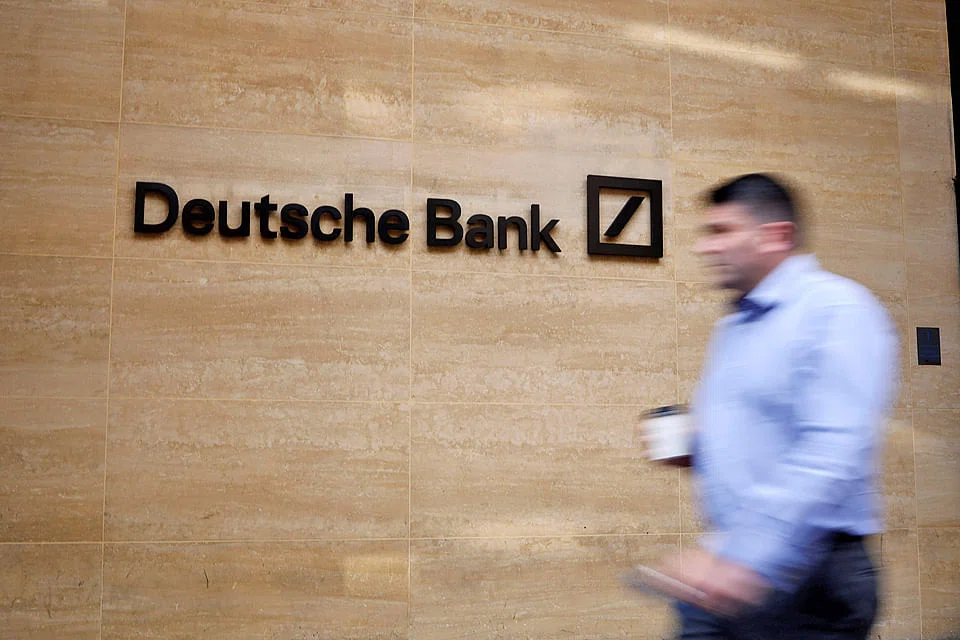
DEUTSCHE Bank - even while undertaking what is likely the biggest overhaul in the investment banking industry in years - has identified the Asia-Pacific as a clear growth region, allocating to it a lion's share of the 13 billion euros (S$19.8 billion) that the group expects to spend on technology by 2022, its top executives told The Business Times.
In an interview, Chandra Mallika, group chief operating officer for the Asia-Pacific at the bank, said the group expects the percentage of the Asia-Pacific's revenue contribution to group to grow from 12 per cent to 14 per cent by 2022, with Singapore being one of the top two contributors to revenue out of this region.
The overall revenue pool out of the Asia-Pacific is now bigger - and expanding faster - than in Europe.
The 12-per cent contribution in full-year 2018 translated to a topline figure of 3.15 billion euros (S$ 4.8 billion); gains came on the back of double-digit percentage growth from the business units of corporate finance, global transaction banking and wealth management, she said.
The German banking behemoth, in righting its ship after failing to measure up to its Wall Street peers, has zoomed in on its leadership position in fixed income and financing; it is also exiting its loss-making equities sales and trading business globally.
Christian Sewing, its chief executive, spoke unequivocally in July about seeking out profitable growth, and shedding under-performing businesses that have been a drag on earnings.
For the bank, this has mainly meant ending the sale and trading of equities. Equity trading here involves servicing institutional clients to interest them in recommended trades. Such units also execute trades while typically offering leverage or borrowed securities to customers such as hedge funds.
But with technology and tighter regulations such as MIFID II - which prevents fund managers from getting free stock research as commission-paying customers to the brokerages issuing the reports - fees have been crimped, and the game has increasingly been on high-speed algorithm execution.
In recent days, Deutsche Bank has also brought cuts to fixed-income traders who were reportedly in underperforming divisions such as the credit business in Latin America; the bulk of the 18,000 job cuts expected by 2022 are still due to come out of the US and Europe.
In Hong Kong, its Asia equities hub, its investment banking team for the Asia-Pacific was reportedly at about 300 in staff strength, with up to 15 per cent or 45 of the staff cut.
There will be "minimal" impact on the 2,000 staff working in Singapore, the hub for the bank's fixed income and currencies business in the region.
David Lynne, Deutsche Bank's head of corporate banking, as well as the fixed income and currencies business in the Asia-Pacific, was pointed about the bank's pole position in credit trading and in structuring financing deals.
"In credit trading, we've been the No.1 in the Asia-Pacific for multiple years; we are almost double the No. 2 firm," said Mr Lynne, who is also chief country officer for Singapore. "I'll repeat that, we are double."
He added that the bank has kept most of its clients since the announcement of the restructuring, though it had a "small knock-on effect" on clients from exiting the equities business here.
"The firm made a difficult decision to exit the equity business. The fundamental reason we did it, was that we were not in the top three to four in the equity business, and the investment and technology needed to get to the top tier would be reasonably significant.
"If we cover an asset manager for both their equity and debt business, does it have some degree of a knock-on effect? Potentially. But we'll see."
Fresh figures provided to BT showed that the bank's advisory business in the fixed income and financing business in the Asia-Pacific has jumped by about 30 per cent a year for the last three to four years.
The bump in numbers from the fixed income and currencies advisory business comes as the region is not fully open across the board. The capital controls mean that companies still need solutions to hedge the dividend flow out of China, or to access Indonesia's fixed income market, said Mr Lynne.
The bank effectively tackles this business by mingling the high-volume, low-margin business at one end of the spectrum, and the fatter margins on the other end of the spectrum in this region, with Deutsche Bank present in 14 markets.
This means that the fixed income and currencies business out of the Asia-Pacific involves high-speed trading for efficient, open markets such as Australia, and more advisory businesses for much of Asia.
"We've gone through this inflexion point. If you look at fixed income and currencies revenues around the world, the effect of technology, transparent markets, MIFID II and best-execution, have reduced margins. Take that to this region. We have a better technology processing platform than almost everybody. And we still have closed capital markets. Asia is like that, Japan is somewhere halfway in-between, and Australia is completely open," he said, referring to the markets under his charge.
"In Asia, we still have greater margin to work with amid regulation, capital-market constraints and cross-border requirements."
The bank will also look to bulk up its traditional stronghold in transaction banking, with its rough market position estimated by Mr Lynne at about fifth or sixth in Asia, against big transaction banking houses such as HSBC and Citi.
Deutsche Bank will look to gain more meaningful market share in banking more technology companies that are selling services via platforms. As it is, the bank holds the global mandate from a tech giant to process payments and foreign exchange conversion to its app developers.
While all banks are selling their ability to bring digital-payment services, Mr Lynne cautioned that wholesale payments are a whole different ball game from retail banking.
As an example, a conglomerate in Thailand alone may have five different workflow systems for inventories and sales processing, and a global transaction bank needs to use the right technology to effectively connect to these systems to get payments sent and processed across the world.
Mr Lynne compared the process to component engineering, in which pieces of payment solutions must be stacked efficiently to sell to multinational corporations.
"If you think about retail technology, here is an app. Five million people need to use the app. They don't get a choice," he said. "It's a harder process in wholesale. You don't build singular pieces of technology. You build lots of component pieces, and the question then is, how do you put those pieces together?"
TRENDING NOW

He built the Vingroup empire. Now South-east Asia’s richest man is handing some key roles to his sons

Fed hike throws Singapore banks a margin lifeline; UOB likely to benefit more

Luxury properties seized in S$3 billion money laundering case fail to sell at auction

US stocks: Tech leads Wall Street to higher close as oil eases, Treasury yields dip

