

Disclosure with no transparency fails as fair dealing: MAS chief
Culture and conduct practices are uneven in financial industry here, says MAS MD Ravi Menon
Singapore
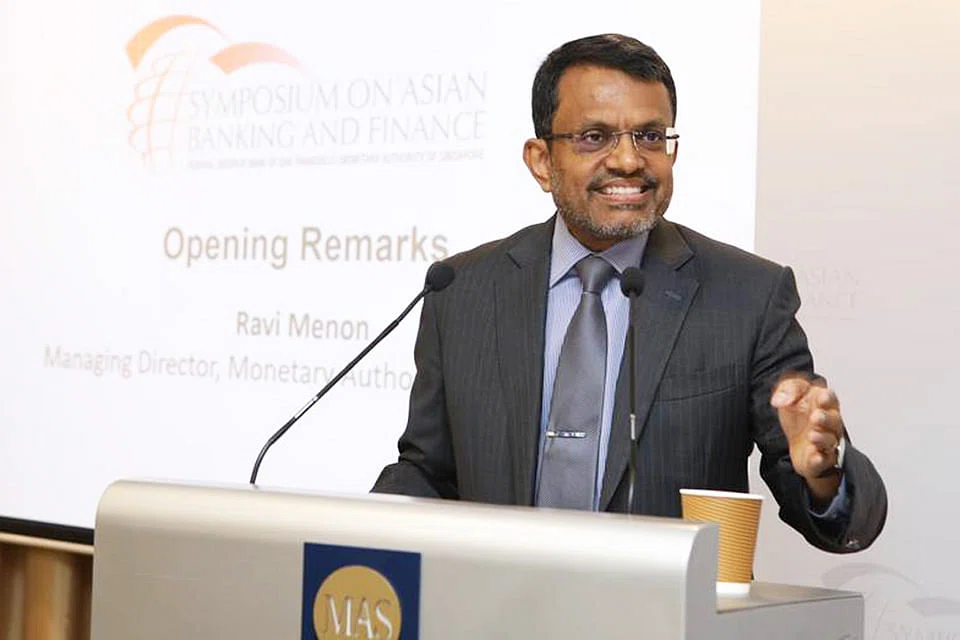
IT IS transparency, not disclosure alone, that defines proper fair dealing from financial institutions, said Monetary Authority of Singapore's (MAS) managing director Ravi Menon on Monday, as the regulator notes the "uneven" culture and conduct practices in the financial industry here.
Speaking at the Symposium on Asian Banking and Finance held in Singapore, Mr Menon said financial institutions must make the information they provide more transparent in at least three areas.
They are: transparency in the risk, especially the circumstances under which the customer could lose all or most of his money; transparency in the assumptions underlying return projections or estimates; and transparency in the fees, charges, and commissions.
"Disclosure alone is not enough. Ask any consumer of financial products having to go through hundreds of pages of product disclosure written in unintelligible legalese," said Mr Menon.
The board and senior management of financial institutions are responsible for setting a clear strategy in fair dealing, he noted.
Against this backdrop, Mr Menon said MAS has conducted a stocktake of culture and conduct practices across selected financial institutions.
With MAS intensifying its supervisory emphasis on the culture and conduct within financial institutions, the regulator's supervisors had extensive one-on-one conversations with not just the management of these financial institutions but also staff across the ranks.
In doing so, MAS tried to develop a keener sense of whether "the organisational values plastered on the walls of the board room were practised on the ground", said Mr Menon.
"What have we found? Culture and conduct practices are uneven in the industry. Many financial institutions still struggle to articulate the conduct risks they face," Mr Menon said.
He added that many financial institutions are "only starting" to develop tools and indicators to get a fuller, cross-functional view of the culture within their organisation.
MAS has set up a steering group with the banks to identify emerging trends in conduct and behaviour as well as share best practices in "getting the culture right".
The regulator has also set up a small behavioural sciences unit to help supervisors with methodologies get a better understanding of culture and conduct issues in the institutions they supervise, he said.
In Singapore, prospective financial advisory representatives will in time be tested on their understanding of ethical principles as well, going beyond just product knowledge and skills to engage their customers to understand their financial needs and risk profiles, said Mr Menon.
Into its 12th edition, the Symposium on Asian Banking and Finance is jointly organised by the Federal Reserve Bank of San Francisco and the MAS.
In a keynote address, Mary Daly, president and CEO of the Federal Reserve Bank of San Francisco said she has a front-row seat watching the wariness of financial firms. Consumers today are willing to turn to Big Tech, and away from banks, to manage their finances.
"The world didn't stand still while banks worked to recover their credibility with the public. Technology-based competitors emerged with customer-centric approaches to finance," she said.
These headwinds for traditional financial institutions cannot be addressed through regulatory guardrails alone, she added.
"Banks, large and small, need to become owners. Owners who are committed to, and accountable for, doing right by their customers and their communities."
The financial sector still suffers from a trust deficit globally. Mr Menon cited the Edelman Trust Barometer that showed financial services was the least trusted industry out of 15 industries.
"Why this mistrust? The reckless risk-taking and blatant disregard for ethical conduct that we saw in the lead-up to the global financial crisis are a big part of the explanation," he said.
"It has not helped that the financial industry continues to be dogged by disappointing revelations of financial misconduct and malfeasance."
Mr Menon pointed to Europe's largest-ever money laundering scandal that occurred just last year, as well as the US regulators and prosecutors imposing on financial institutions a total of US$1.5 billion in penalties in 2018 for failing to comply with anti-money laundering requirements.
"I take some comfort that financial institutions in Singapore have generally been better behaved and are better regarded. But we have had our problems too: the mis-selling of (Lehman) minibonds and other structured products; the manipulation by traders of financial benchmarks; and more recently, the laundering of 1MDB-related funds through our banking system," said Mr Menon. "We too can do better."






