Income Insurance moves beyond South-east Asia with Japan partnership

Raphael Lim
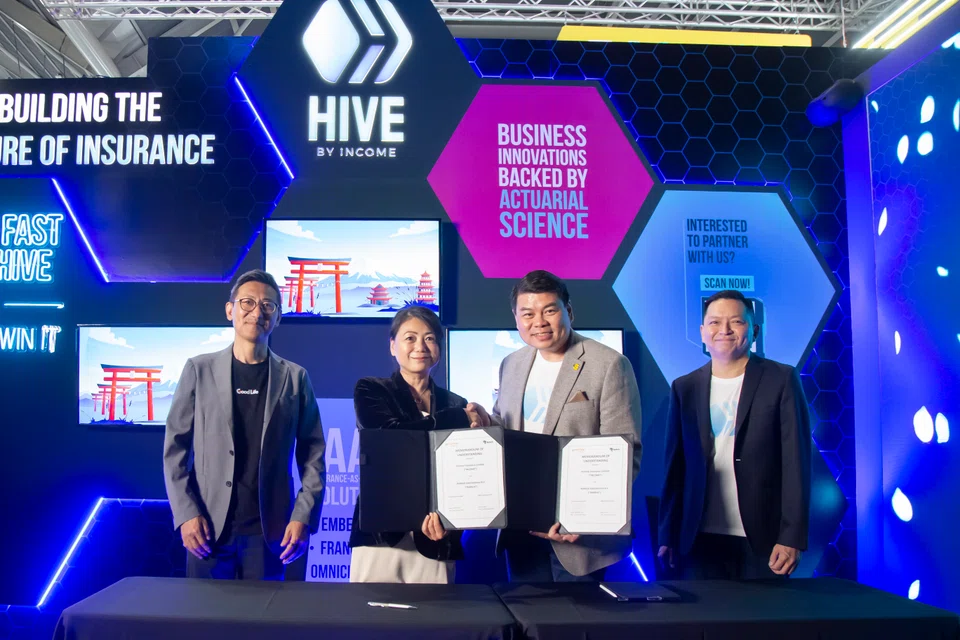
INCOME Insurance is moving further in its regionalisation push, with a new partnership in Japan marking its first foray out of South-east Asia and the company’s fifth overseas market in a year.
The company announced on Wednesday (Nov 2) the launch of its micro-insurance franchise model on its Insurance-as-a-Service (IaaS) platform, HIVE by Income, and signed a partnership with ReMark during the Singapore Fintech Festival.
ReMark – the digital solutions provider of global reinsurer Scor – is the first international partner to adopt Income’s micro-insurance franchise model, and it is targeting to offer lifestyle-based micro-insurance, SNACK, to Japanese consumers next year.
Income was formerly known as NTUC Income, before it went through a corporatisation exercise this year to convert its legal form from a co-operative to a company. The exercise was carried out to “further strengthen its competitiveness for long-term growth”.
Andrew Yeo, chief executive of Income, told The Business Times (BT) that their premise of going overseas is as a “digital attacker” to bring their digital propositions to the region.
“That actually allows us to regionalise in a very asset and resource-light manner, to build distribution partnerships with local incumbents who actually, in our mind, have the best knowledge of the marketplace as well as the customers,” he said.
Income made its first foray overseas in October 2021, and has partners in Vietnam, Malaysia, Indonesia and Thailand.
The insurer has a longer-term vision for its regionalisation, and is aiming for a business mix where 25 per cent of its revenue premium – or around S$1 billion based on current revenue – comes from outside of Singapore within the next 10 years, Yeo said.
SNACK – which has already been launched in Singapore – is intended to lower barriers to insurance and investments. Users can stack or accumulate micro-insurance in life, critical illness or accident policies, or make micro-investments by paying premiums as low as S$0.30 while doing their daily activities.
Over 90,000 users are making use of this in Singapore, with over S$385 million in sum assured across the insurance and investment offerings.
Yeo said that customers such as young adults or gig workers find this proposition intriguing as they may have fluctuating incomes that do not allow for large purchases at one time.
The companies see similar opportunities in Japan, and said in a statement: “(The partnership is) a strategic move that promises vast market potential given the similarities in insurance landscape and consumer behaviours in both Singapore and Japan as developed markets with high mobile penetration rates.”
Na Jia, chief executive of ReMark, told BT that the older generation in Japan usually have good insurance coverage, as they typically join a company after graduation and stay on until retirement.
The younger generation, however, may have other priorities, and take on contract-based work, which also means that their insurance coverage is “a bit sketchy”. She added that it would be important for such a product to enter Japan to meet the insurance protection gap for the millennials and Gen-Z.
While the partnership starts off in Japan, Jia noted that ReMark is a global operator. She said: “If the Japan model works, we’ll be looking at Europe and North America.”
For Income, the most important aspect in regionalisation would be to find “like-minded partners”, who can understand opportunities in the local context, Yeo said.
“It is through (our) partners that we will then keep our minds open in terms of which are the potential geographies we can go into. It may be Asia-Pacific now, but it could be rest of the world next.”