

Inverted Singapore bond yield curve adds to expectations for higher mortgage rates
Singapore Savings Bonds priced off the daily average yields of government bonds, but unlikely to track any yield curve inversions

Tay Peck Gek

THE Singapore government securities yield curve has inverted, which means an increase in home mortgage rates and other borrowing costs pegged to short-term interest rates is not far off.
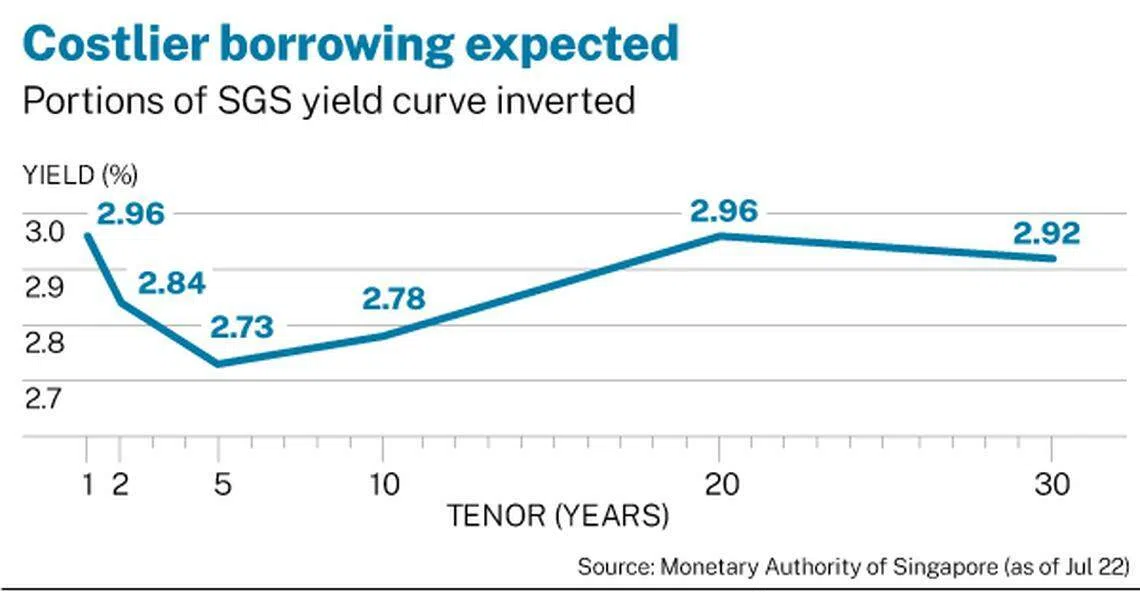
On Jul 22, the yield on 10-year Singapore Government Securities (SGS) closed at 2.78 per cent — below the 2-year SGS yield of 2.84 per cent.
Yields on the 2-year bond have been higher than yields on the 5-year bond since Singapore’s tightening of its monetary policy on Jul 14 — a day after the United States’ inflation rate hit a 40-year-high. But the relationship between 2-year and 10-year bonds is more closely watched.
Historically, an inverse relationship between the yields of 2-year and 10-year US Treasuries has been a reasonably accurate predictor of a recession.
Longer-dated bonds should command higher yields than those with a shorter maturity, and the yield curve normally slopes upward as duration rises, because investors want to be rewarded with a higher premium for a longer holding period, for which the risks are deemed higher.
An inversion in the yield curve typically suggests bond investors are expecting yields to fall in the long term due to an economic slowdown.
The US 2-year/10-year has already shown an inversion several times this year.
On Jul 22, the 1-year SGS bill had the highest yield among all the tenors and was on par with the 20-year, at 2.96 per cent.
But it may be too early to suggest the current inversion in the SGS yields presages a recession for Singapore, as various factors may be at play that have affected short-term yields.
DBS senior rates strategist Eugene Leow told The Business Times that Singapore dollar (SGD) liquidity is perceived to be tight, as seen in Singapore’s unsecured overnight cash borrowing rates having lately been higher than their US dollar comparables.
He highlighted that Singapore Overnight Rate Average (Sora) fixings have stayed clearly above the Secured Overnight Funding Rate (SOFR) in recent weeks.
Sora is a benchmark computed from the volume-weighted average rate of actual borrowing transactions in the unsecured overnight interbank SGD cash market. This is also used by banks here to price floating-rate home loans.
The SOFR is the cost of borrowing cash overnight collateralised by US Treasuries, and used as a reference by the banking industry internationally in place of the London interbank offered rate (Libor).
In addition, the high cutoff yields for the bills issued by Singapore’s central bank, the Monetary Authority of Singapore (MAS), are another sign that liquidity of the currency appears to be tight. MAS uses the bills to manage liquidity in the Singapore banking system.
Tight liquidity, DBS’s Leow stated, has the effect of bumping up short-term Singapore dollar rates, including the 2-year bond yields.
Leow does, however, think borrowers should prepare for their costs to go up: “Higher Sora fixings will quickly filter into the 3-month compounded Sora figures, which a lot of loans are tied to. So, (the) short answer is borrowing costs tagged to shorter term Singapore dollar rates will go up.”
How will this latest development affect the yields of Singapore Savings Bonds?
These are priced off the daily average yields of the government bonds the month before. But their rates are unlikely to track any yield curve inversions and offer a lower coupon rate for a longer holding period, because the “step up” feature reflects the objective of the fixed income instrument to facilitate long-term savings and investment.
MAS has already stated that adjustments may be made to ensure that interest payments do not step down in any year within the life of a particular savings bond. The adjustment does not affect the return on the savings bond if it is held for the full 10 years.
TRENDING NOW

Simba admits exceeding spectrum limits amid failed M1 deal; parent company Tuas’ full-year profit surges 277%

He built the Vingroup empire. Now South-east Asia’s richest man is handing some key roles to his sons

Ex-execs of CW Group, Allied Tech charged with offences linked to lawyer’s S$76 million misappropriation

Singapore to prioritise high-value AI infrastructure as Asean markets play to their strengths: Tan Kiat How

