

New ESG-linked bonds emerging for Asia to transit its inconvenient truth
Sustainability-linked debt helps Asian corporates shift to cleaner future, as 'traditional' green bonds clash with economic needs

Singapore
ASIA is growing, and for certain parts of the region, that means many sectors are still heavily reliant on coal and other raw materials.
The inconvenient truth then, is that traditional green bonds may not be a viable funding source in the transition to net zero. They may be irrelevant if there are no direct energy-efficient investments to fund.
For some corporates, there are just not enough eligible projects to issue green bonds - an emerging asset class touted as the way to invest in a defence against climate change. Proceeds raised from such debt must be tied to specific green projects.
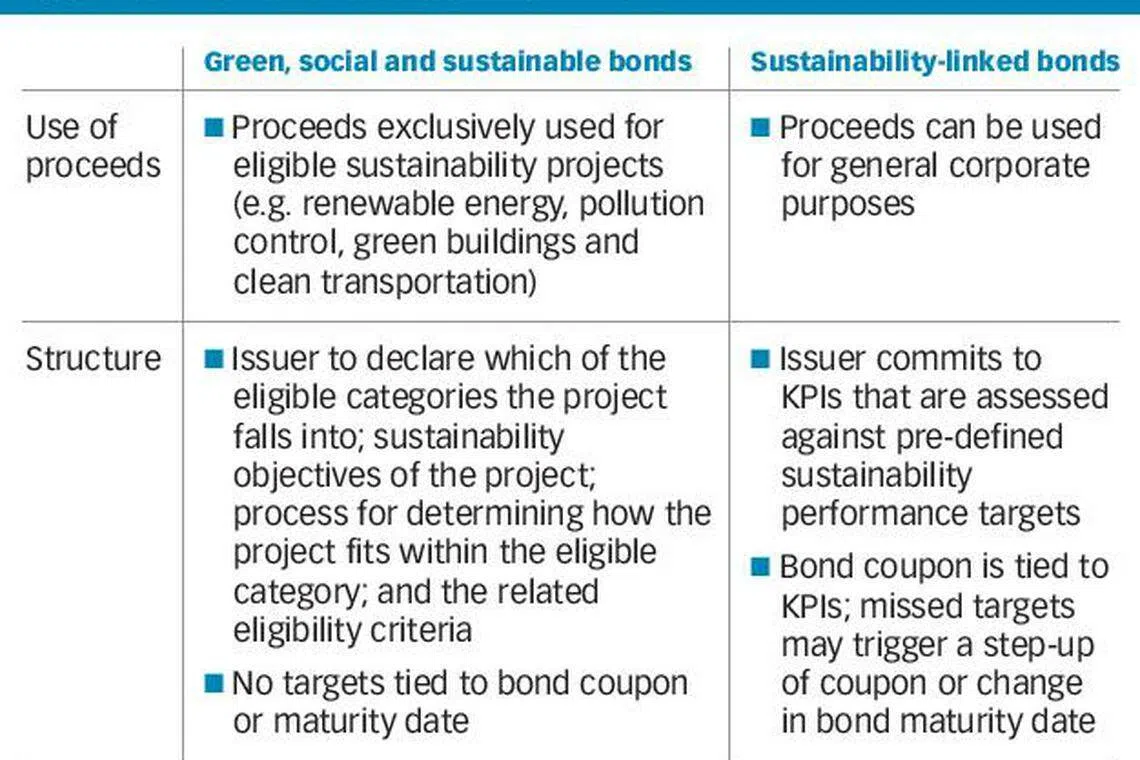
But then came sustainability-linked bonds (SLBs) some two years ago. Unlike green bonds, SLB proceeds can be used for general corporate purposes, so long as the issuer meets a set of sustainability targets. If they fail to do so, this will trigger a step-up in bond coupon, or a premium on the redemption amount.
With no restriction on the use of proceeds, SLBs are open to a wide range of issuers across sectors, including sovereigns, Huang Chaoni, BNP Paribas head of sustainable capital markets, told The Business Times (BT). Corporates have so far dominated issuances.
Market reception towards the flexible structure of SLBs has been promising, considering they were only introduced in 2019. More than 20 bonds have been issued globally, totalling over US$18 billion so far.
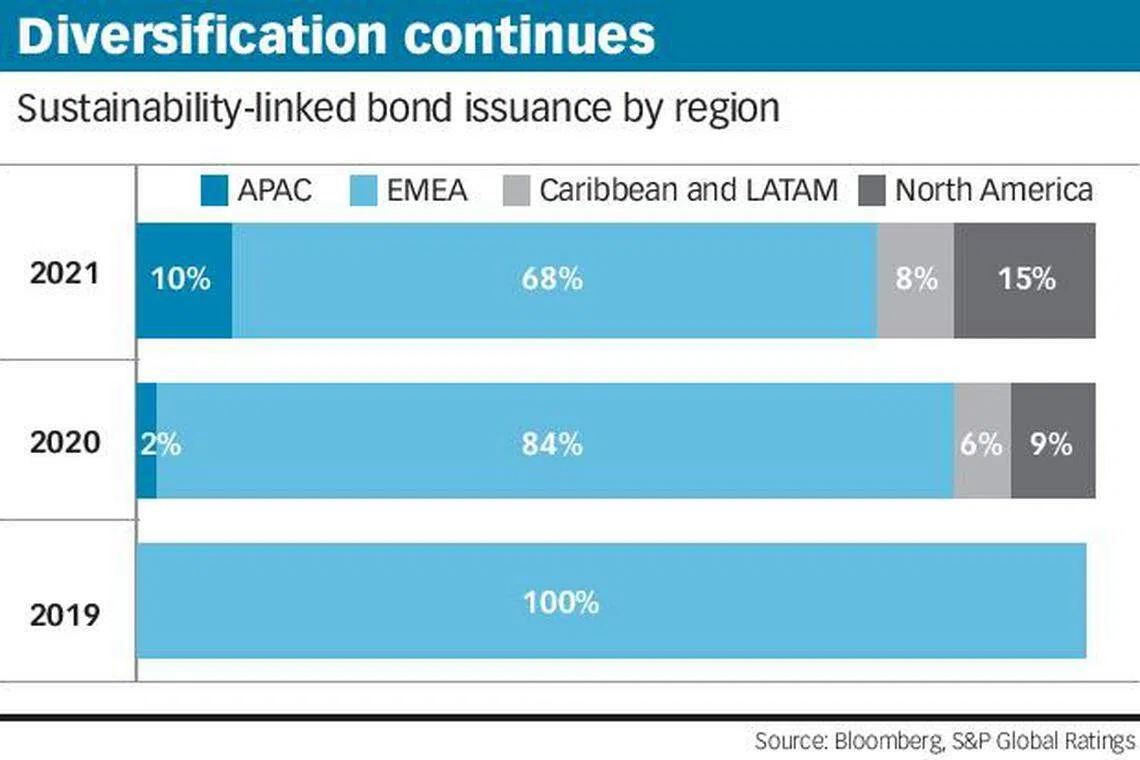
Asia is fertile ground for SLBs amid fresh decarbonisation targets committed by China, South Korea and Japan, analysts said. Though the market remains small relative to green bonds, momentum has picked up this year, with SLB issuance in Asia up nearly three times year-to-date compared with the whole of 2020, data from S&P Global Ratings showed.
"The flexibility has made the instrument more attractive to a wider range of issuers than the green bond market," said PC Chakravarti, banking lead and sustainable finance lead at Accenture.
DBS head of fixed income Clifford Lee pointed out that SLBs are "intuitively attractive" for corporates looking to go green without shelving their expansion plans.
"They can use the proceeds to continue to grow their business... to make sure they're economically empowered to then fulfil those sustainability goals," he told BT.
SLBs also have strong growth potential because issuers can select key performance indicators (KPIs) relevant to their business. These KPIs are then assessed against pre-defined sustainability performance targets.
This allows companies in the early stages of transition, or those that might not have enough green or social projects today, to issue an instrument that may appeal to investors focused on sustainability, according to a recent report by Moody's.
"The issuer is able to commit to goals that have more meaningful, impactful relevance to their business. Many of them already have sustainability goals in their corporate governance. It's a matter of putting those down as KPIs to meet," DBS's Mr Lee said.
In Asia, about eight SLBs have been issued from sectors such as real estate, transport, construction and food and beverage since December, data from Dealogic showed. Notable issuers include Hong Kong's real estate developer New World Development and India's Ultratech Cement.
Closer to home, Surbana Jurong (SJ) Group in February priced a 10-year S$250 million SLB at a coupon rate of 2.48 per cent.
SJ has two targets to meet: a 10 per cent reduction in greenhouse gas emissions intensity by 2029, and net zero carbon emissions status in the Surbana Jurong Campus by Aug 30, 2030. If unmet, SJ has to pay investors a premium of 0.75 per cent of the redemption amount at maturity.
Meanwhile, a unit of agri-food company Japfa in March priced a US$350 million senior fixed rate sustainability-linked bond (SLB) due 2026 at 5.375 per cent. The oversubscribed SLBs from Japfa Comfeed Indonesia are listed in Singapore.
Over the next three years and nine months from the date the SLB is issued, Japfa Comfeed Indonesia is expected to build eight water recycling facilities out of 15 slaughterhouses under its poultry operations, and one water recycling facility at a hatchery within the poultry breeding unit.
DBS's Mr Lee said in setting quantifiable goals, and legally enforceable penalties if the issuer falls short, there is clear economic incentive for issuers to change their behaviour.
"In certain ways, that's more powerful than just having a use-of-proceeds category," he added.
Because of the way SLBs are structured - coupled with growing investor scrutiny - there is potential reputational risk for issuers, particularly those without credible transition plans and achievable KPIs.
Ideally, this means only corporates with viable sustainability plans will come forward to the market.
"They must have sustainability parameters and principles already laid out. Then, issuing a SLB effectively operationalises those targets," said Mr Lee.
As climate change and Covid-19 impact bring ESG (environmental, social and governance) considerations to the fore, industry watchers expect SLBs to take up a larger share of the sustainable finance pie.
S&P analyst Lori Shapiro said SLB diversification by region will continue over the next year, with Asia-Pacific issuers expected to play a "much more prominent" role in the market.
Carbon-neutrality commitments in Asia will be a key driver to the rise of SLBs. Industry targets will be the push factor for companies to develop their own targets, at least in line with respective government commitments, said BNP's Ms Huang.
"ESG investors have been a key market driving force too, encouraging companies to develop quantifiable ESG targets," she added.
In the next couple of years, SLBs are unlikely to cannibalise green bonds, given their nascency.
For now, SLBs serve more as a complementary tool that offer issuers without enough capital or operating expenditures for specific green projects the chance to participate in the sustainable debt market, said S&P's Ms Shapiro.
Green bonds will still have a big role to play. While SLBs provide businesses with a forward-looking approach to sustainability, green bonds enable them to profile actual sustainability projects and investments, Accenture's Mr Chakravarti said.
Analysts also flagged that SLBs are far from perfect, even with the Sustainability-Linked Bond Principles (SLBP) established last June.
"While the SLBP has undoubtedly helped to create some clarity around these structures, the market remains in the early stages of defining what constitutes robust sustainability targets across different sectors, making it difficult to forecast how rapidly sustainability-linked bond volumes may expand," said Moody's in a report.






