PayNow-DuitNow linkage may lower cash use when borders open
Singapore
SINGAPORE'S largest remittance corridor connects with Malaysia, and this pipe will soon see quicker payments flow through once the two countries' real-time payment systems link up next year.
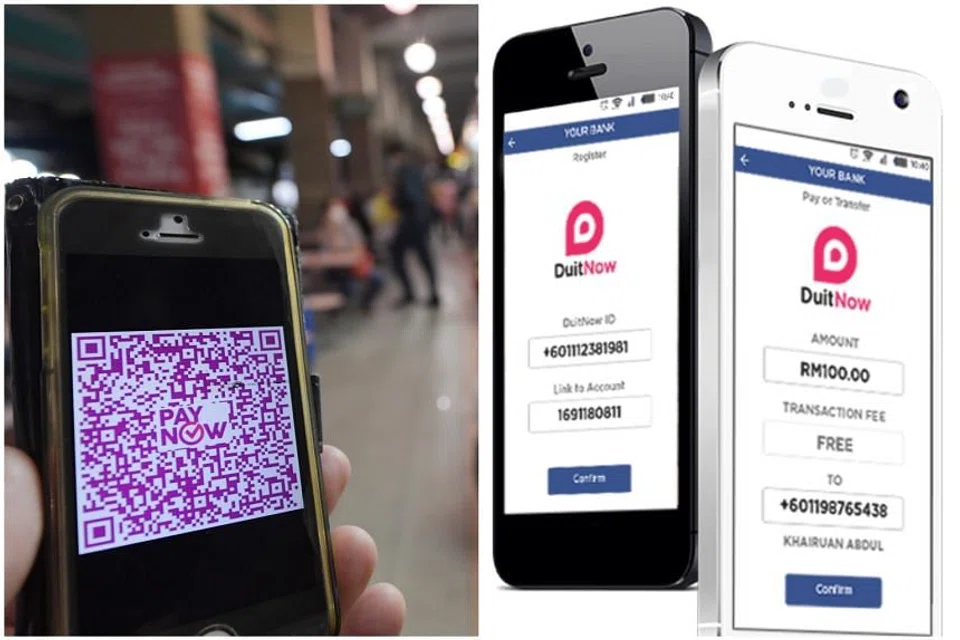
The Monetary Authority of Singapore (MAS) and Bank Negara Malaysia (BNM) on Monday announced plans to start a phased linkage of Singapore's PayNow and Malaysia's DuitNow payment rails starting from the fourth quarter of 2022.
Customers of participating financial institutions will be able to make real-time transfers between both countries using a mobile number, as well as make retail payments by scanning Nets or DuitNow QR codes displayed at merchants' storefronts.
Industry watchers told The Business Times that individual and corporate customers will stand to gain from cheaper and faster transfers, while banks and other fintech players with strong digital capabilities could potentially offer more services.
On a broader scale, this payments linkage could rid the cash hassle when travel borders reopen.
Still, the demand for such a service would largely hinge on the exchange rate being offered. There are also question marks on how the ringgit can be held in bank accounts and other digital wallets, given that it is a restricted currency.
David Brown, head of payments, Asia-Pacific global consulting solutions at Finastra, said that banks - especially those that have invested in digital and payment solutions - will be able to leverage existing capabilities to offer more services to customers.
For those with more "rigid" payment capabilities, where the right digital investments have not been made, this may "cause concern" for their position in the market as such changes are costly to implement, he cautioned.
BT understands that the list of participating banks in the first phase of the PayNow-DuitNow linkage is being finalised.
It will also be made open to non-bank financial institutions that are PayNow participants; the access criteria will be developed and finalised over the course of the collaboration and shared in due course.
The volume of remittances between Singapore and Malaysia reached S$1.3 billion in 2020. As for travellers between both countries, there was sizeable pre-pandemic traffic of about 12 million arrivals yearly on average.
"Given the close ties between Singapore and Malaysia, the PayNow-DuitNow initiative will help more bank customers send money to each other across borders quickly, safely and easily," said Wee Ee Cheong, UOB chief executive and chairman of the Association of Banks in Singapore.
Finastra's Mr Brown reckoned that cash and cards will be impacted when travel restrictions ease. "Converting cash to local currency is a hassle most travellers could do without, especially being left with a collection of small change at the end of a trip which is hard to convert back."
While credit cards are an alternative, they are not an option offered by many small traders, and are at risk of fraud in a way direct payments are not. Many travellers will see the ability to pay the exact amount with just a mobile phone number or a QR code as far more convenient and safe, said Mr Brown.
Economist Walter Theseira, an associate professor at the Singapore University of Social Sciences, believes that the market for the PayNow-DuitNow linkage is "fragmented" despite huge remittance flows and extensive traffic between both countries before Covid-19 struck.
While the most convenient option for most Singaporeans, as well as for Malaysians working in Singapore, would likely be remittance from a Singapore bank account or payment by Singapore-based credit card, there is still a "large role" played by money changers and non-bank remittance sources.
This is down to the perception that bank exchange rates are relatively unfavourable compared to cash exchange rates and non-bank remittance rates. Credit card rates also typically have an additional foreign transaction fee, noted Prof Theseira.
He added: "The issue with the PayNow-DuitNow linkage is whether the exchange rates, which will likely be based on the bank exchange rates, will be competitive."
Banks, aware that their service is seen as more convenient, may be less pressured to make their rates more competitive. There are also fintech players such as Wise and Revolut specialising in cross-border flows, which adds to competition in the sector, said Prof Theseira.
According to Wise, it is about 12 times cheaper to send money internationally with the firm, compared to major banks in Singapore.
Abhishek Choudhari, Wise product director, told BT there is clear demand for low-cost and transparent international transfers. Its recent survey found that 23 per cent of Singaporeans are transferring money overseas at least once a month, yet 40 per cent are either unsure of or believe there are no additional fees when sending money overseas.
Ultimately, all banks and remittance players in Singapore and Malaysia will lose some fee income when the new PayNow-DuitNow linkage goes live.
The market is about S$1.3 billion both ways. Assuming a 4 per cent average fee, total fees that banks and remittance firms collect annually stand at around S$50 million, said Eugene Tarzimanov, vice-president and senior credit officer at Moody's.
While it is not clear what the split between banks and non-banks is, the loss of fee income will be "immaterial" at banks for now, given their large and diversified income streams. This will be more significant if more regional money transfer systems are interlinked, said Mr Tarzimanov.
PayNow is already linked to Thailand's PromptPay, and will be linked to India's Unified Payments Interface by July next year.
Following the first-phase launch of the PayNow-DuitNow linkage in Q4 2022, the project will be progressively expanded to incorporate a wider range of features and participants.
In a statement, MAS and BNM said they will also explore the feasibility of integrating innovative features such as distributed ledger technology-based solutions to catalyse greater efficiencies in payments clearing and settlement between participating banks.