

Singapore banks show voracious appetite in buying back shares
Since start of March, UOB has spent S$16.2m on share buybacks and OCBC, S$19.2m; DBS leads tally with S$368m
Singapore
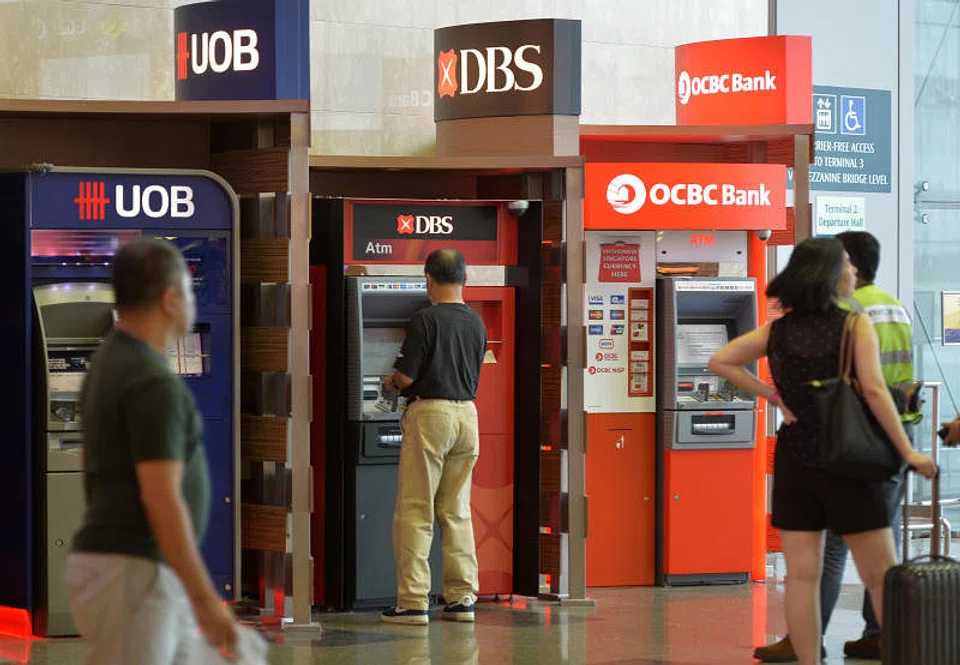
SHARE buybacks by Singapore banks surged this month amid the market turmoil, as the valuations of their shares have hit levels below their book value in recent days.
DBS leads the tally across all Singapore-listed stocks in share buybacks with a whopping S$368 million spent on share buybacks since the start of March, well exceeding the bank's total of S$103 million for all of 2019, data requested from the Singapore Exchange showed.
Based off share buyback data since the start of March through to last Thursday, share buybacks by DBS made up more than 80 per cent of the total S$450 million in share buybacks by listed companies in Singapore. As a comparison, share buybacks recorded in all of March last year tallied up to just S$54 million.
UOB also jumped into share buybacks after going a full year without in 2019, spending S$16.2 million since the start of March. OCBC spent S$19.2 million on share buybacks over the same period as well.
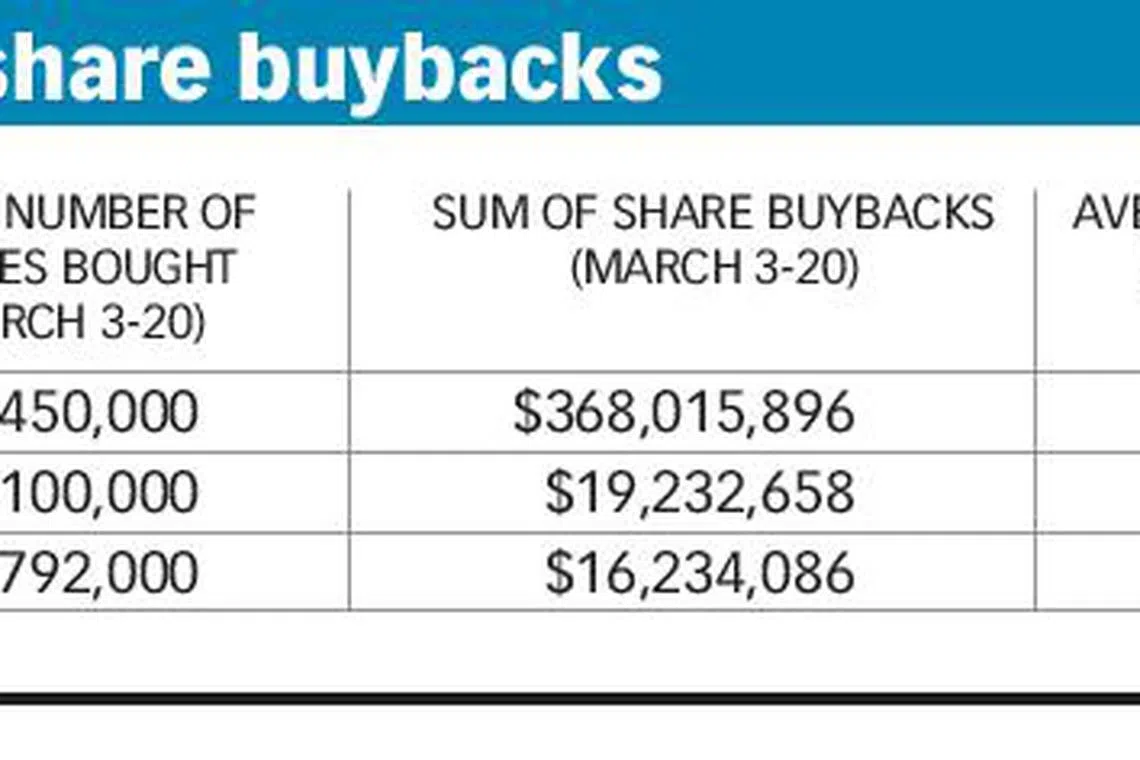
Checks by The Business Times showed that even after stripping out the banks' share repurchases since the start of March, and comparing that against all non-bank share purchases made in all of March 2019, share buybacks by listed companies have already nearly doubled this month from that of March a year ago.
Share buybacks are undertaken by companies for various reasons, including holding shares to be issued to senior executives as part of their pay packages. It can also be read as a signal that the companies believe their shares are being priced below their intrinsic value, with book value as an indicative benchmark.
Share repurchases mathematically increase the earnings per share that each investor receives from holding the stock too, because the number of outstanding shares has been reduced.
For Singapore-listed companies, share buybacks are limited to 10 per cent of the total number of issued ordinary shares. Listed firms here seek a mandate from shareholders each year to be allowed to execute share repurchases.
The rise in share buybacks comes as Singapore banks' shares have been mauled given the virus outbreak, sliding by about 25 per cent to close to 30 per cent since the start of the year. On a pure share-price movement basis, DBS has been hit harder than its peers due to its greater sensitivity to rates.
But all together, shares of the trio have traded below book value.
DBS is trading at around 0.94 times price-to-book (P/B), while OCBC and UOB have hit trough valuation, trading at 0.83 and 0.82 times P/B respectively, according to a report by Jefferies on March 17.
These valuations mean that OCBC and UOB are now trading below how they had been valued at their lowest points during the global financial crisis (GFC) against their book value then. DBS, by comparison, is still trading above its GFC trough level, as well as above its peers on a P/B basis, the Jefferies report said.
Data showed that DBS undertook share buybacks in March at an average price of S$19.95. Over this period, these purchases were as high as S$24.31 on March 3, right down to the low of S$17.36 on March 19.
Shares of DBS closed on Friday at S$18.16, up 76 Singapore cents.
Over the same period, OCBC bought back shares at an average price of SS$9.16, with share repurchase done at a high of S$10.68 on March 3 and a low of S$8.17 on March 20. OCBC closed at S$8.36 on Friday, adding on 28 Singapore cents.
UOB's share buybacks averaged S$20.50 per share, ranging from a high of S$23.30 on March 6 to a low of S$18.18 on March 20. Like its peers, UOB shares finished higher on Friday at S$18.96, gaining 61 Singapore cents.
As a result of the virus pandemic, banks are expected to be hit from rising credit costs given their exposure to businesses under pressure from the demand shock. Banks are also under pressure now as recent moves from central banks - particularly from the US Federal Reserve - have extended the lower-for-longer rates environment. Falling interest rates hurt the net interest margins that banks earn off their lending.
CGS-CIMB analyst Andrea Choong on Thursday joined other analysts in raising overall credit costs assumptions for Singapore banks. She has now factored it at 60 basis points (bps) in 2020, which reflects in a bear case of credit costs trending higher to around 50 to 120 bps last seen during the GFC.
"Increasing travel and business lockdowns by countries compound the risks of unemployment and lower incomes, as well as a potential erosion in asset prices," said Ms Choong in a note.
Still, Jefferies analyst Krishna Guha sees "historical resilience" behind the banks' earnings, and sees comfort around dividend payouts despite a decline in earnings given the banks' strong capital ratios. "The valuations are inexpensive," the analyst said.
READ MORE: Buybacks and director acquisitions continue surge
TRENDING NOW

Indonesia’s coal tycoon Low Tuck Kwong replaced as Bayan Resources president-director

OCBC names Ang Eng Siong as global corporate banking head in rejig of wholesale banking business

Consider lowering homeownership barriers for some non-resident foreigners

DBS opens flagship investment strategy to retail investors with new fund

