Singapore Savings Bonds return could be hit as yield curve inverts

Tay Peck Gek
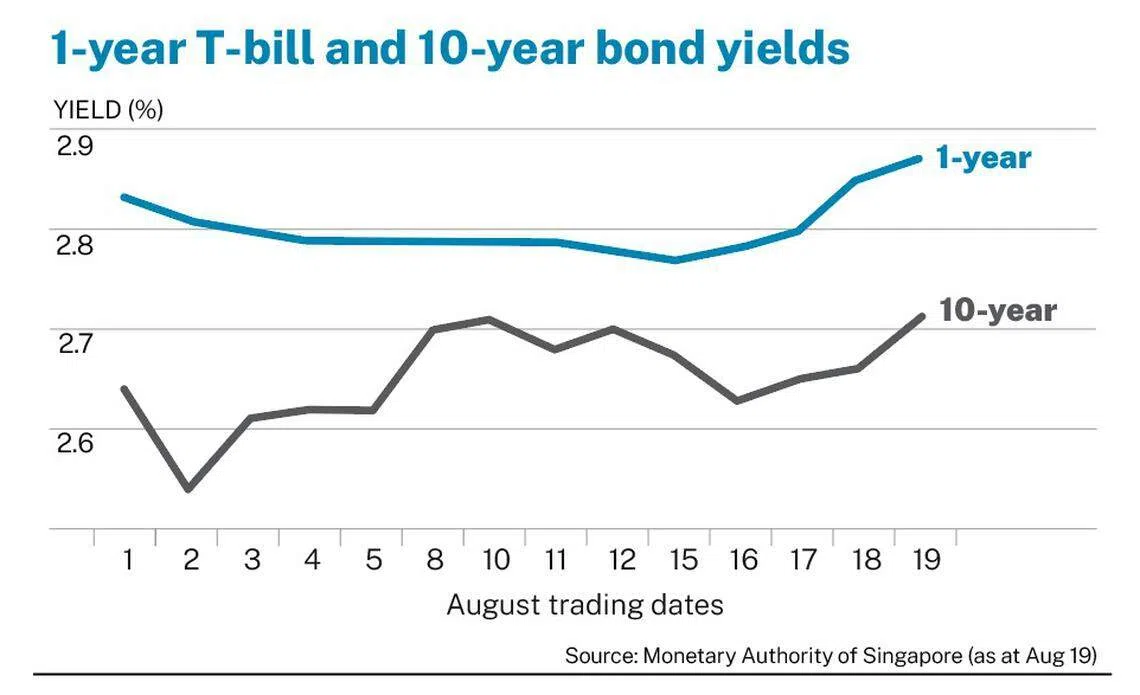
THE yield on the 1-year Singapore Treasury bill (T-bill) has averaged 2.8 per cent so far this month as short-term interest rates move up, but investors eyeing higher yields for the increasingly popular Singapore Savings Bonds (SSB) should not expect a similar pattern for these long-term instruments.
The upcoming October issuance of SSB, opening early next month, will be an interesting one to watch, as the 1-year T-bill has been rising over its 10-year counterpart in yield every trading day so far this month.
The yield on the 10-year T-bill has averaged 2.65 per cent for the month to Friday (Aug 19).
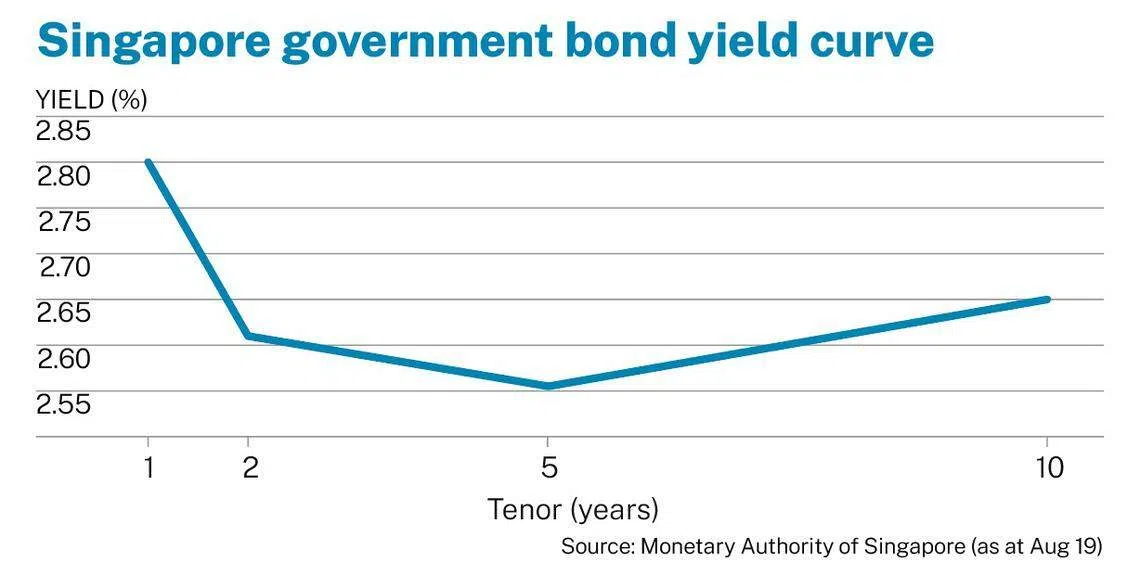
If the average yield on the 1-year T-bill outstrips the 10-year’s when the month ends, the October SSB should theoretically have a downward sloping yield curve.
This is because coupon rates for each issuance of SSB are determined such that the average annual compounded return over an investor’s holding period is linked to the yield of a Singapore government bond of a corresponding tenor – subject to adjustments.
In the event the yield curve is inverted, however, the government has committed to offering SSB investors a return that increases with their holding periods, and may make adjustments to ensure that the return does not step down before the SSB matures. Any adjustment, the government has stated, does not affect the return on the SSB if it is held for the full 10 years.
SSB interest rates, which had been on the rise this year, have already dipped. The January SSB bore an interest rate of 2.44 per cent in its 10th year and an average return of 1.78 per cent per annum if held to maturity.
Both those numbers rose steadily till the August issue, which bore an interest rate of 3.29 per cent in the 10th year and an average return of 3 per cent per annum.
The September issue, however, had an interest rate of 3.04 per cent in the 10th year and an average return of 2.8 per cent per annum.
What might investors expect for the October issue?
Bondsupermart senior research analyst for global fixed income Lim Teng Chong told The Business Times that the government would probably have to lower the first-year coupon for the SSB to adjust for the inverted yield curve of the T-bill and to prevent any step-downs in interest payments.
He noted that the September tranche of SSB closing on Aug 26 has provided constant interest payments from year 2 to year 5, thus ensuring that the interest payment does not step down while increasing the average yields of the SSB.
The Monetary Authority of Singapore did not respond by press time to BT queries.
There is a bit of inversion in United States Treasuries because of the steep interest rate hikes from the Federal Reserve and that is spilling over onto Singapore’s, DBS senior rates strategist Eugene Leow said.
“This is because market participants feel that rate hikes might turn into rate cuts in the coming 1-2 years as the global economy, including the US’, slows. It is also a reflection of pessimism on the global economy,” he added.
Meanwhile, although the September SSB tranche has a lower average return than the August one, analysts believe the September tranche will still be very much in demand.
The 2.8 per cent yield is still “very high” by recent standards, said DBS’ Leow. “I think demand will still be very strong, judging from how oversubscribed the previous issue was. It is probably easier to get a larger-sized allocation in T-bills compared to SSB. However, T-bills are much shorter in tenor and might not appeal to all investors.”
Bondsupermart‘s Lim said holding this SSB over a longer maturity offers much higher yield than the 10-year T-bill’s current yield. “With the current inflationary environment as well as recessionary fears, I think the demand for safer assets such as SSBs will continue to see high demand… Given the volatile and uncertain investment environment, investors could buy in the SSBs and wait out until market conditions are better and redeem their SSBs to invest back into equities when the market recovers,” he added.