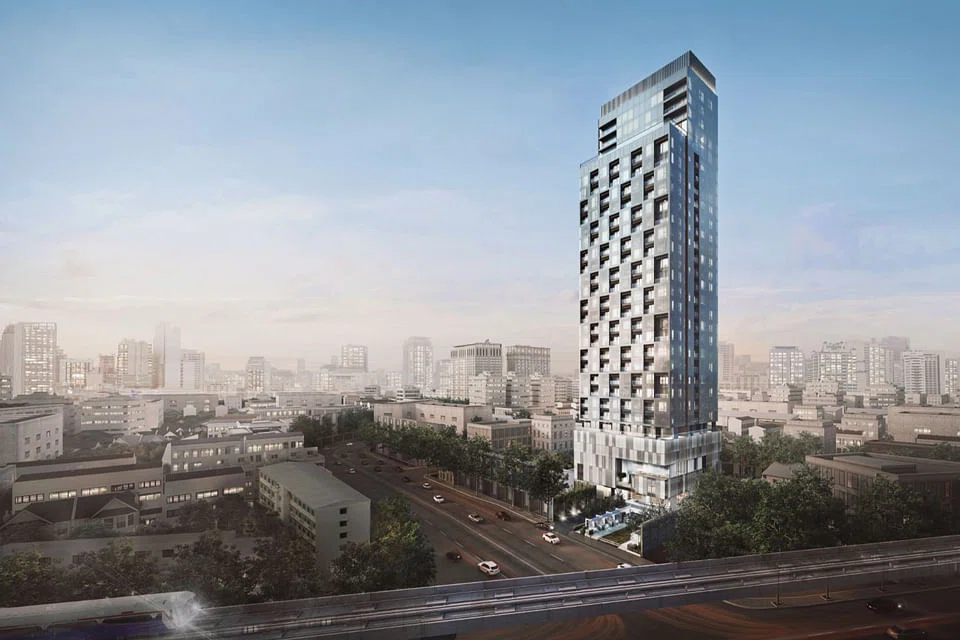
Thailand's The Strand accepts crypto as payment but others see limited prospect in property deals
Proponents of digital payment tokens hope to establish nascent crypto-property market in S-E Asia. But it might not come to Singapore just yet, with cryptocurrencies whipsawing in prices in a regulatory grey zone


Singapore
DESPITE its volatility, cryptocurrency is becoming an alternative way for consumers to make purchases in South-east Asia, from food and coffee to luxury cars. But properties?
Just last month, Singapore-based digital exchange Zipmex partnered Thai luxury developer One.Six Development to facilitate crypto payments for a 188-unit condo in Bangkok.
With this tie-up, the platform - which is not licensed in Singapore - expands on its service of arranging Lamborghini and Tesla purchases using bitcoin. ZipSpend, its payment network, also allows fine-art lovers to buy artwork with cryptocurrency.
Zipmex's chief executive officer and co-founder Marcus Lim said the ability to facilitate crypto transactions helps developers "get a new type of customers through the door".
One.Six's freehold project along Thonglor Road, The Strand, was launched in August 2018 with pre-sales starting from 16.5 million baht (S$695,355), and is slated for completion in Q3. Close to half of the units - 91 out of 188 - have been sold, at an average price of about 32,000 baht (S$1,361) per square foot. The Strand also houses a three-storey retail podium and a park with public access.
One.Six co-founder Chawin Athakravisunthorn told The Business Times that one of The Strand's penthouses was sold in 2018 to a wealthy crypto investor, but "at the time there wasn't really the infrastructure for us to be able to receive payments in cryptocurrencies".
Mr Lim said Zipmex has thus far received one crypto deposit for the development, adding that there has been a "steady stream of interest".
One.Six and Zipmex's tie-up provides the infrastructure to make such payments possible, but the initiative is at a "very early stage", and the developer's conversations with real estate agents about it have just begun, Mr Athakravisunthorn said.
One.Six's customers can close part of their property transactions, such as the deposit, with crypto, and the remainder with fiat money.
Zipmex's platform can "immediately" convert crypto to fiat, and vice versa, based on the market price at the point of transaction. One.Six quotes its price in baht and the buyer shells out an equivalent amount in crypto, which is then converted into baht to be accepted by the developer. Zipmex takes a portion of the conversion fees; Mr Lim declined to disclose the percentage as "arrangements can be different for each partner".
Asked if Zipmex is exploring the same with property developers in Singapore, Mr Lim said: "We are kind of looking at certain partnerships in Singapore (but) it's still very early at this point in time."
Still, there are potential issues such as wild price swings, opportunities for bad actors, and complex property tax schedules in jurisdictions like Singapore, industry observers told BT, even as this option allows sellers to widen their reach to buyers.
Mr Lim said while the Thai authorities have clear regulations for the inner workings of cryptocurrency exchanges, there remains what he calls a "regulatory gap" in Singapore.
Zipmex is not licensed by the Monetary Authority of Singapore (MAS) to provide digital payment token services.
Under the latest Payment Services Act, which went into effect in January 2020, entities dealing in or facilitating the exchange of cryptocurrencies or digital payment tokens (DPTs) in Singapore must eventually be licensed and regulated.
But in this period of regulatory transition, Zipmex is among more than 300 entities - which also include Alibaba Group, Binance Holdings, and Alphabet Inc - seeking licences but allowed to be exempted temporarily from holding one under the Act for specific payment services. The exemption will cease after a specified period, MAS said.
On its website, Zipmex tells customers that it takes a risk-based approach in assessing and managing money-laundering and terrorist financing risks to the company. Its due-diligence processes are such that "you are part of an ecosystem where all bad actors are prohibited from entering and all participants exist in the real-world", it said.
MAS does not regulate the tokens themselves, and "does not set requirements on whether businesses can accept DPTs for payments", said a spokesperson for the authority in response to BT's queries.
"Businesses that wish to accept DPTs as payments, including for property purchases, should understand the nature of DPTs and be prepared to bear the attendant risks. DPTs are not legal tender, they are not issued by any government and their market value can be highly volatile," she said.
In Singapore, fiat payments for uncompleted residential and commercial properties are standardised under the terms of options to purchase (OTPs) and sale and purchase agreements (SPAs). If a developer wants to amend the OTP or SPA for such uncompleted properties - for instance, to add crypto as a payment mode - it must seek approval from the Controller of Housing, BT understands.
Crypto payments for transactions involving other types of properties, including those in the resale market, do not appear to be regulated.
Major property developers in Singapore declined to comment when approached by BT.
Lee Nai Jia, deputy director of the Institute of Real Estate and Urban Studies at the National University of Singapore (IREUS), said given the volatility of crypto conversion rates to fiat money, it will be "hard" for developers to accept crypto payments for new launches. "They probably will only try if they have very few remaining units and want to widen their net" to reach more buyers, he added.
And in the resale market, it is even less likely for digital tokens to be used, as individual sellers tend to have fewer resources to conduct due diligence and may not fully understand cryptocurrencies, Dr Lee noted.
Some of Singapore's largest real estate agencies, including PropNex and OrangeTee & Tie, noted that crypto-related enquiries from property buyers and sellers have been scarce.
ERA Singapore CEO Jack Chua said: "There isn't any legislative protection if you lose money from dealing with digital currencies. Property transactions are highly regulated in Singapore, so I don't foresee crypto being accepted by the authorities as an alternative mode of payment."
Huttons Asia research director Lee Sze Teck said the environment for such payments is "still at its infancy in Singapore and yet to become mainstream". Interest in using crypto for property transactions remains "low", given the associated risks and the fact that the tokens are not considered legal tender here, he said, though this may change once it is more regulated.
Dr Lee from IREUS expects demographic shifts to potentially support the adoption of crypto in real estate deals, as younger buyers are likely to be savvier in digital tokens and "less entrenched in the traditional manner of how transactions can take place".
He sees a higher likelihood for crypto to be accepted in the commercial property leasing market and for property management fees. As these payment quantums are smaller than in property purchases, landlords will face lower risk associated with crypto price fluctuations, Dr Lee said.
Tan Kok Keong, chief business officer at Korea-based financial services platform Kasa, which looks at fractionalising real estate investments, said collaborations such as Zipmex and One.Six's could serve as a marketing tactic: "With regard to crypto payments for property, both sides could be taking on quite a big risk due to volatility. But although they may lose a bit in the actual transactions, the novelty of the option could generate publicity for them, maybe even globally. So they could treat the loss as an indirect marketing fee."
One.Six's Mr Athakravisunthorn is certain that in time, cryptocurrency will become "an important alternative form of payment" in Thailand's real estate market. "The plan is not for it to be the main form of transaction for our residential units, but to provide a secure alternative for customers who are active in the crypto markets."
READ MORE: