US dollar weakening to extend into 2021, lends strength to Singdollar
Claudia Tan HS
Singapore
THE Singapore dollar (SGD) is expected to strengthen in 2021 as improvement in global risk appetite continues to weigh on the US dollar (USD).
This comes as investors cast away safe havens, driving more inflows into riskier assets amid loose fiscal and monetary policy, diminishing uncertainty surrounding the US presidential elections and prospects of an economic recovery.
The SGD was trading at its highest since April 2018 at US$1.323 on Thursday morning.
DBS's forecasts for the USD/SGD is 1.36 for the first quarter next year, 1.35 in the second and third quarters and 1.34 in the fourth quarter.
UOB's house view is for further modest SGD gains against the USD with forecasts at 1.32 in the first quarter, 1.31 in the second quarter and 1.30 in the second half of next year.
"The USD is likely to further depreciate and maintain a low rate against the SGD, as investors unwind safe haven positions in the USD and rotate into other assets amidst a widely expected global economic recovery," said Phillip Futures senior strategist Simon Teo. His forecast is for the exchange rate to hit below the 1.30 band in the near-term, supported by a weakening US dollar, and a neutral Singapore dollar.
Further into 2021, however, Mr Teo expects the USD/SGD to return closer to pre-pandemic support levels of around 1.345 amid expectations of a recovering US economy and return to higher inflation.
Bank of Singapore (BoS)'s currency strategist Sim Moh Siong said that the vaccine rollout will in part contribute to a supportive risk environment that would "undermine the USD status as a safe haven currency".
This comes as vaccine deliveries kickstart a return to normal economic activity around the world, spurring investors to swing out of relatively safe US assets, and into other investments that offer higher yield, such as foreign currencies, stocks, and bonds.
Analysts have also suggested that a US under President-elect Joe Biden's leadership will have more predictable policies and reduce risks to global trade. That could benefit the Chinese Yuan (CNY), which is "looking slightly undervalued given their steep losses this year", according to Fitch Solutions.
A boost in yuan will in turn lend strength to the SGD.
"If the Chinese currency continues to benefit from stronger China growth and less destabilising US-China relations, then we could see scope for further China currency strength that would spill over into the SGD," said Mr Sim.
While the Monetary Authority of Singapore is keeping monetary policy unchanged, strength in the underlying basket of currencies such as the Euro and the Chinese Yuan (CNY) could translate to SGD strength against the USD, according to Mr Sim.
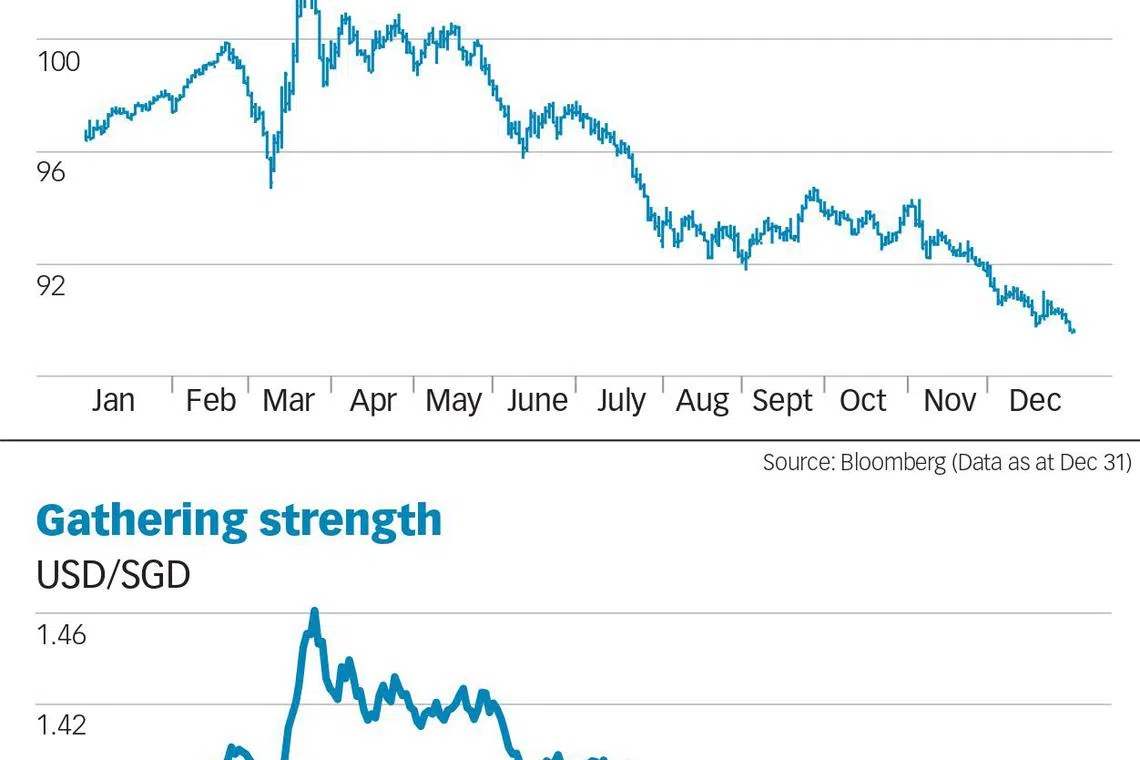
The world's reserve currency thrived when investors held onto it at the height of the pandemic earlier this year. At its height, the US dollar index (DXY), which measures it against a basket of currencies, was at 102.92 in March. It sank to a two-and-a-half-year low to 89.52 against major currencies on Dec 31. UOB is expecting the DXY to keep testing the "psychological support at 90". At the time of writing, the DXY was trading at 89.61, down 0.08 per cent.
Still, risks that could potentially trigger a flight to greenback safety persist.
Renewed waves of Covid-19 spread and vaccine distribution concerns could potentially boost the greenback strength, said IG senior market strategist Pan Jingyi.
"In the event that a greater sense of risk aversion captures the market due to these risk factors, the USD may take the upper hand instead," she said.
The new and more infectious strain of coronavirus that has surfaced in the UK, for instance, may provide some support for the greenback in the short-term.
Despite markets currently leaning towards the Fed's commitment to quantitative easing and an extended period of low interest rates to foster a post-Covid economic recovery, there is a chance for the greenback to reverse its downward trajectory if a vaccine-led recovery comes faster and stronger than expected, leading to high levels of inflation, said DailyFX strategist Margaret Yang.
But consensus remains that Fed is likely to keep interest rates lower for longer.
Mr Teo pointed out that the slack in employment conditions will make it more challenging to achieve inflation, particularly in the wake of further job losses during the pandemic. Low energy prices are also likely to persist in the near-term, contributing to low or no inflation.
"Central banks around the world will be working very hard to get inflation back on track, particularly in the US, which is a consumer economy," he added.
Investors should therefore manage their currency exposure while looking towards other assets or currencies that offer higher yield.
"Much of this short-term optimism had been baked in presently, but there remains opportunities to capture the moves alongside this continued recovery into 2021. Equities may stand to see bigger moves compared to the FX market, with the continued shift towards cyclical stocks one to watch," said IG's Ms Pan.