

Weaker Q1 earnings seen for Singapore banks amid volatility, lower risk appetites
However, the 3 banks are expected to do better for the year because net interest margins have edged up in response to Fed's rate moves

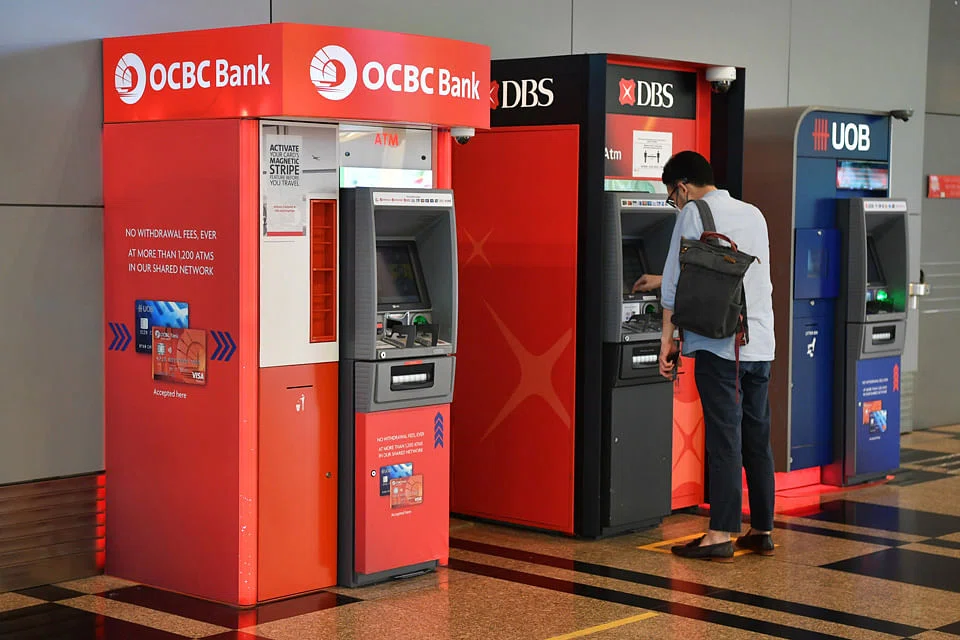
SINGAPORE banks are expected to report weaker first quarter earnings from a year ago, as wealth and treasury income are weighed down by investors' risk-off sentiment amid market volatility.
Analysts forecast that profits will come off by 15 per cent to 20 per cent across the sector from record earnings in Q1 2021, when the trio of lenders had benefited from robust wealth management fees and lower provisions.
On Apr 29, Singapore's 3 listed banks - DBS, OCBC and UOB - are expected to report their earnings for the quarter ended Mar 31.
With strong earnings in the year-ago quarter, UOB Kay Hian analyst Jonathan Koh said the banks could have a poorer showing this quarter due to a "high base effect".
The lenders had seen stronger-than-usual contributions from wealth management and other non-interest income sources for the Q1 period last year.
For this year as a whole, the banks are expected to do better than in 2021 because net interest margins (NIMs) have edged up - a response to the Federal Reserve lifting benchmark interest rates by a quarter percentage point in March.
But significant NIM expansion will likely materialise only later in the year. The NIM, which compares the amount of money a bank is earning in interest on loans with the amount it is paying in interest on deposits, is a key indicator of profitability.
As at Q4 2021, DBS's NIM stood at 1.43 per cent, OCBC's at 1.52 per cent and UOB's at 1.56 per cent. (see amendment note)
CGS-CIMB analyst Andrea Choong expects NIMs to have inched up by 1 basis point for each of the banks in Q1 2022.
Meanwhile, loan demand had appeared mixed across the banks, with corporate demand sustained but housing loans flattish, she noted.
While other fee income drivers may have held steady, with trade, transaction and loan-related fees tracking the pick-up in business activity, Choong said these were likely insufficient to offset market-related income weaknesses.
Jefferies equity analyst Krishna Guha also said the slow quarter for capital markets and broader deleveraging in a rising rate environment would have dented non-interest income and negatively affected revenue.
A slow pick-up in loan growth, coupled with higher interbank rates towards the end of the quarter, means any offsets from net interest income, too, will be minimal, he added.
Choong and Koh expect DBS's net profit to be 15 per cent lower year on year (yoy), but noted that for the full FY2022, the bank's loan growth is "on track" to meet its mid- to single-digit target.
Guha, however, held a more conservative view. He expects DBS's net profit for the quarter to go down by 24 per cent yoy.
At OCBC, Choong and Guha expect a 21 per cent drop in earnings; Koh expects a 26 per cent fall. Both Koh and Choong highlighted mark-to-market losses from the bank's insurance arm Great Eastern, which would have muted net trading income.
Still, Choong said, the bank's insurance income would likely have held steady as rising interest rates aid in crafting products that are more attractive.
Choong expects UOB's net profit to dip by 5 per cent while Guha expects it to maintain at just past the S$1 billion mark.
UOB has seen strong loan growth via sustained demand from property funds and financial institutions, as well as traders tapping larger credit lines amid higher commodity prices, Choong said. But she expects that inflationary pressures could push future credit costs higher, particularly among its clientele of small and medium-sized enterprises.
Asset quality could face "moderate downward pressure" given the progressive expiry of moratorium programmes in some Asean markets, as well as the supply chain stress and economic disruptions from ongoing lockdowns in China, said Rujun Duan, an associate director at S&P Global Ratings.
Analysts also said the lenders are likely to revise the guidance upwards for the rest of the financial year.
Maybank analyst Thilan Wickramasinghe said that weakness in Europe and China, coupled with higher inflation forecasts, could drive upgrades to general provisions. That said, the improved outlook for the oil and gas sector could result in some write-backs against provisions taken in the 2017-18 cycle.
CGS-CIMB's Choong, UOB's Koh and Maybank's Wickramasinghe maintained their overweight/positive ratings on the sector while Jefferies' Guha maintained his neutral stance.
Monetary tightening and higher interest rates are positive for banks, while higher inflation keeps bond yields higher for longer, Koh noted.
Guha, on the other hand, said the sector's valuation is "yet to be compelling" and that risk-reward ratio is still not favourable, especially with surging inflation, tepid lending and elevated credit spreads.
On Friday (Apr 22), shares in the banks closed up S$0.25, or 0.75 per cent, at S$33.64 for DBS; up S$0.03, or 0.25 per cent, at S$12.11 for OCBC; and down S$0.02, or 0.06 per cent, at S$31.13 for UOB.
Amendment note: A previous version of this article wrongly stated OCBC's Q4 NIM. The article has been amended to reflect this change.
TRENDING NOW

Britain’s mansion tax shows the difficulty of targeting wealth

Once staunchly pro-China, Malaysian Chinese businesses are now distancing themselves from Beijing

The only common thing in S-E Asia is that we all eat rice: Cisco’s Asean president

Singapore data centre operator DayOne opts for US IPO at likely US$20 billion valuation

