

A chatbot will help you now
Online shopping is increasingly personalised, as retailers adopt messaging apps and chatbots to support customers and create communities




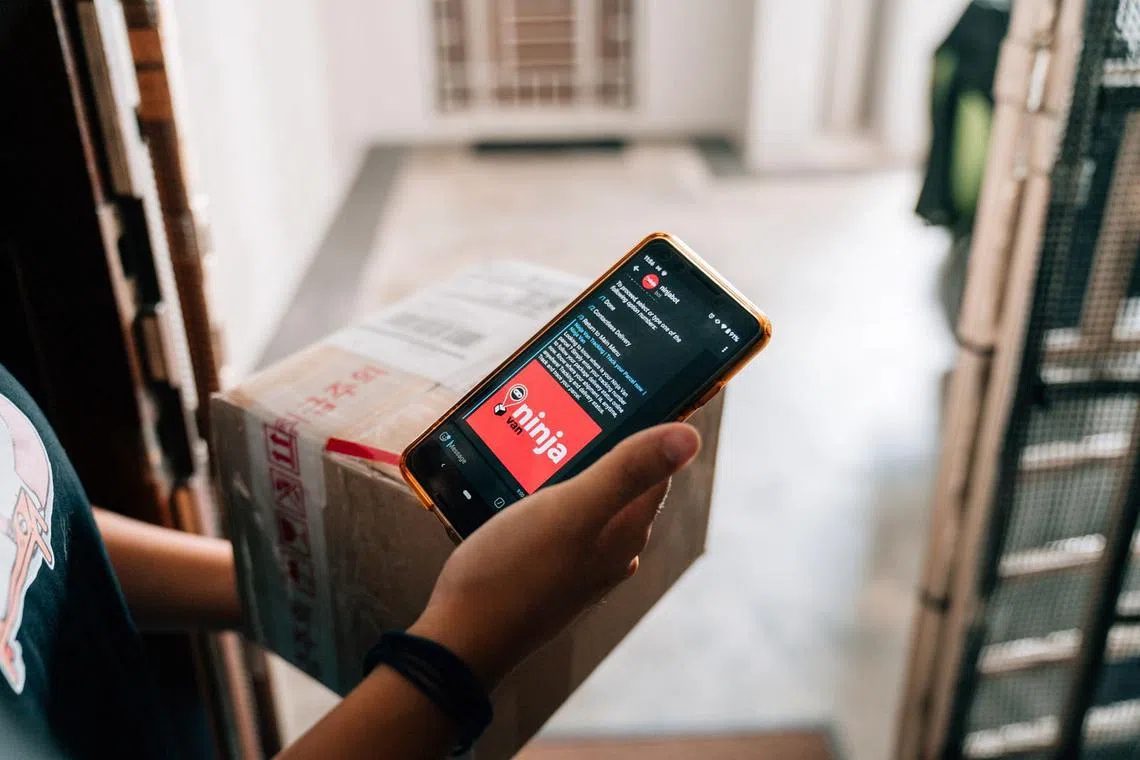
WHEN customers want to redirect their Ninja Van parcels, they no longer need to speak to someone on the phone. For the last year and a half, they have been able to send a text to a chatbot powered by artificial intelligence (AI).
Ninja Van's co-founder and chief product officer Tan Boxian estimates that about a million unique users in Singapore had subscribed to receive their parcel delivery updates through the NinjaChat system by December last year.
Since NinjaChat was rolled out, the courier company has seen increased parcel delivery success rates as well as faster issue resolution. This has led, in turn, to improvements in customer experience and satisfaction.
"We are (now) able to deliver more parcels within a day due to the contactless delivery option that we offer through NinjaChat, allowing our delivery personnel to leave the parcel at the customer's doorstep instead of having to wait for them to receive the parcel in-person," added Tan.
NinjaChat is available in all 6 of Ninja Van's South-east Asian markets, and through the preferred messaging app of customers in all those markets.
"Because the system is not tied specifically to any one social messaging platform, we're able to tailor options to the social messaging preferences of each market and create a localised experience that meets the consumer behaviours and preferences of each country," Tan said. "For example, in the Philippines, NinjaChat is available on Telegram, Facebook Messenger and Viber, while in Thailand we offer Line as one of the options instead of Viber."
Ninja Van's story is one example of the growing adoption of technology in the e-commerce space. For most players, it is no longer sufficient to have a website or online product catalogue. Business owners increasingly try to provide a seamless customer engagement experience - from browsing through to delivery - and are incorporating chat applications as an essential component of the digital purchase cycle.
A 2021 report by AI solutions company iKala showed that while e-commerce remains the preferred mode of shopping in South-east Asia, social commerce is hot on its heels. Among shoppers surveyed, 42 per cent had made use of social media to shop at least 1-2 times a month.
The survey also found that AI chatbots were among the top 3 technologies adopted by retailers in both Singapore and Malaysia to handle the deluge of online orders driven by pandemic-driven lockdowns and travel restrictions.
The power of chat
Chat apps are useful because of their reach and the personalised approach they enable - replicating the physical shopping experience.
According to a January 2021 study jointly published by social media agencies Hootsuite and We Are Social, 5 million or 84.4 per cent of Singapore's population is active on social media. YouTube is the most popular social media platform, used by 88.7 per cent of those aged 16 to 64. But WhatsApp ranks a close second, at 87.1 per cent.
Social media platforms Facebook and Instagram were further behind - at 82 per cent and 65.1 per cent, respectively.
Xavier Tan, director of local social media agency Heroes of Digital, said many of the company's clients have been establishing groups on social apps such as Telegram and Whatsapp to keep up their customer engagement.
These businesses may range from service-based small- to medium-sized enterprises (SMEs) to big brand retailers, he said, and many are doing so because the content marketing landscape has evolved beyond simply creating and publishing information consistently on social media pages.
"Facebook, LinkedIn, and the major social media platforms are all optimising for content that keep users on their platforms (instead of encouraging them to click) on your links. They are also optimising for ads, and reducing your social media posts' organic reach," Xavier Tan said. "One of the ways companies can adapt is to collect customers' data and communicate with them directly, for example through email marketing, SMS marketing and social media group channels."
Building an online community
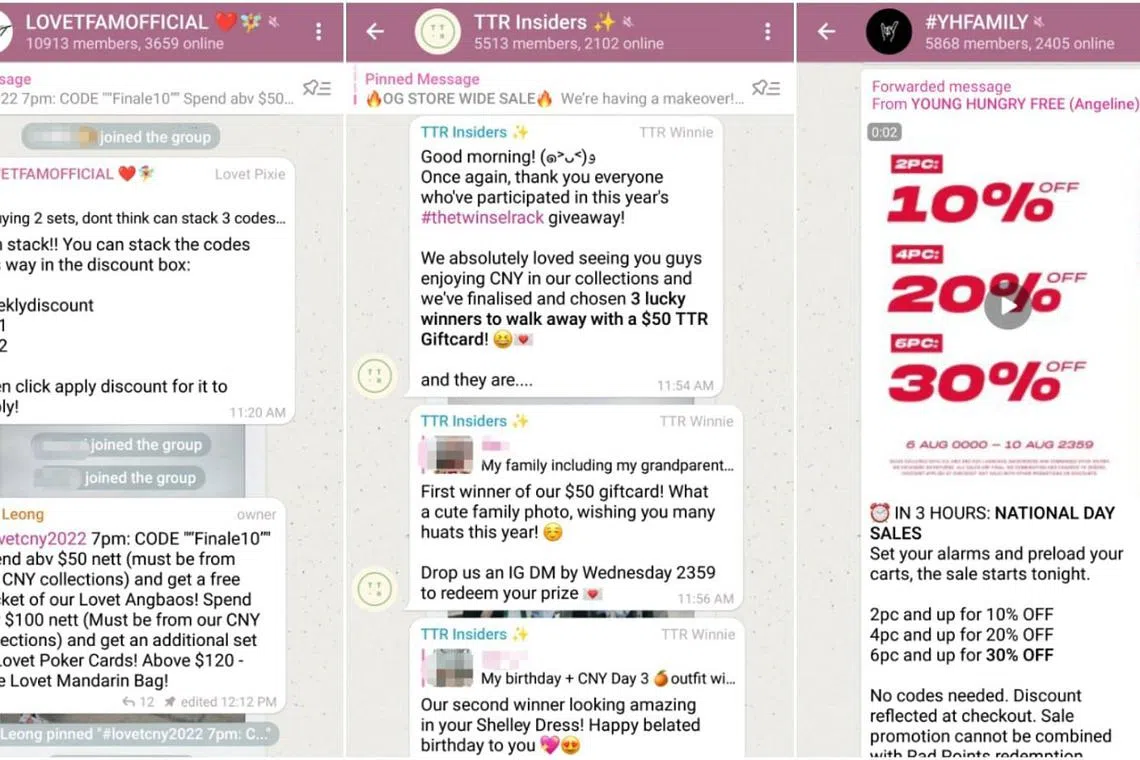
Messaging apps can be a powerful platform for outreach, as several local fashion e-commerce stores have found. These stores have set up interactive groups where customers can ask questions or post about the products they buy. Many of these groups have thousands of members, and are active every day of the week.
Winnie Ong, founder of local e-commerce brand Young Hungry Free, is among the retailers who has started just such a group. She chose Telegram as it was already widely used and its features supported her aim to promote two-way conversations with customers without being entirely intrusive.
"Our mission is to be like our customers' new best friend, a personal stylist; and we wanted to build a community of like-minded individuals - where everyone can share their version of outfits and styles, and freely exchange reviews of their purchases," Ong said.
Young Hungry Free launched its group during the Circuit Breaker period in 2020, and had close to 5,870 members as at Feb 8.
Another e-commerce store, The Tinsel Rack, uses its group to answer real-time customer queries and share previews of product launches. Its group had just over 5,510 members as at Feb 8.
To measure effectiveness, general manager Heu Ser Lyn said the brand creates trackable links to view the traffic. Heu also said consumer-generated content and engagements, such as the sharing of outfits, have probably contributed to sales.
At e-commerce brand Lovet, director Lee Wei Leong said queries often translate directly into sales. Lovet's group, set up in September 2020, had just over 10,910 members as at Feb 8.
And while all these brands have staff moderating the groups and responding to customers, they noted that customers in the group are also quick to answer each other's queries. Customers are often also the ones who start conversations.
The ability of chat apps to foster a sense of community has been a boon for travel wallet operator YouTrip, which operates 3 Telegram groups in a bid to bring users together and engage them with the brand.
Its general group YouTrip Squad had some 3,200 members as at Feb 8. Users discuss topics such as international shopping, travel and tips to make the most of the payment wallet.
YouTrip's regional general manager Kelvin Lam said Telegram had helped boost word-of-mouth marketing, which is the biggest contributor to the company's user base.
"The open dialogues on Telegram groups are a key channel for organic, word-of-mouth shareability of the brand as it enables our existing loyal customers to share their experiences with our product and help answer questions that news users might have about YouTrip," he said.
The rise of chatbots
Having to manage additional communication channels can, however, be resource intensive. The Tinsel Rack's Heu and Lovet's Lee both said managing Telegram has added to staff workload. Ong of Young Hungry Free also noted that the team is kept on their toes 24/7, as long as customers are awake.
YouTrip's Telegram channels are managed by its marketing team as well as close to 30 YouTrip brand ambassadors. But the company also uses bots to filter spam and get engagement statistics.
In fact, businesses are progressively taking their messenger apps to the next level by incorporating AI technologies such as chatbots.
Like Ninja Van's NinjaChat, these bots can be deployed on most popular chat apps - WhatsApp, Facebook Messenger, Instagram Direct Messenger, Telegram, Line and even Slack.
Kester Poh, chief executive and co-founder of AiChat - a provider of omni-channel chatbot solutions - has seen "rapid growth" in his business since Covid-19 emerged. Chat volume trebled during the lockdown, Poh said, adding that clients are now spending between S$30,000 and S$300,000 on his company's bots, depending on complexity.
Fully customised enterprise-grade chatbots can reach into the "tens of hundreds of thousands" of dollars, noted Pand.ai business director Ezline Lee. Meanwhile, the do-it-yourself type of chatbots can cost as little as a few thousand dollars.
On top of development fees, businesses are also paying chatbot creators recurring payments to help maintain the bots. These might include subscription fees for software as a service solutions, or licensing fees.
The customer base for chatbots is a diverse one - spanning banks, insurance companies, asset management firms, logistics companies, statutory boards and retail conglomerates - said Pand.ai's Lee.
Pand.ai recently partnered with Allianz, MSIG, and Etiqa to launch Gina - a bilingual AI chatbot that acts as a digital insurance broker on WhatsApp. The project also falls under the Monetary Authority of Singapore's fintech sandbox.
Some clients AiChat has worked with include Tesco, Mr D.I.Y, Kia Motors, Bayer, Marina Bay Sands, National Council of Social Service, Ministry of Health Indonesia, SUTD and FWD Insurance.
Common features requested include automated responses for frequently asked questions, marketing automation and leads generation, as well as social commerce.
"A leads collection module would be important for a marketing chatbot while a live chat feature would be more beneficial for a customer care chatbot or payment capabilities for an e-commerce chatbot," Lee said.
Advanced clients may also include features such as personalised infographics generation, and the ability to understand multi-conditioned or complex queries.
In Singapore and Malaysia, WhatsApp and Facebook are still the most popular channels for chatbots, said AiChat's Poh. But there is also growing demand beyond the little red dot. Some chatbots speak Bahasa Indonesia, Bahasa Melayu, Tagalog, Vietnamese, Thai and Chinese.
As the industry grows, customers can expect more intelligence and personalisation for these bots. In fact, some of them can already speak Singlish.
TRENDING NOW

If Europe goes to war, the fallout will be felt in East Asia

Singapore government slaps loan curbs on individual private-hire car buyers
Wider talent pools, smoother operations: What these S’pore firms gain from inclusive hiring

Philippines’ FDI slowdown exposes uneven investment prospects across S-E Asia

