

Why young Singaporeans are ready to go back to the office
Gen Zs and young millennials weigh new-found flexibility and their careers

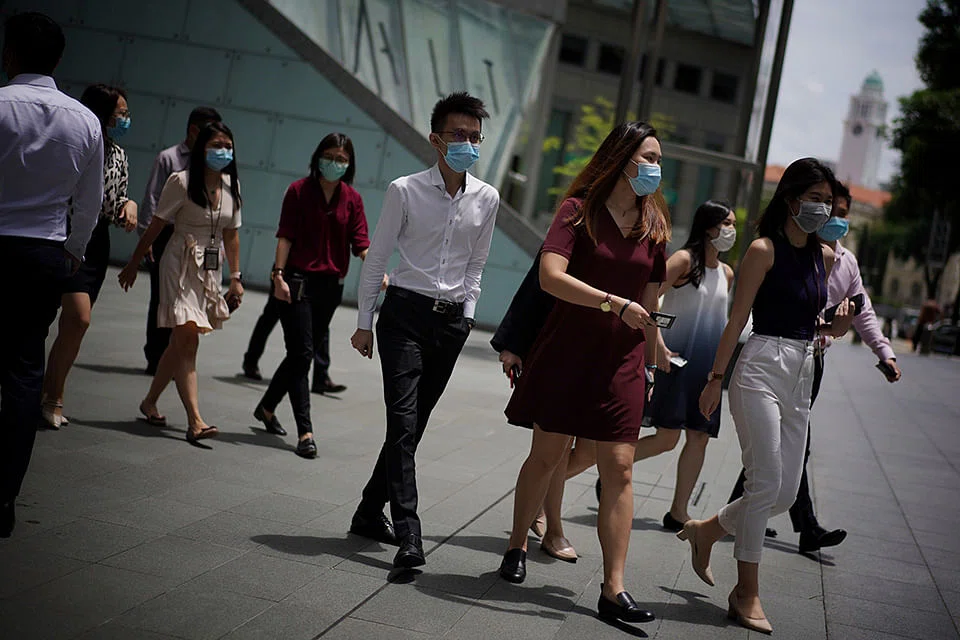


DESPITE not having experienced much of what being in the office five days a week feels like, Zhou Yu Shan, 22, cannot wait to be back at her seat at the corner of the office. To her, working in the office promises a healthy social life in the workplace - of lunches with colleagues and conversations in person.
"At first, I was quite happy to be able to work from home. But it's been about a month now and it feels suffocating because there is no social interaction. I'm always alone," says Ms Zhou, who is currently on a marketing internship.
She is not the only one.
In a recent Work Trend Index report published by Microsoft, Singaporean Gen Zs, or those aged between 18 and 25 years old, were found to be more likely to struggle balancing work with life when compared to older generations.
They also reported difficulties feeling engaged or excited about work, getting a word in during meetings and bringing new ideas to the table, more so than older workers.
"Networking as someone early in their career has gotten so much more daunting since the move to fully remote work - especially since switching to a totally different team during the pandemic," says Hannah McConnaughey, product marketing manager at Microsoft.
"Without hallway conversations, chance encounters, and small talk over coffee, it's hard to feel connected even to my immediate team, much less build meaningful connections across the company."
Perhaps a deeper concern among younger staff is that staying away from the office takes away opportunities not just to connect with co-workers, but to build networks for career advancement.
As TSMP Law Corp joint managing partner Stefanie Yuen-Thio put it in a post on LinkedIn: "If I were a young lawyer or a mid-level paralegal, I would be raring to go back. To upskill, to make up for the last 18 months of lost training, to build networks among co-workers that will help me in my future career. The hand wave icon on the Zoom app cannot replace a handshake in real life."
The spectre of job loss has also surfaced, with many pointing out a sobering truth - that any job that can be done well remotely, can be worked remotely from anywhere in the world and by anyone else similarly qualified.
Career concerns
While work from home is still the default mode in Singapore, companies elsewhere have begun recalling employees into the office as inoculation numbers rise. Tech giants such as Google, Facebook and Uber have taken the lead, as have Wall Street's biggest banks.
The office recall has been met with some pushback among workers, especially among millennials who have a higher tendency to job hop in a booming job market.
Yet young millennials and Gen Zs in Singapore do not seem to mind the switch back to the pre-pandemic workplace - perhaps prioritising job security instead.
In a poll conducted by The Business Times, more than 85 per cent of Gen Z and millennial respondents said they would remain in their current jobs even if the employer did not offer flexibility. More than six in 10 believe that working from home is a privilege and not a necessity, with over half of respondents saying they still believe in the benefits of being in an office.
This does not mean young Singaporeans want to spend all five weekdays sitting in the compartmentalised cubicles. Instead, many prize the newfound flexibility of today's hybrid working arrangements, where staff go into the office a few days a week.
Of the pool of 95 respondents BT surveyed, almost a quarter said they would not be keen to take up a job offer which did not provide a flexible working arrangement.
A recent EY survey found a strong preference among Singapore Gen Zs and millennials (born after 1980s), where 65 per cent of respondents in this age group want to work anywhere or remotely full time. (On the flipside, only 7 per cent would prefer to work full time in the office.)
However, across all age groups, the majority of Singapore respondents (75 per cent) believe that working remotely will have an impact on their careers, says Samir Bedi, EY Asean Workforce Advisory Leader. Roughly four in 10 are also worried about the possible implications of not working at the same location as their supervisor.
Across South-east Asia, employees expressed a strong perception that flexible arrangements like remote working and a shorter working week "would impact their access to career opportunities", EY found. The EY 2021 Work Reimagined Employee Survey polled 1,037 respondents in Singapore, Malaysia, Indonesia and the Philippines, as part of a global survey of more than 16,000 employees across 16 countries.
Productivity rules
Expectations among younger workers, or workers-to-be, are changing - they now want the freedom to choose the time and place where they work, surveys suggest.
"The pandemic has resulted in a very disruptive time for Gen Zs, many of whom are entering the workforce for the first time," says Lewis Garrad, partner, career business leader, Singapore at Mercer.
This group of young workers have more "demanding and complex expectations of employers", and are harder to engage and retain if employers do not understand their expectations and needs, Mr Garrard adds.
One of the reasons why Singapore Gen Zs and millennials prefer working anywhere or fully remote is the belief that remote and hybrid work arrangements increase productivity, says EY's Mr Bedi.
EY found that the majority (69 per cent) of those surveyed also believe that productivity can be accurately measured irrespective of location.
Some suggest that this could be because many of them are entering the workforce at a time where working-from-home is already the norm, having never experienced what a five-day-week in the office is like.
And now that it has been proven that not all work needs to be done in the office, few want a transition back into a full work-in-office mode.
More importantly, many believe that the emphasis should now be on the productivity of an employee, instead of the hours or place.
Nearly three quarters of respondents in the Asean Gen Z and millennial demographic perceive productivity to increase with a hybrid mix of onsite and remote work arrangements, EY found.
"A healthy working environment should be less focused on hours or location, as long as it does not affect the quality and quantity of your work," says Lydia Wong, a communications executive.
"It's just like working overtime. When you work overtime in the office, it doesn't mean that you are doing good work," says Ms Wong, who is part of the group of young workers seeking greater flexibility from their employers.
Managing the newfound work flexibility
Employers appear to stand on the same page on the benefits of hybrid working arrangements, though some have voiced concerns that young workers may miss out on opportunities - in collaboration and training - when they work from home.
Some of Wall Street's head honchos have railed against remote working for bankers. Morgan Stanley CEO James Gorman said in June he would be "very disappointed" if workers aren't back by Labor Day (Sept 1 in the US). David Solomon, CEO of Goldman Sachs, called working from home an "aberration". And JP Morgan's Jamie Dimon has said working from home "doesn't work for those who want to hustle. It doesn't work for spontaneous idea generation. It doesn't work for culture".
Speaking at an event hosted by The Wall Street Journal, Mr Dimon also pointed out that his bank had lost business because rivals had visited a potential client in person while JPMorgan's bankers had not.
Several Singapore banks have switched to adopting the hybrid model permanently.
DBS for example, has introduced a series of measures such as keeping Friday afternoons free from internal calls or meetings, which CEO Piyush Gupta believes would serve to help employees manage their physical, emotional and mental well-being.
The bank has also moved to introduce a permanent hybrid working arrangement, where employees are given the flexibility to work remotely up to 40 per cent of the time.
TSMP's Stefanie Yuen-Thio believes the flexibility is good, especially for professionals like lawyers. "Being able to regulate your time gives you a greater sense of control over your work and ownership of your career track. Professionals need to innovate in an environment that encourages freedom of thought and working in a drone like framework runs counter to that," says Ms Yuen-Thio, who manages a group of 130 employees.
But staff must make the hybrid arrangement work for them.
"A lot of learning comes from random discussions around the pantry table and oftentimes the best ideas and most effective solutions are born of organic discussions. We learn less in silos than we do in vibrant groups," says Ms Yuen-Thio.
Mercer's Mr Gerrard also notes that Gen Zs entering the workforce remotely may miss out on in-person interactions and apprenticeship, which are crucial for on-the-job learning and building relationships with colleagues that enable better collaboration.
Some Gen Zs however, seem unfazed.
"I don't think the working arrangement is that significant. The pandemic already affects the work progression due to disruptions and restrictions, so everyone would be experiencing it together," says Eu Yan Jun, a final-year communications studies undergraduate.
Others believe that their work should speak for itself in terms of career opportunities. Coupled with the fact that they would still be in office a few days a week, hybrid working models would provide them with opportunities to learn from colleagues.
Attracting young jobseekers
According to the latest labour report from the Ministry of Manpower, resignation rates for the first quarter of this year remained low at 1.6 per cent, just 0.1 per cent lower than the previous quarter.
This suggests that even as more millennials and Gen Zs seek work flexibility, it has not become a determining factor in choosing one's career.
Attractive salary and benefits, work-life balance as well as career progression remain the top three priorities among Gen Z and millennial workers, according to a study by Randstad published this year.
Beyond that, more are also making an effort to better understand the potential employer's workplace culture and their personality fit in the company, as virtual interviews and reduced face-to-face interactions can make it challenging for them to deduce that during the interview rounds, says Foo See Yang, managing director and country head at PersolKelly Singapore.
To help young workers adapt to the hybrid workforce, employers must make it a priority to help workers stay connected through digital tools, or encouraging regular catch-ups between teams, says Feon Ang, vice-president, Linkedin Talent Solutions, Asia Pacific.
"Initiatives that bring the company's culture to life, like workshops, or company-wide meetings, can also help employees stay connected and even thrive in remote work environments," she adds.
Betul Genc, country manager at Adecco Singapore & Spring Professional, believes employers play a key role in ensuring that a hybrid arrangement works for all.
"No matter what the work arrangement may be, it ultimately boils down to the employers to ensure that employees are provided with everything they need to work comfortably from whichever setting," says Ms Genc.
She believes business leaders have to think beyond the work space when building relationships with their employees. This involves understanding their personal pressures, limitations, hesitations and responding with flexibility and compassion.






