

Former Ferrari dealer charges into a surprising new business
Hong Seh Evolution believes electric vehicles have commercial appeal.
 Add BT as a preferred source
DeeperDive is a beta AI feature. Refer to full articles for the facts.
Singapore
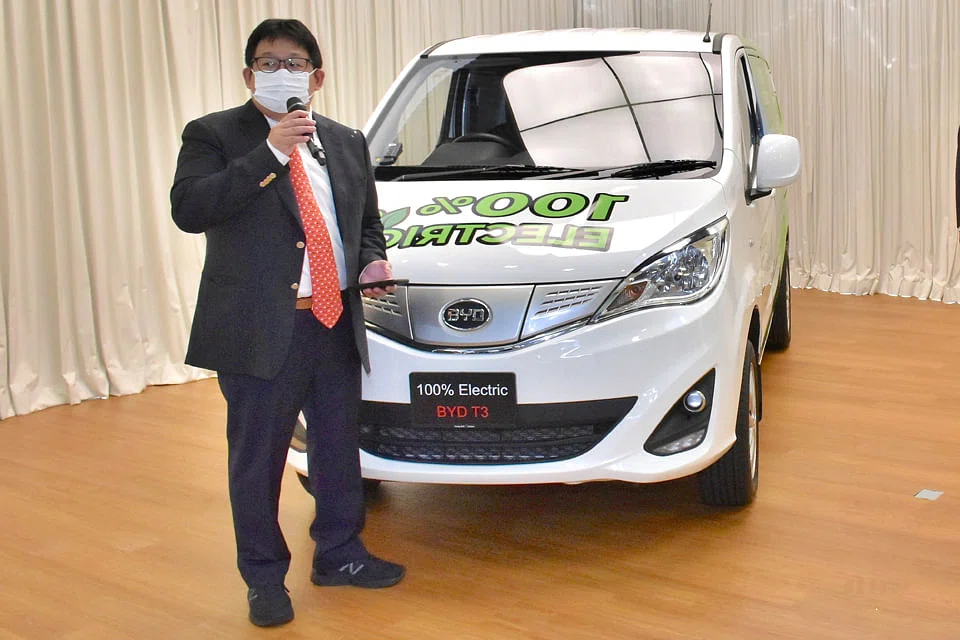
THE father-son team best known for building the Ferrari and Maserati brands in Singapore are turning their focus to a kind of vehicle far removed from the glamorous world of exotic Italian cars: electric vans.
On Wednesday, Hong Seh Evolution (HSEV) opened a new showroom at 237 Alexandra Road to handle retail sales for the BYD T3, a battery-powered panel van with a range of 300km.
Alfred Tan and son, Edward, set up the business to focus on electric vehicles (EVs). A sister company helmed by the duo, Hong Seh Motors, imported Ferrari and Maseratis officially for decades, but when those franchises went to Komoco Holdings in a global dealership reshuffle, the outfit switched to parallel importing other luxury brands, including Tesla.
Hong Seh also has a vehicle leasing arm and distributes luxury yachts, but it's the BYD T3 that has the younger Mr Tan most excited these days.
"The future is getting bright for the electrification of vehicles because it's fantastic. The drive is unlike anything that we have known," he says.
Navigate Asia in
a new global order
Get the insights delivered to your inbox.
He points out that combustion engine technology has essentially stayed the same for decades, but EVs feel more advanced, especially since they deliver smooth, silent acceleration. Then there's the pollution, or lack of it. "The Earth is not going to fix itself," Mr Tan says. "We need to help fix it."
BYD, which has a high-profile backer in Warren Buffett, has been in Singapore for years, but in an unusually fragmented way. Its cars made up the all-electric fleet of HDT, a former taxi operator. Sime Darby-owned Vantage Automotive handles its passenger vehicles here. ST Engineering imports the T3 van, but HSEV is its dealer.
Because the T3 is cheaper to run than a petrol or diesel equivalent, Mr Tan sees a strong case for it in the commercial vehicle world, where operating costs are usually the main deciding factor. His rough calculations suggest that waving goodbye to filling stations alone would lead to tens of thousands in savings.
"For example, in a similar diesel van driven 200 kilometres a day for a year, you would have chalked up something between S$6,000 and S$9,000 of diesel (bills). If you did it with electricity, maybe about S$2,000. So you've got at least S$4,000 of savings," he says.
That adds up to S$40,000 over a vehicle's 10-year Certificate Of Entitlement (COE) lifespan, he adds.
Calculations from other commercial EV sellers show similar savings, more so if the comparison is with a petrol-fuelled vehicle. Cycle & Carriage says its Maxus e-Deliver 3 should save its operator more than S$7,000 a year if the switch is from petrol to electricity.
Another reason Mr Tan is bullish on HSEV's prospects is that a new incentive scheme that takes effect on April 1 should give sales a boost by lowering the cost of buying an electric van like the T3.
The Commercial Vehicle Emissions Scheme will effectively lop S$30,000 off the eventual price of the BYD. The van costs S$67,800 on its own, so budgeting S$38,000 for a COE would take its total price to S$105,800. The CVES rebate (which comes in the form of cash rebates of S$10,000 a year for three years) would lower that to S$75,800.
For comparison, Nissan's NV200 van costs S$25,800 without COE, including a S$10,000 CVES rebate because its petrol engine is relatively clean.
While EVs have yet to take off in a big way in the passenger car world, Mr Tan says the BYD T3 hasn't been a tough sell so far. "Now you have people coming in to ask about the van because of the savings," he says.
The government's stated aim to have 60,000 charging points in the country, including in HDB car parks, is also opening up what was a choke point to EV adoption, he feels. "Within three years, this choke point will become a waterfall," Mr Tan says.
The enthusiasm for electric vans seems at odds with someone whose family in large part made their fortune selling gas-guzzling Ferraris, and who still has a collection of them. These days, both Mr Tans are usually seen in Teslas.
"My balance of lifestyle would be, let me have my electric vehicle Monday to Friday, and Saturday and Sundays I can go live in nostalgia, reliving the days when I was young, driving an old combustion engined vehicle," he says. "One is about remembering history, and then the rest is the future."
Decoding Asia newsletter: your guide to navigating Asia in a new global order. Sign up here to get Decoding Asia newsletter. Delivered to your inbox. Free.
Copyright SPH Media. All rights reserved.
TRENDING NOW

From 1MDB to ‘corporate mafia’: Is Malaysia facing a new governance test?
Middle East-linked energy supply shocks put Asean Power Grid back in focus

Beijing’s calculated silence on the Iran war
DPM Gan warns of 3 structural shifts to the global system that will bring greater challenges – and opportunities

