Mini JCW review: Super Cooper
With the Singapore Grand prix around the corner, we've rounded up three machines with racing in their DNA
Khao Yai
NAMES like Ferrari, McLaren or Mercedes might be titans of Formula One racing, but how about Mini? True, you won't see a Mini on the grid, but one name on certain cars from the brand has had a monumental effect on the sport.
You might have heard of a Mini Cooper, thanks to the original model's reputation for sprightliness and its habit of beating more powerful cars at rallying. But the ultimate iteration of a speedy Mini is one with "John Cooper Works" affixed to its body.
Other cars have high performance labels that play up some connection to motor sport, but with its JCW models, Mini pays homage to a man who altered racing in profound ways.
A British racing driver and engineer who co-founded the Cooper Car Company with his father after World War II, John Cooper was the first to put the engine behind the driver in F1. The standard layout in those days was to have the engine in front.
Enzo Ferrari famously scoffed at the idea, and said the horse should always draw the carriage. But Cooper's layout improved handling balance and increased the rear tyres' traction, helping his team defeat the giants of the sport to win championships in 1959 and 1960.
Since then, no one has won a championship in F1 without sitting in front of the car's engine.
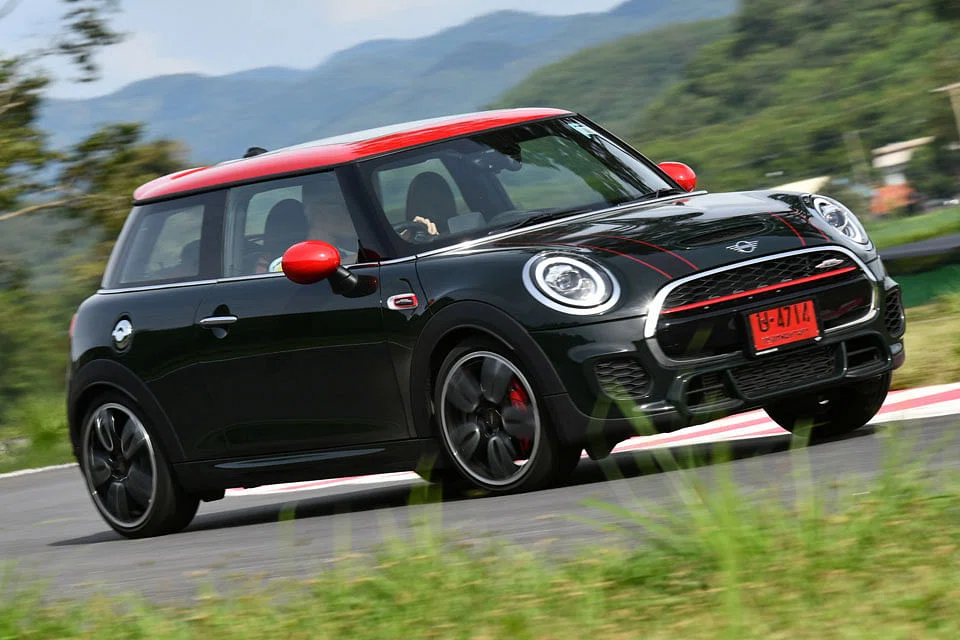
That giant-slaying spirit lives on in the Mini JCW hatchback. The car cuts a striking figure, with add-ons to create a real sense of occasion. It has aggressive aerodynamic body-kitting up front, for instance, with a prominent roof spoiler at the back.
The sports exhaust system has a specific design for the tail pipes, and parts of the body are painted in what Mini calls Chili Red. A similar colour scheme spices up the upholstery.
But while Mini's current model line-up is intended to delight with playful design flourishes, the JCW is more about go than show.
Thanks to a hefty rise in power over a Mini Cooper S (itself no slug), the JCW goes like a firecracker, and when you accelerate hard, you can feel the front tyres just about struggle to cope with the engine's oomph.
Modifications to the 2.0-litre turbo engine, which has always been something of a JCW speciality, bump its output to 231 horsepower, compared to 192hp in a normal Cooper S.
That said, the sprint time to 100km/h is 6.1 seconds, which isn't fast enough to blister tarmac. But what defines a sporty car is not how fast it is, but how fast it makes you want to go. And the JCW hatch is a car for people who live to drive.
The brand's trademark go-kart handling is present and accounted for, and every input to the steering brings about an immediate and faithful response. Curiously, the JCW rolls out of the factory on Pirelli tyres that are crafted more for comfort than performance, so it feels as if it's missing a crispness to the steering.
But it's a joyful car to throw into corners, and it never threatens to snap out of line or swap ends on you, so you can be as rough or enthusiastic as you like.
JCW models also have beefed-up brakes, and the hatchback's suspension has active dampers to calm down the ride for when you simply want a comfy commute to work.
The one thing the Mini is not, is a family car. It will seat four in reasonable comfort, but it's far more pony than workhorse.
Thankfully, other Mini models have been given the JCW treatment, too. The Convertible model is even less practical than the hatch, and its body's flexibility robs it of steering precision, but it is undeniably more fun.
The Clubman, which is something of a Mini wagon, is also available in JCW trim, and it trades some agility for room and poshness.
Even the largest of Minis, the Countryman crossover, works quite well as a JCW model, accelerating gamely and tackling corners much more competently than the normal version.
The JCW badge comes at a premium, of course. In the case of the three-door hatch, the JCW costs S$17,000 more than the Cooper S. Apart from better performance, the extra money does buy something that feels a bit special, so the JCW is well worth considering.
Driving the car at the frenzied pace at which it feels the most enjoyable, one gets the feeling that John Cooper would have approved of it.
MINI JOHN COOPER WORKS HATCHBACK
Engine 1,998cc, 16V, in-line 4, turbo Power 231hp at 5200 to 6200rpm Torque 320Nm at 1450 to 4800rpm Gearbox 8-speed automatic Top speed 246km/h 0-100km/h 6.1 seconds Fuel efficiency 6.3L/100km Price S$178,088 with COE Agent Eurokars Habitat Available Now
Share with us your feedback on BT's products and services