
New Mercedes S-Class: Successful in Singapore, but a challenger is looming
Why have Daimler's shares tripled in a year? Don't look at the new S-Class for answers, even if it is a hit.
 Add BT as a preferred source
Singapore
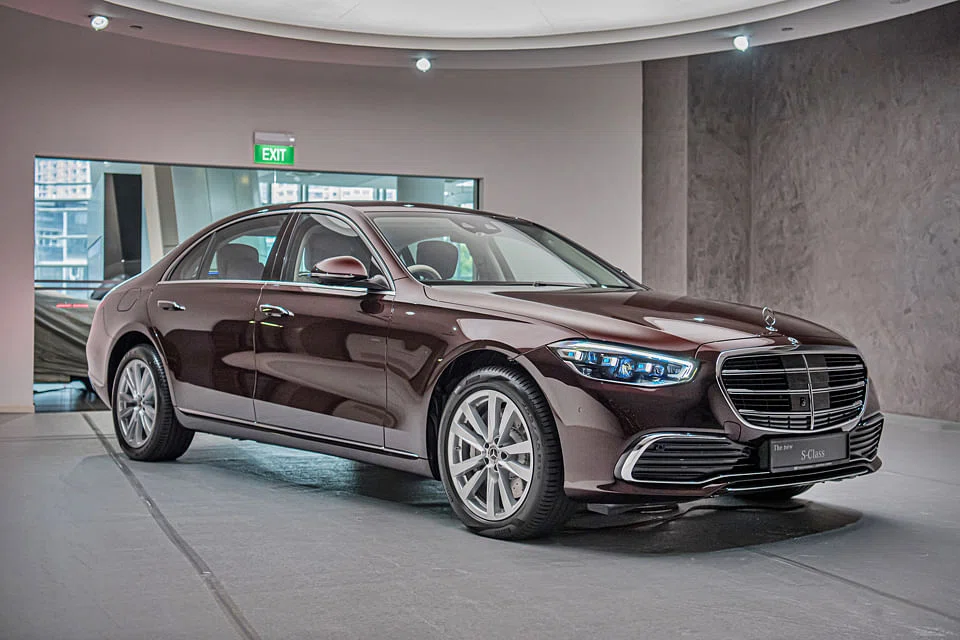
MERCEDES-Benz says its flagship is the world's best selling large luxury saloon, and given the way it's selling, it's hard to argue. An all-new version made its public debut here a week ago with a price tag of S$513,888 including Certificate Of Entitlement for the S 450L 4Matic, and even at that sort of money there has been no shortage of takers. A waiting list began to form even before its launch, precisely because an all-new S-Class is the sort of car people want to be seen in today, yesterday if possible.
That's as much for what it symbolises as its actual performance as a car. Apart from its ability to tell the world that you had half a million dollars sloshing about somewhere, this new S-Class embodies its makers' most strenuous efforts. It is the one model all the engineers at Mercedes try the hardest for, the company's chief executive and chairman, Ola Kallenius, once told this newspaper.
That being so, the new S-Class continues a habit of bringing new features into the motoring world, particularly those designed to keep people alive. Previous models popularised such things as anti-lock brakes, airbags and stability control; this new one has frontal airbags for rear passengers, the better to keep the boss alive in a nasty crash.
Also new are something Mercedes calls "digital lights", which beam light ahead in 2.6 million precisely focused pixels. Its rear wheels steer up to 10 degrees so that in tight situations, the lengthy limo feels no more unwieldy to handle than an A-Class, Mercedes' smallest car.
Special (and optional) chairs offer 10 different massage programmes, and an active suspension system (also optional) adapts itself 1,000 times a second so the car can glide over bumps or even lean into corners like a motorcycle.
Navigate Asia in
a new global order
Get the insights delivered to your inbox.
While the new S-Class sounds like a mechanical engineer's wet dream, it is really a car whose computing power is as impressive as its horsepower. Its user interface has a 12.8-inch OLED touchscreen with slick displays and smooth graphics, courtesy of Nvidia chips that give it 50 per cent more processing power than the previous system, 16GB of RAM and a 320GB solid state drive. It understands spoken commands in 27 languages and has cameras to watch and interpret your movements. Wave your hand a certain way, for example, and the sunroof slides open.
For all that, the new S-Class could already be under threat from a new and even more technologically advanced rival, one that a much-respected carmaker will launch on April 15. That carmaker is Mercedes-Benz or, more precisely, Mercedes-EQ, a sister brand dedicated to electric cars.
When its own flagship, the EQS, makes its global debut next week, the motoring press will probably hail it as a Tesla-fighter. It can reportedly travel up to 765km on a single charge, will have more than 500 horsepower, and its shape will make it the most slippery car through air ever made, which is key to its efficiency.
What car fans could miss is that the EQS is intended to be an arrowhead for Mercedes to morph itself into something of a software company. Its computing power is even greater than that of the S-Class, and Mercedes chairman Mr Kallenius has made little secret of his wish to sell software via over-the-air updates to customers. One day, you could unlock new features in your Mercedes in that manner, the way your smartphone sometimes gets better when you update it.
The harsh truth that Mr Kallenius has probably confronted is that building cars is a lousy business, compared to selling software. Carmakers sell a product to someone infrequently and at terrible gross margins, below 20 per cent. Software is something you can sell frequently to a person, and at gross margins higher than 80 per cent. "We never discuss margins", is what Mr Kallenius said when The Business Times asked him about this, but it's clear which kind of company he would prefer Mercedes to be.
Earlier this year, Mr Kallenius announced a plan to spin off the Mercedes truck division, a sign that he is no longer interested in old economy stuff, and at an annual general meeting last week he said Mercedes would accelerate its electric car rollout. Shareholders have cheered those moves; prices for stock in Mercedes parent Daimler AG have nearly tripled from a year ago.
An industry-wide rebound in sales has doubtless helped, but the sharp rise in share prices suggests that the market is bullish on new cars like the Mercedes-EQ EQS. The S-Class is still a money-spinner for Mercedes, but as the company begins to reinvent itself, the less important its traditional flagship is going to be.
Decoding Asia newsletter: your guide to navigating Asia in a new global order. Sign up here to get Decoding Asia newsletter. Delivered to your inbox. Free.
Share with us your feedback on BT's products and services

