

Bank J. Safra Sarasin’s 185 years of private banking heritage: A legacy of forward-thinking stewardship
By integrating advanced financial technology with traditional bespoke advisory services, Bank J. Safra Sarasin demonstrates that preserving a legacy and building a future-ready business go hand in hand

The J. Safra Group (the “Group”) approaches its landmark 185th anniversary uniquely positioned to meet the demands of a changing financial landscape. Through Bank J. Safra Sarasin, the Group seamlessly blends historical heritage with strategic transformation.
The recent acquisition of Saxo Bank equips Bank J. Safra Sarasin with a cutting-edge digital platform and serves as a catalyst for a profound evolution in its mindset. By integrating advanced financial technology with traditional, bespoke advisory services, Bank J. Safra Sarasin demonstrates that preserving a legacy and building a future-ready business go hand in hand.
This dynamic approach comes at a defining moment, particularly in Asia. ^McKinsey estimates that US$5.8 trillion in family wealth across the region will be transferred between generations by 2030, marking one of the largest intergenerational wealth transfers in its history.
Ultra-high-net-worth and high-net-worth families face a distinct challenge today: partnering with an institution that combines established, long-term stability with forward-looking innovation.
A foundation of stability: 185 years of global resilience
Innovation begins with trust. For nearly two centuries, the J. Safra Sarasin Group has built a reputation for financial strength and disciplined stewardship. It was ranked as the Best Performing Bank in Switzerland in The Banker’s Top 1000 World Banks 2025 and 2026, and operates in more than 35 locations across Europe, Asia, the Middle East and Latin America.
J. Safra Sarasin Group maintains a highly conservative and strong balance sheet. Standard & Poor’s rates the Bank as “A” for long-term and “A-1” for short-term counterparty credit.
Through this capital strength, J. Safra Sarasin underscores its commitment to preserving client wealth through prudent risk management. For wealthy families, this translates into confidence that their assets are safeguarded by a financial institution built to withstand global market volatility.
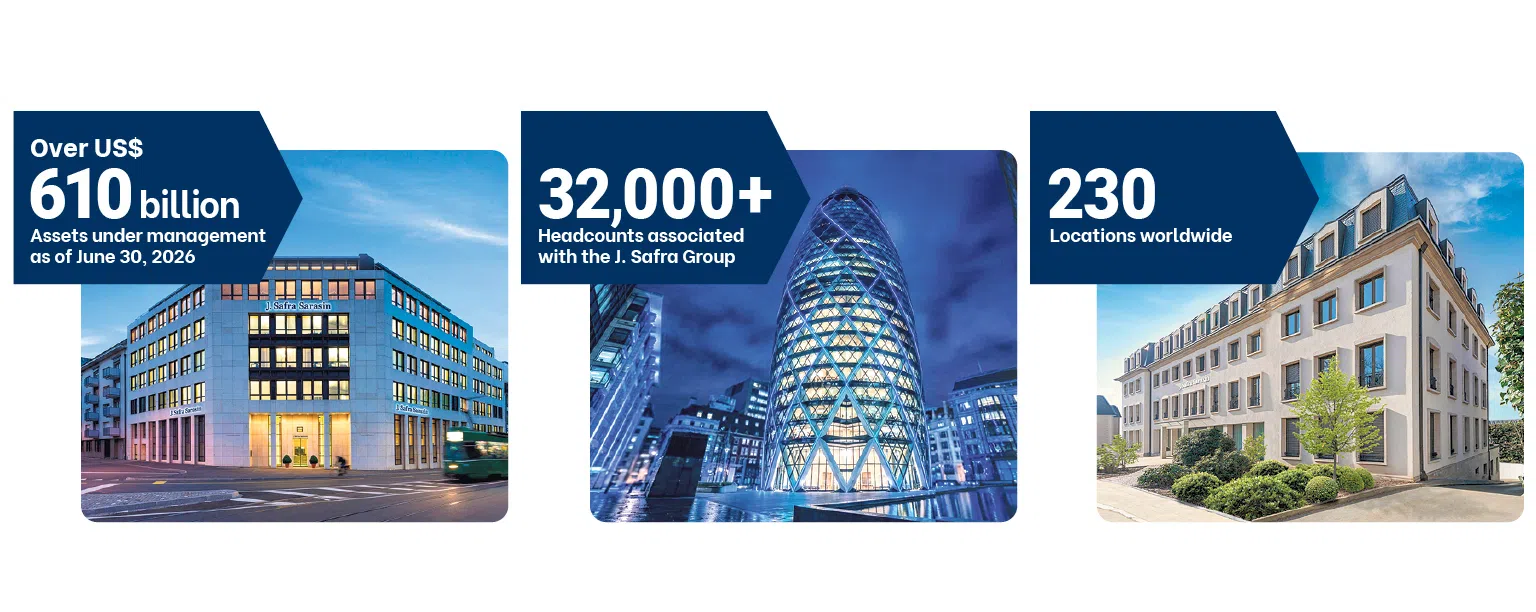
This generational perspective is backed by the colossal scale of the broader J. Safra Group, whose banking interests span 33 countries and more than 230 locations globally through its three sub-groups: J. Safra Sarasin (including Saxo Bank), headquartered in Basel, Switzerland; Banco Safra, headquartered in São Paulo, Brazil; Safra National Bank of New York, headquartered in New York City, USA. These sub-groups are all independent from one another from a consolidated supervision standpoint.
Following the completion of the Saxo bank acquisition in March 2026, the Group’s combined assets under management exceeded US$610 billion as of June 2026.
Strategic evolution: Empowering Asia’s next-gen legacy
In Asia’s fast-paced markets, stability must be complemented by constant evolution. Bank J. Safra Sarasin recognises that the next generation of wealth expects seamless digital execution alongside bespoke advisory services.
The acquisition of Saxo Bank marks a pivotal step in this strategy. It reflects the Group’s highly strategic approach to acquiring outstanding innovative financial services businesses that enhance its core private banking and wealth management offering through advanced digital capabilities.
Beyond adding this, the integration of Saxo Bank’s technology is driving greater agility and operational efficiency across Bank J. Safra Sarasin. The result is a highly differentiated market proposition: the unique combination of nearly two centuries of Swiss private banking discipline with the speed, scalability and open architecture of a modern fintech platform.
Through this transformation, Bank J. Safra Sarasin is advancing its ambition to become one of the world’s most digitalised private banks, ensuring its core purpose – supporting the seamless transfer of wealth across generations – remains firmly intact.
Sustainable Swiss private banking since 1841
For Bank J. Safra Sarasin, long-term wealth preservation is inseparable from sustainability. This conviction is embedded across the Bank’s investment processes, reflecting a disciplined approach to building portfolios that are resilient not only to market cycles, but also to the structural environmental and economic shifts shaping the global landscape.
“Sustainability is a cornerstone of our convictions and a key driver of long-term value creation,” says Elie Sassoon, CEO of Bank J. Safra Sarasin.
“We believe that responsible investing is integral to preserving and growing wealth across generations. This requires us to look forward with a truly progressive mindset; our strategic digital evolution with advanced tools and data is what equips us to identify sustainable opportunities with precision.”
Mr Sassoon also added: “By working closely with our clients and leveraging these cutting-edge capabilities, we help direct capital towards opportunities that support a more resilient, low-carbon economy, while maintaining a strong focus on risk-adjusted returns.”
“In doing so, we aim to deliver sustainable value today while contributing to a more stable and sustainable future.”
Deepening the commitment to Asia
This strategic combination of stability and innovation is particularly relevant in Asia, where wealth creation continues at an unprecedented pace. Bank J. Safra Sarasin anchors its presence in the region’s premier financial hubs of Hong Kong and Singapore, delivering localised private banking services backed by global expertise.
Industry data underscores the region’s importance. *BCG’s Global Wealth Report 2026 projects that emerging markets are expected to add nearly USD 7 trillion in financial wealth by 2030, reinforcing Asia’s position as the key engine of global wealth growth.
To capture this opportunity, Bank J. Safra Sarasin continues to invest in both infrastructure and talent. “Prudence, efficiency and process optimisation remain management priorities, with ongoing transformational investments to future-proof infrastructure,” says Andy Chai, Asia CEO at Bank J. Safra Sarasin.
Mr Chai also highlighted the importance of human expertise alongside technology: “Recruiting elite talent in this competitive industry is key, and we have excelled thus far and will continue to advance with conviction and confidence.”
The Group’s global standards are consistently applied at the local level. “By emphasising discretion, long-term value creation, client-centric service, our Asia platform, anchored in both Hong Kong and Singapore, reinforces the Bank’s positioning as a trusted partner for Asian families and family offices,” says Jeffrey Benjamin, CEO, Singapore.
Together, these unified regional efforts reflect a consistent approach: combining global institutional strength with local expertise to support the increasingly sophisticated needs of Asia’s wealth ecosystem. With 185 years of heritage, the J. Safra Sarasin Group continues to evolve without losing sight of its foundations.
Backed by an unmatched capital position, a transformative digital ecosystem powered by the Saxo Bank acquisition, and a deeply committed management team in Asia, the Bank is well positioned to serve Asia’s wealth today and for generations to come – where legacy meets tomorrow.
*https://www.bcg.com/press/27may2026-hong-kong-surpasses-switzerland-largest-cross-border-wealth-hub

Share with us your feedback on BT's products and services
TRENDING NOW

Companies still in search of AI use cases with worthwhile ROI, says Broadcom’s CEO

Malaysian king buys stake in Singapore-listed mining firm expanding into rare earths

Once staunchly pro-China, Malaysian Chinese businesses are now distancing themselves from Beijing

Singapore’s wealth management success should extend to everyday families

