

2019 M&As may still top 2018's, with property dominating deals
Lawyers cite slowing China growth, Beijing clampdown for softer market, although outbound M&A from Singapore expected to be active

Singapore
CAPITALAND'S acquisition of Ascendas-Singbridge for S$11 billion may have opened the year with much optimism for billion dollar tie-ups, but the truth of it is that deals of this size are likely to be few and far between.
That said, real estate will remain an active area for merger and acquisition (M&A) activity this year.
PwC's South-east Asia corporate finance partner Girish Sahajwalla said the CapitaLand/Ascendas-Singbridge deal could push the total deal value past last year's figure, with the real-estate sector accounting for most of the pie.
He added, however, that most M&A deals involving Singapore-listed companies are most likely to be mid-sized ones in the region of US$100 to US$500 million, and that property deal activity is likely to remain strong because of the need for consolidation.
The sector's relevance in the M&A space is also not lost on Srividya Gopalakrishnan, the managing director of consultancy Duff & Phelps Singapore, and Stefanie Yuen Thio, the joint managing partner of TSMP Law Corporation.
Ms Yuen Thio commented: "Real estate will continue to be a feature because that's the Singapore investor's usual obsession."
The current global climate is characterised by uncertainty with market volatility, the US-China trade situation and Brexit. And amid the backdrop of a global growth slowdown and a rising interest rate environment, will the market for tie-ups in Singapore blossom or wither?
Bearing in mind that the global economic and political climate has carried over from last year, looking back at last year's activity involving Singapore companies would not be a bad place to start.
Based on Mergermarket data on last year's M&A deals, Singapore had 132 inbound and domestic M&A transactions, the highest number in South-east Asia. With the deals worth a total of US$15.4 billion, this worked out to an average deal size of US$116.7 million - within Mr Sahajwalla's range where most deals involving Singapore-listed entities would fall this year.
The total deal value of S$15.4 billion paled in comparison, however, to 2017's US$37.6 billion, a record year for Singapore.
Noting that large-format M&A deal activity - that is, those involving large listed companies - had slowed down last year, Ms Yuen Thio said that on top of geopolitical conditions, the dip can be attributed to a good number of privatisations having already taken place in years prior.
Robson Lee, a partner at legal firm Gibson Dunn shared her sentiment, saying: "There are only so many big companies to buy. I believe a large part of the reason is the squeeze on capital coming out of China in 2018."
On the drop in interest from the Chinese mainland, Ms Yuen Thio said: "They had their investment wings clipped by the floundering Chinese economy and the Chinese government's measures to clamp down on offshore acquisitions."
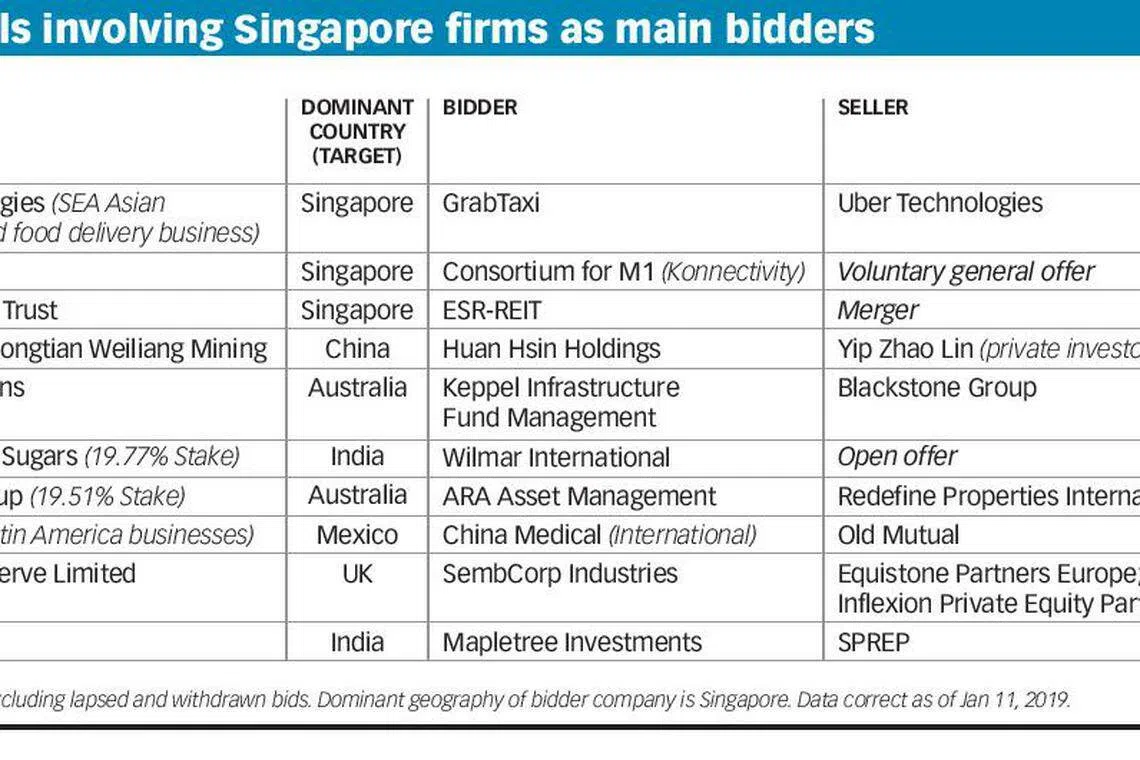
The fall in acquisition plays by Chinese firms aside, Mergermarket data showed Singapore companies made 51 deals worth a total of US$5.9 billion, accounting for just over a third of inbound/domestic deals.
Among deals worth S$100 million and above where Singapore firms were the main acquirers, real estate continued to be among the strongest. Interestingly, though, industrials and energy, mining and utilities deals ranked as among the most frequent.
Mr Sahajwalla said industrials could see further consolidation this year: "The sector possesses many family-owned entities, whose incoming generations might not be keen to continue the business. It is very much so in Singapore and in Malaysia."
The biggest deals do not always involve the property sector. In 2018, the talk of the town was ride-hailer Grab's deal to buy over competitor Uber's South-east Asian business, with Mr Lee and Gibson Dunn acting for Uber.
But the move was viewed by many as more of a strategic play than one borne of necessity to consolidate.
Ms Gopalakrishnan of Duff & Phelps Singapore predicted that the technology sector will continue to clock several deals this year. She said: "We see significant growth in investment in the technology sector. Such deals are likely to further intertwine with sectors such as data centres, financial services, transportation, healthcare and others."
Mr Sahajwalla pointed out, however, that the size of tech-related deals are likely to be small, and to involve larger players from other fields acquiring smaller tech outfits.
For 2019, he does not expect oil and gas M&A deals to be making much noise as the sector has not fully recovered.
Entities based or listed in Singapore are also looking overseas for mergers. Mergermarket data shows that the outbound market grew in 2018 to US$41.5 billion across 152 deals, overshadowing inbound/domestic activity. Seven of the top 10 deals involving Singapore companies as main bidders in 2018 had targets that were based overseas.
Mr Lee did not find this surprising, given the city-state's political stability and conducive tax regime have attracted funds and fund management companies to set up shop here.
"Developing Asian economies such as Myanmar, Thailand, Vietnam and Cambodia are burgeoning and experiencing rising growth with potential good investment returns."
Singapore's ability to attract funds and fund managers, as well as the region's flourishing economies are the "two cardinal factors" contributing to there having been more outbound M&A activities from Singapore last year(2018), he said.
"I envisage the growth trend to continue in 2019, barring any major fallout arising from adverse geo-political contagion as a result of an unexpected all-out trade war between the US and China."
Seeing that global factors have carried into the current year, it could be a year of challenges. But Ms Gopalakrishnan said: "Based on what we see in the market today, we can say that the transaction landscape is going to be extremely active for M&A deals."
Mr Lee also believes 2019 to be a year with good potential for the M&A scene both locally and in the continent. This may be influenced by the need for firms facing digital disruption, like the growth of artificial intelligence technologies, to tie up and be better equipped to face a "whole new world".
Ms Yuen Thio noted companies have also been making "more thoughtful acquisitions, driven by business needs and commercial expansion". "While this is not the sexy M&A market that investment banks like, it does mean that businessmen are actively looking for ways to broaden their business."






