3 in 5 Singapore listed firms post poorer results in latest quarter
Earnings could deteriorate further when full impact of trade war filters through in next few quarters, analysts say
Singapore
MORE misses than hits - that's the score for the fiscal earnings of Singapore-listed firms in their latest quarterly results.
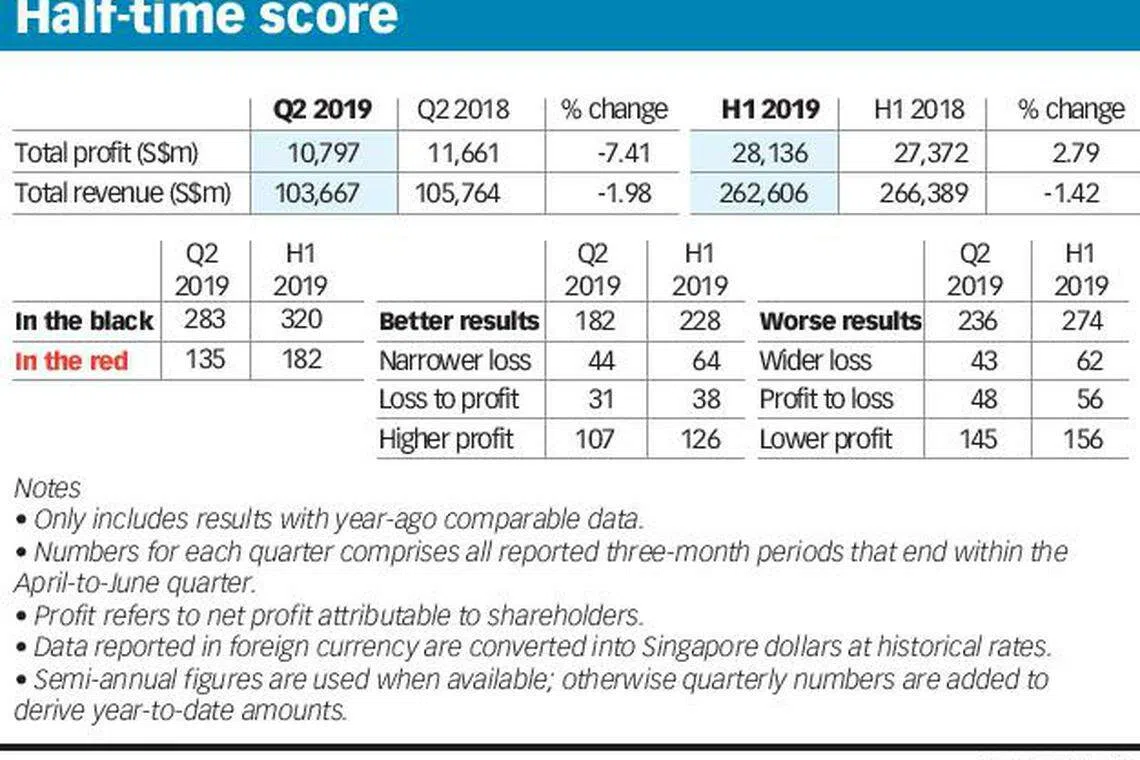
Of the 418 companies which had released their results as at Aug 19, 2019, about 60 per cent did worse than the corresponding quarter last year, prompting brokerages to cut their earnings forecasts and to expect further reductions in FY2020 should the US-China trade war drag on.
A tally by The Business Times showed that of the 418 companies whose latest quarter ended within the April-to-June period, one in three chalked up losses. Together, they reported a combined net profit of S$10.8 billion, 7.4 per cent lower than the year-ago quarter.
This was primarily dragged down by the earnings slide in the communication services, consumer staples, and materials sectors - segmented according to the Global Industry Classification Standard.
In all, there were 283 companies in the black, and 135 in the red. About three in five of the companies reported worse results - defined by either wider losses, lower profits, or reversals from profit to loss.
Total revenue slipped about 2 per cent to S$103.7 billion from the year-ago quarter.
DBS equity market strategist Yeo Kee Yan and regional head of research Janice Chua noted in their Tuesday report: "Four companies disappointed for every one that surprised on the upside."
For the universe of companies they cover, earnings fell 2.2 per cent quarter on quarter to reverse the slight 0.5 per cent uptick seen in the first quarter.
The biggest disappointments? Sembcorp Marine, with its weak order book; Wilmar International, Indofood Agri Resources, First Resources and Bumitama Agri, dragged down by a weak crude palm oil price outlook; consumer services companies such as BreadTalk, which was hit by start-up losses, Dairy Farm, affected by rising costs and lower margins, and Jumbo Group, weighed down by renovation disruption.
Telco Singtel's profit also slumped, hurt by lower profit contribution from associates and erosion of its voice revenue.
Property stocks, due to the lumpy nature of income streams, depending on the number of projects sold and completed as well as the schedule for earnings recognition, saw mixed results.
Conglomerate Keppel Corporation posted weaker than expected property earnings, while APAC Realty's first-half net profit missed estimates due to slower private resale volumes and higher marketing expenses.
Shekhar Jaiswal, head of Singapore equity research at RHB Securities Singapore, said: "Still, transactions are showing signs of a pick-up in Q2, with new launches and resale activity improving quarter on quarter. The take-up rates for several recent launches were encouraging, and should result in a better second half of the year for APAC Realty."
Property firms that did well benefited from either the timing of revenue recognition or revaluation gains.
UOL, for example, recognised S$182 million of fair value gains on its investment properties in Q2 2019.
The obvious outperformers in Q2 were banks. They saw profits improve on stronger net interest margins, loan growth, and higher wealth management fees.
KGI Securities noted that wealth management fees grew 8 to 21 per cent year on year for the three banks in Q2 FY19, on the back of an 8 to 9 per cent growth in their assets under management.
Within the financial sector, the Singapore Exchange also did well, boosted by a strong derivatives segment with market volatility driving its China A50 index and USD/CNH forex derivatives, KGI Securities' head of research Joel Ng said.
CGS-CIMB's list of companies that missed expectations included blue chips such as ST Engineering due to its underperforming electronics segment; Singapore Press Holdings for the weaker profitability in its media segment and lower investment income; SATS due to higher depreciation after adopting the SFRS 16 accounting standard, and Singapore Airlines due to higher share of losses from associates and finance costs.
Carmen Lee, head of OCBC Investment Research, said although the macroeconomic environment has slowed significantly, the impact on corporate earnings is still not obvious in the Q2 results, but may flow through to demand and revenue in the next few quarters.
The pain will not be equally distributed, though. "For the domestically focused companies, we expect the impact to be more muted. However, for companies which are largely dependent on exports or global trades, tourism, demand, et cetera, the impact could start to become more obvious in the next two to four quarters.
"Lower interest rates will also put pressure on banks' interest margins, but this should be positive for the property sector as well as for companies with high gearing, because it means less interest costs. Defensive sectors are likely to be less impacted."
Mr Jaiswal also expects global economic growth to decelerate in the second half as global manufacturing continues to decline, trade volumes moderate and investments weaken further.
This is expected to bring about further deceleration in Singapore's economic growth in Q3, with a likelihood that the economy could head into a technical recession if things don't improve in Q4.
"In terms of investment outlook, risk-off trade remains our key equity strategy for Singapore. We recommend investors to focus on high dividend yield with sustainable earnings. We maintain that falling risk free rate makes yield spread an interesting investment option. Reits, consumer and banks are our preferred sectors for H2 2019."