Adopting climate-related financial disclosures could help listcos and investors: market watchers
Task Force on Climate-related Financial Disclosures recommendations are not merely a disclosure framework, but also a strategy and management framework
Singapore
INCORPORATING the recommendations of the Task Force on Climate-related Financial Disclosures (TCFD) under listing rules could help listed companies make better disclosures, said market observers.
Investors, meanwhile, would benefit from standardised climate-related disclosures as they hunt for companies with sustainable business practices.
There is growing interest in environmental, social and governance (ESG) topics across global capital markets, particularly with reference to climate reporting.
Cherine Fok, director of sustainability services and KPMG Impact at KPMG in Singapore, said the market landscape has changed since the Singapore Exchange (SGX) first rolled out its sustainability reporting requirement in 2016.
"There's been a change in the kind of issues, the profile of the issues that are gaining in prominence," she said, noting that these include the urgency on climate change.
The TCFD was established in 2015 by the Financial Stability Board, an international body that monitors and makes recommendations about the global financial system.
Its goal was to develop consistent climate-related financial risk disclosures for use by companies, banks and investors.
In recent months, SGX executives have said the bourse would consult the market on whether it should incorporate the TCFD recommendations into its rules.
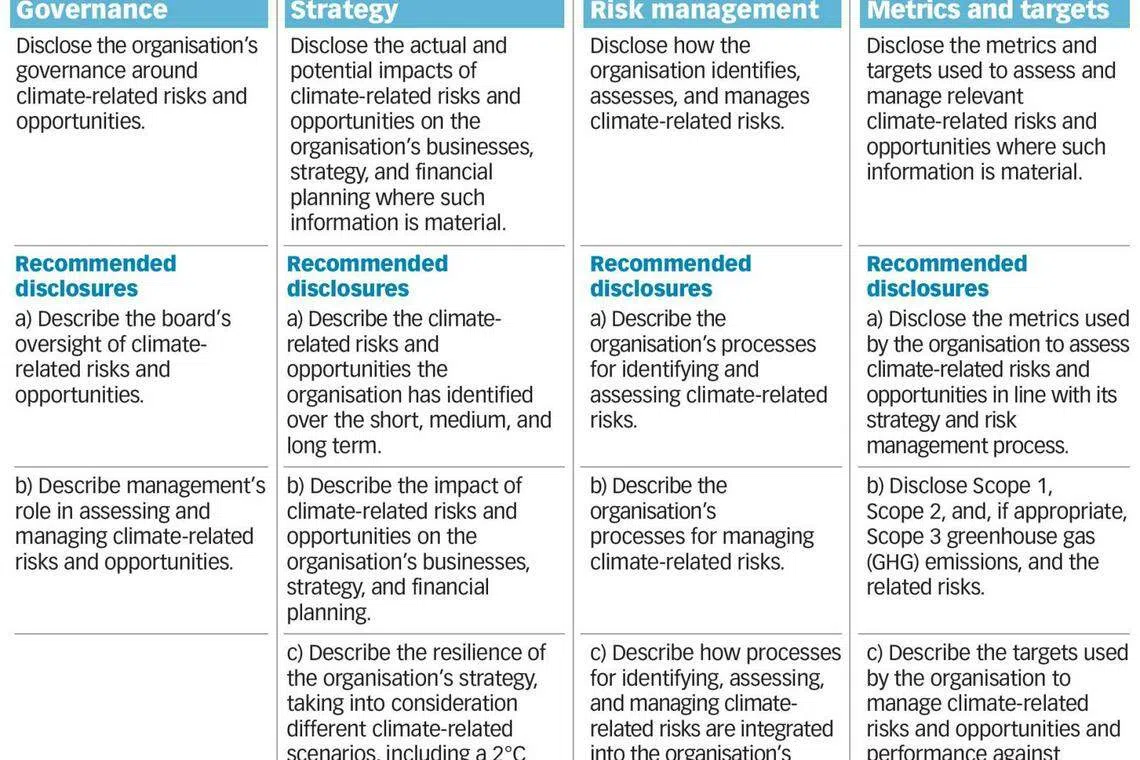
The task force's recommendations, released in mid-2017, were structured around four themes - governance, strategy, risk management, and metrics and targets - with recommended disclosures under each of these segments.
Mary Leung, head of advocacy for Asia-Pacific at the CFA Institute, noted that with the growing concerns over the risks coming from climate change, regulators want to ensure that there are no systemic risks.
Investors also want to know that their portfolio companies are conscious of such risks.
Many investors and regulators, Ms Leung said, are therefore coalescing around TCFD recommendations.
TCFD's recommendations incorporate a different way of looking at sustainability, said KPMG's Ms Fok. It is not merely a disclosure framework, but is also a strategy and management framework.
"Traditional sustainability frameworks talk a lot about (an) inside- out view, you talk about how your company affects the society and environment," she said. Conversely, the TCFD requirements are very focused on business environment changes and impact.
This framework is in line with a shift in focus among stakeholders, Ms Fok added, from merely requiring companies to issue a sustainability report, to assessing how meaningful such reporting is and the quality of ESG disclosures.
"Governance is extremely important and therefore there is a need to push a lot of these ESG factors, making sure that it is integrated within the (risk) architecture of the company," she said.
She added it was important for companies to understand that climate risk goes beyond physical risk such as rising sea levels. They would also need to consider transition risks as the global economy shifts towards a low carbon-emitting future, and identify business risks or opportunities that would emerge, and the TCFD can help with this.
Reporting according to TCFD recommendations would likely see listed issuers to more definitely acknowledge climate risk as a material issue, and companies would need to explain more on how climate risks fit in their traditional risk buckets.
Adoption of the TCFD recommendations is gaining traction.
The UK has launched a consultation last month looking at introducing disclosure rules aligned with the TCFD recommendations for a wider range of listed issuers. And New Zealand has announced a mandatory climate-related disclosure regime that is based on TCFD.
In Singapore, some listed companies - including Singtel, DBS and City Developments - take into consideration recommendations of the TCFD in their sustainability reports, but these may be the minority.
The 2021 Sustainability Reporting Review by SGX Regulation and the Centre for Governance and Sustainability at the National University of Singapore Business School noted that very few listed issuers are adopting reporting frameworks specifically adapted to climate change disclosures. Only 2 per cent of listed issuers are using frameworks by the TCFD, Carbon Disclosure Project (CDP) or Science Based Targets initiative (SBTi).
But the report noted that almost all issuers use the Global Reporting Initiative (GRI), and many use the United Nations Sustainable Development Goals, which incorporate climate change in their frameworks.
The GRI is currently a popular framework; and companies that are reporting under GRI can still make TCFD disclosures, said Ms Leung of the CFA Institute. "There have been efforts to align some of these frameworks, so that the users and the preparers can maximise their utility and benefits."
Ms Leung noted that there is a wide variation in how companies make their TCFD disclosures at the moment. Some reports span several pages, but other very detailed reports can be as long as 50 pages.
More data is not necessarily better for investors. Standardisation of data based on agreed-upon frameworks could make the data more useful.
Eric Nietsch, head of ESG for Asia at Manulife Investment Management, said institutional investors are increasingly looking to support companies that are effectively managing their environmental exposures and that can provide data that verifies their efforts.
He noted that SGX has been assisting listed companies with reporting since sustainability reporting was first introduced.
"The incorporation of the TCFD recommendations would enhance this by helping to standardise climate-related disclosures in Singapore," he said, adding that corporate TCFD reporting is helpful as climate action is prioritised, and the data can be used in the sustainable investing process.
Ms Leung also said driving awareness to one of the better-known international frameworks would be helpful as there have been complaints on the fragmentation of standards, which can cause confusion for the users and preparers of such reports.
She said: "Referring to a global standard, and one that is reasonably well-known and getting a lot of traction, is actually not a bad thing."