

AEM expects AI supercycle to lift its fortunes
The group aims to tap the ability of local engineers to quickly customise and adapt solutions to customers’ needs

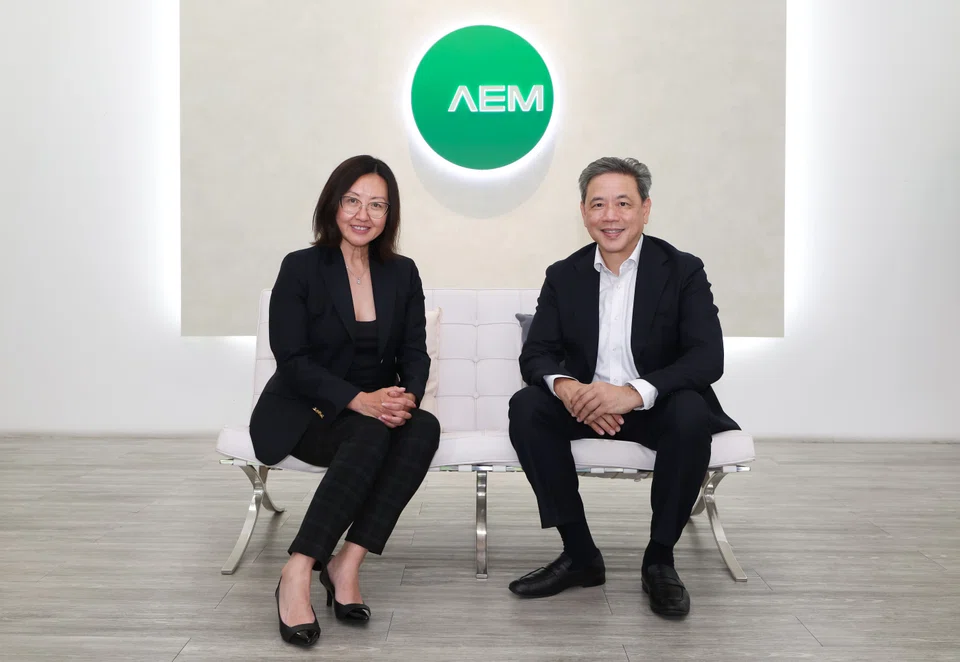
AS SHE entered AEM Holdings’ seven-storey office in Serangoon North for the first time, chief executive Amy Leong said she was impressed that it felt like that of a global company, rather than just a local outfit.
“We have so many engineering centres, not only in Singapore but also in the US and Europe. Being a global company really creates differentiation for us, and we’re very unique in this space,” she said.
Leong took over on Jul 1 this year from chief executive Chandran Nair, who left the company to “pursue other interests”. She has more than 20 years of experience in the semiconductor test equipment space.
The leadership change comes at a delicate time for the company as it seeks to leverage an artificial intelligence (AI) tech upgrade cycle coming out of a deep semiconductor downturn.
In 2023, the semiconductor testing solutions provider posted its first annual loss since 2014. It posted a loss of S$1.2 million as revenue declined 45 per cent to S$481.3 million for the year ended Dec 31, 2023.
The company also recognised a shortfall in inventory in the fourth quarter of FY2023 as part of its year-end stock-taking exercise, which led to an adjustment of S$18 million to S$25 million to inventory value and profit before tax.
It attributed this to human error as it migrated production to its Penang facility from Singapore.
These issues have dented investor confidence in AEM as its share price has more than halved year-to-date as at Aug 2.
Still, Leong believes that the company – among the leading semiconductor players in Singapore – still occupies a critical position in the global semiconductor supply chain and will benefit as the industry emerges from a cyclical slump.
In particular, she believes that the ability of local engineers to quickly customise and adapt solutions to customers’ needs is something that AEM can leverage as it tries to broaden its client base beyond its major customer, Intel.
In the area of system level testing, she said that solutions need to be customised because chips could be used for Internet-of-Things applications or compute-heavy computing devices.
Chip testing
Semiconductor chips typically see four stages of testing: wafer sort, burn-in, functional tests and system level tests.
While functional tests tend to be done within seconds, system level tests take minutes to complete.
AEM chairman Loke Wai San, who is the managing partner of private equity firm Novo Tellus Capital Partners, said that chips are being packaged in more complicated ways for applications such as AI, with different amounts of memory, central processing or graphics processing power being added to each package.
As a result, he has observed that all chips now go through system level testing, whereas this was previously reserved for only a selected sample of chips. This has led to a bottleneck at the system level testing phase.
Offering more efficient testing solutions
To solve this, he said that the company’s Test 2.0 strategy is meant to create solutions that integrate more tests in parallel, to make the testing process more efficient.
Leong added that the company has done a lot of research and development into ensuring that its tests can be done under tightly-controlled conditions.
For instance, the company has developed its solutions to be able to test chips at anywhere from minus 40 deg C to 150 deg C, and to ensure consistency in the desired temperature.
“If you don’t test (chips) in the right test environment, you can potentially throw a good die away or mix a bad die into the good bin,” she said.
Binning is the process of sorting different silicon chip qualities to be sold at different performance levels.
Loke added that the company’s chief technology officer, Samer Kabbani, is based in the US, where he can engage with semiconductor companies on the technical side.
“You should not try to sell into something that’s been already delivered because you’ve got no chance of success. You try to intercept something two or three years from now,” he said.
Leveraging acquisitions to offer better solutions
Loke noted that the company made acquisitions four to five years ago to prepare itself for moving beyond simply producing system level test machines to creating solutions as well.
For instance, AEM announced in July 2020 that it would acquire DB Design, a supplier of automation fixtures, device kits and other test-related products.
At the time, Loke said that the acquisition would allow the company to provide almost 24-hour research and development services to its customers in both the US and Asia.
As the group integrates these acquisitions, it has also begun to reap the benefits of these investments.
The company announced that it received a high volume manufacturing order win for its automated burn-in test solution by a major fabless provider of high-performance compute and artificial intelligence chips.
In fact, Loke sees multiple tech upgrade cycles coinciding in the near term, which could lead to a supercycle that will trigger a large boom in chip demand.
He noted that data centres, mobile phones and computers are being “massively retooled” to update them for AI use cases.
“If you are a trader…(and) you require the best AI solution to be competitive as part of your business, you will upgrade all your laptops so that all your people will have the best (equipment),” he said.
TRENDING NOW

Grab CEO’s wife Chloe Tong on life with Anthony Tan and finding her purpose

Once staunchly pro-China, Malaysian Chinese businesses are now distancing themselves from Beijing

Crystal Jade Fine Dining faces charge for failing to file income tax return on time

UOB found ‘grossly negligent’ over Stamford Land rights issue advice, to pay S$1.9 million

