AEM's bid for CEI cements its M&A strategy to extend industry leadership
Claudia Tan HS
IN WHAT could end up being its largest acquisition to date, AEM Holdings' S$99.7 million buy-out bid for contract manufacturer CEI comes at an opportune time for the fast-growing company to extend its leadership in the industry.
Under the deal, AEM is offering S$1.15 for each share in CEI. While there is an option for an all-cash buyout, CEI shareholders can also choose a mix of 85 per cent cash and 15 per cent new AEM shares, or 70 per cent cash and 30 per cent new AEM shares, at an issue price of S$3.55 for each new share in AEM.
This would come up to either S$0.9775 in cash and 0.0486 of a new AEM share, or S$0.8050 in cash and 0.0972 of a new AEM share.
CEI investors will hold a maximum of 2.49 per cent of the enlarged total number of issued shares in the capital of the company, according to the offer document.
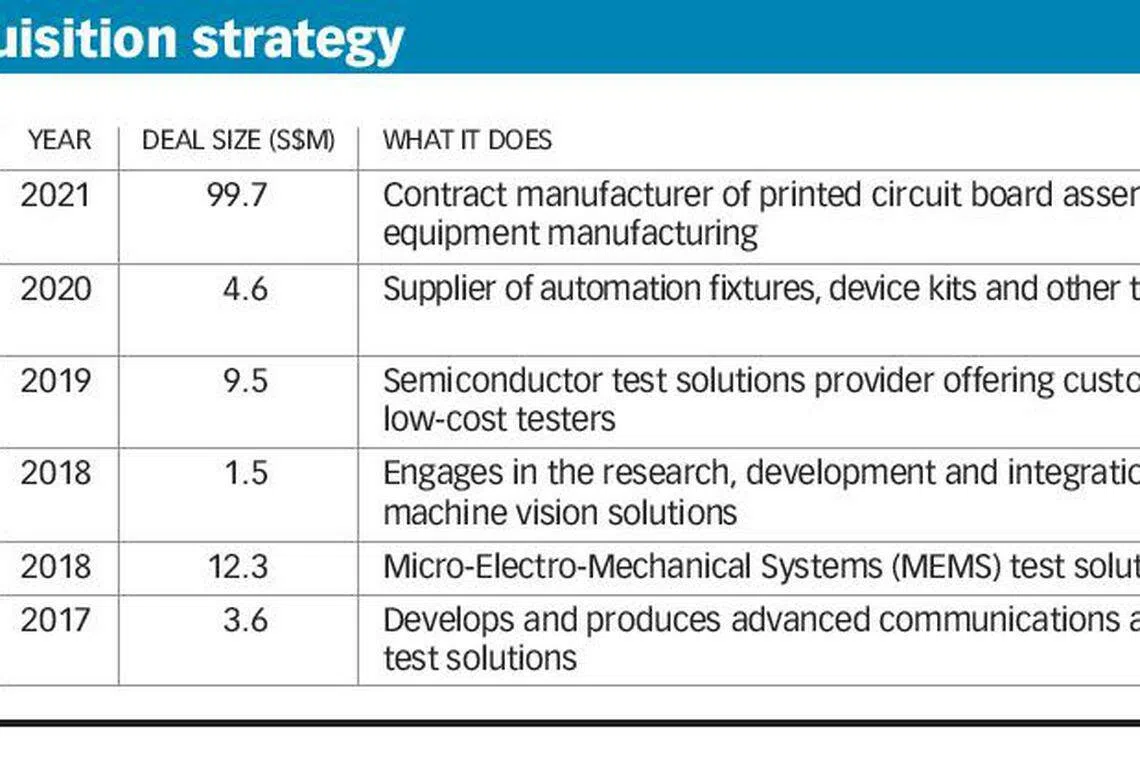
AEM's previous five acquisitions were significantly smaller, ranging between S$1.5 million and S$12.3 million.
With AEM's steady cash flow generation and strong balance sheet strength, however, a deal of this size did not come as a surprise.
Indeed, it was strategic of the board to jump at the chance to finance the acquisition with shares of AEM that are trading close to an all-time high.
The offer for CEI shareholders to stay invested in AEM appears attractive, particularly since some analysts are expecting AEM's shares to rise above S$5.
Shares of AEM soared 70.8 per cent last year, in part due to the pandemic-led demand for tech. The stock closed on Jan 13 at S$3.89 - 20 times its earnings per share (EPS) for FY2019.
Its non-executive chairman Loke Wai San, who runs technology buyout fund Novo Tellus Capital Partners, has made no secret of his strategy of acquiring smaller firms with the technology or processes that will boost the group's capabilities and diversify revenue growth. (see amendment note)
AEM has, in fact, got to where it is today on the strength of some astute acquisitions.
At the time Mr Loke acquired control of AEM, in 2011, the company was flying under the radar of many investors despite its strong ties with one of the largest players in the industry - with most reports pointing to Intel.
Mr Loke had previously told The Business Times in an interview that mergers and acquisitions (M&As) are a way to bring in new technologies and integrate them with the rest of its business.
AEM's track record proves this. For instance, it had in 2018 expanded into micro-electro mechanical system (MEMS) test solutions with the acquisition of Finnish firm Afore. In 2017, it expanded into network infrastructure testing and measurement by acquiring InspiRain Technologies.
CEI has some of the traits that Mr Loke has shown a preference for in the past.
It is a relatively small company, with a market cap of S$87.9 million before the announcement of AEM's offer was made.
The counter saw limited trading interest among investors, but it was a healthy company with a wide range of customers.
Its electronic components go into analytical instruments, medical equipment, semiconductor equipment and displays for industrial machinery; and are used in the oil and gas, and aviation industries.
Although it has not always been able to grow its earnings - reporting a decline in net profit of some 33 per cent between 2015 and 2019 - the group has maintained a healthy cash position thanks to its ability to generate positive operating cash flow.
In the first half of 2020, CEI's revenue fell 12.2 per cent to S$61.1 million. And its net profit fell 20.4 per cent to S$2.9 million. It nevertheless managed to generate net cash flows from operating activities of S$5.8 million.
After accounting for investing and financing activities - including the payment of S$3.8 million in dividends, unchanged from the same period of FY2019 - CEI's cash and cash equivalents decreased by a marginal S$724,000.
As at end-June 2020, it had net cash of S$3.5 million, up from S$1.3 million in the year ago period.
The company's cash generation abilities have allowed it to pay dividends consistently between 2011 and 2020.
For the half year ended June 30, 2020, the group declared an interim dividend of 1.04 Singapore cents and a special dividend of 2 cents.
Post-transaction, AEM is expected to see EPS accretion (based on FY19 earnings) of between 11 and 13 per cent from the current 19.48 Singapore cents.
In a DBS report on Tuesday, analysts Chung Wei Le and Ling Lee Keng wrote that the acquisition "does not directly complement AEM's business nor is it very helpful in advancing its technological capabilities".
AEM had, however, stated in its offer document that there is a "strategic fit" between the two companies, and that CEI is expected to "provide synergistic benefits to the business and operations".
CEI's capabilities in printed circuit board assembly and box build manufacturing are expected to bring in opportunities for better supply-chain integration, wider cross-selling and improved manufacturing processes, according to AEM.
AEM has indicated that it has no plans to introduce any major change to CEI and will, in fact, continue to develop the business, signalling AEM's confidence in the alignment between the two.
Amendment note: An earlier version of this story stated that Mr Loke was executive chairman of AEM. He is in fact non-executive chairman.