Affirma Capital eyes Singapore buyout opportunities
Newly-spun-off private equity unit of Standard Chartered Bank is homing in on mid-sized, founder-owned firms which can benefit from PE expertise
Singapore
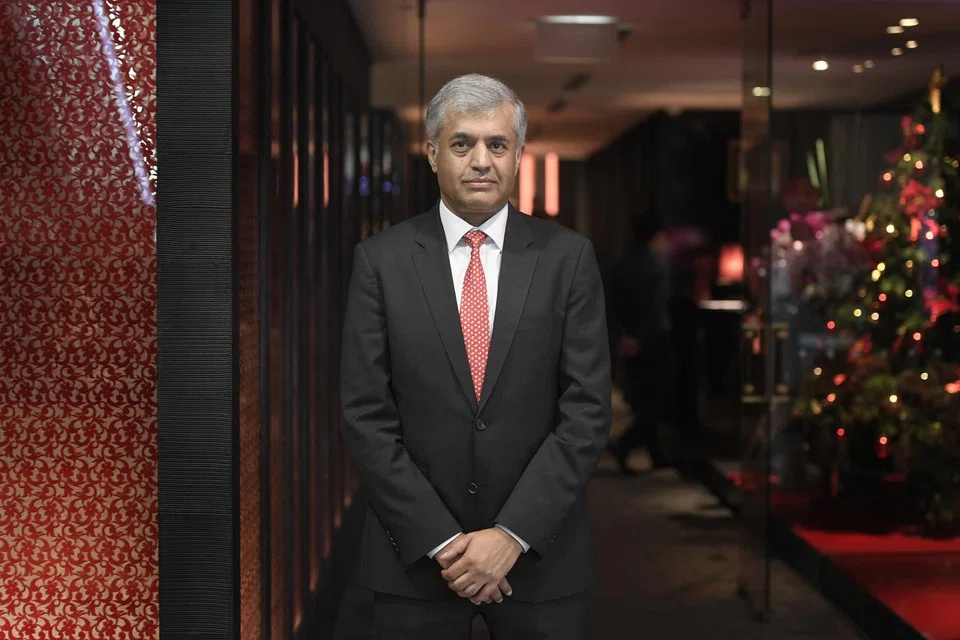
AFFIRMA CAPITAL, the newly- spun-off former private equity business of Standard Chartered Bank, is eyeing buyout opportunities in Singapore, and has its sights on founder-owned, medium-sized enterprises and family businesses.
Its chief executive Nainesh Jaisingh believes privatisation will enable founders to realise better value for their companies, and institutionalising these "informal" businesses, putting them through the surgical hands of private equity professionals, will take them to their next phase of growth.
The management buyout (MBO) of Affirma Capital by global alternative asset manager Intermediate Capital Group's (ICG's) Strategic Equity funds, a US$1 billion transaction, was completed just this week.
Marking the largest MBO of an emerging market private equity business, the deal came with a pool of US$700 million, made available to Affirma Capital for new investments.
Affirma Capital has wasted no time, announcing the first of these investments on Thursday: A US$50 million investment in Tirupati Medicare, a manufacturer of nutraceutical supplements in India.
In an interview with The Business Times this week, Mr Jaisingh said that while the company generally focuses on mid-sized companies in Asia - a region which accounts for four-fifths of its aggregate investments, with Africa and Middle East making up the rest - Singapore makes an interesting market for privatisations.
His target: Singapore-headquartered consumer brands that have the potential to expand into the region. "I think not enough of that (regional expansion) has happened and we can help companies to do that."
Elsewhere in emerging markets such as China, India and South-east Asia, Affirma Capital is on the lookout for family-owned companies, or those led by first-generation founders.
Mr Jaisingh said: "Both these categories of owners have brought the business to a certain stage through their passion, enterprise and intuitive, gut-based management skills. What we bring is a formal, systematic institutionalised approach to building these businesses for the next stage of growth...
"The presence of a investor like us will enable them to attract more seasoned high-quality professionals. We are able to help these companies create better financial management or governance systems, get the right people on their board, prepare them for an initial public offering or trade sale, or help them expand by acquisitions, going abroad, or introducing new products - basically taking the company from being a mid-sized player to a champion in its industry."
He said that privatisation also presents itself as a solution when a company has a succession problem, or when a family may want to split up the economics or wealth of a business. Private equity firms like Affirma Capital can help by either buying out the business, or helping some of the shareholders to exit.
"Entrepreneurs have realised the power of not just the capital, but also the influence, networks and expertise that private equity investors can bring," he said, adding that this is one reason more companies are turning to private rather than public markets to raise capital.
Besides consumer goods, Affirma Capital will focus on sectors such as financial services, healthcare and education - "the offshoots of the consumer discretionary and non-discretionary spend", as well as early-stage technology such as fintech.
Its recent investments have included a mobile-payments firm in Vietnam called Momo, Chinese peer-to-peer lender Dianrong, and Northern Arc Capital, an Indian debt capital platform for financial institutions serving excluded individuals and businesses.
In Singapore, it also partnered Tat Hong's chief executive Roland Ng to take the crane supplier private last year.
Mr Jaisingh said: "The Singapore mid-cap listed companies don't trade very well. Tat Hong went through a period in 2015, when there was a slump. The general patience and longer-term horizon required to invest in this sort of company is not there among public investors.
"We as private equity are patient capital; we saw an opportunity to take this off the market and play the long game with the CEO, and revive the business to a different level of operations, and also look at options for liquidity - either relisting or other investors coming in."
Affirma is no stranger to takeover deals. As far back as in 2002, it had backed billionaire businessman Ong Beng Seng in his privatisation bid for steel company NatSteel; in 2007, it tied up with CVC Asia Pacific to take Amtek Engineering private.
For Mr Jaisingh, South-east Asia provides a great mix of growth and buyout opportunities. About a third of its deals are buyouts, mostly in mature markets such as Singapore.
In Singapore, besides Tat Hong, it also owns Crystal Jade, LVMH-backed private equity firm L Catterton, as well as 70 per cent of baking supplies retailer Phoon Huat.
Affirma Capital is fast becoming one of the few pan-emerging market funds still focusing on mid-sized companies. Its former peers have either moved up the ladder to larger-quantum investments (such as Warburg Pincus and Baring Private Equity Asia), or exited the market for various reasons.
For instance, in 2013, Citigroup's private equity unit, Citi Venture Capital International, was sold to emerging markets investment firm The Rohatyn Group.
Meanwhile, Dubai-based private equity firm Abraaj Group has become responsible for the world's biggest private equity insolvency to date. Last month, it was fined US$315 million by Dubai's financial regulator for deceiving investors and misappropriating their funds.
Over the past three years, Affirma Capital's private equity team has deployed over US$650 million in 13 companies across its core markets of Asia, Africa and the Middle East, while making asset disposals worth more than US$1.2 billion, with capital gains of nearly US$500 million, it said.
Through its 17-year history of investing in emerging markets, the team has deployed over US$5.5 billion in more than 90 companies, and returned over US$5 billion in cash proceeds to investors.
Its realised returns thus far have been over 25 per cent in internal rate of return or IRR (in USD terms), thanks to some early exits. Mr Jaisingh believes IRRs in the low- to mid-20s are sustainable.
Affirma Capital has assets under management of US$3.6 billion.