

Affordability a key focus as food delivery platforms continue to grow: Momentum Works
This has driven down average order value, but the net effect is faster gross merchandise value growth

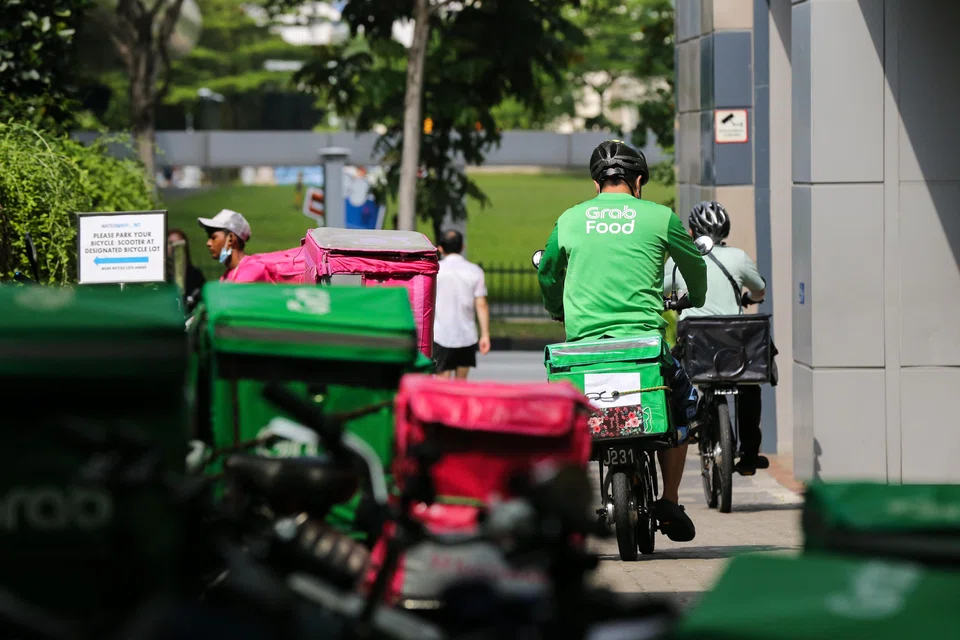
[SINGAPORE] Food delivery platforms across South-east Asia continue to focus on affordability to drive growth, said a report by consultancy Momentum Works.
This has driven down average order value, but the net effect was faster gross merchandise value (GMV) growth due to higher order frequency and a broader user base. As food delivery platforms focus on profitability, the amount of subsidies for users drop along with the mass public.
As competition in the space heats up, food delivery platforms such as Grab, ShopeeFood and foodpanda have chosen to use affordability-focused initiatives to grow their user base.
Chen Weihan, insights lead at Momentum Works, said: “A lot of these platform players that initially have a slightly segregated or segmented user base are starting to converge, and most of them are towards the cost-first and affordability-focused users.”
Across the region, food delivery platform GMV grew about 18 per cent from US$19.3 billion in 2024 to US$22.7 billion in 2025. This was higher than the 13 per cent GMV growth between 2023 and 2024.
Thailand posted the highest percentage growth in GMV, up 21.4 per cent from US$4.2 billion in 2024 to US$5.1 billion in 2025. This was driven by the Thai government’s Khon La Khrueng (half-half) co-payment scheme which also included food delivery.
Indonesia was second, up about 18 per cent from US$5.4 billion in 2024 to US$6.4 billion in 2025. The country saw the highest growth by absolute number across the region. All countries saw double-digit growth in food delivery GMV.
Leader of the pack
Vietnam was the fastest growing in food delivery GMV in 2024 at 26 per cent, but posted a slower 16.7 per cent expansion from US$1.8 billion in 2024 to US$2.1 billion in 2025 due to weather disruptions. Typhoons and floods accounted for 44 days of disruption.
Across the food delivery platforms, Grab remains the leader of the pack with GMV of US$12.5 billion in 2025. Grab extends its regional market share by GMV from 53.8 per cent in 2024 to 55 per cent in 2025.



ShopeeFood has overtaken foodpanda in second spot with a GMV of US$3.3 billion, while foodpanda’s GMV was US$2.6 billion in 2025. Foodpanda exited Thailand in May 2025, while ShopeeFood remained in its four markets of Indonesia, Malaysia, Thailand and Vietnam.
Grab and ShopeeFood remain in a tight race in Vietnam taking 48 per cent of food delivery GMV each.
Drinks have constituted a large part of South-east Asia’s food delivery orders, with about 30 per cent of all food delivery orders in Thailand being beverages. Vietnam and the Philippines follow with about 25 per cent each.
Food delivery platforms are also shifting towards demand orchestration, with dine-out offerings, advertising, content and incentive-led discovery. This is a high margin touchpoint which gives platforms incremental GMV without costs such as delivery fees.
As food delivery platforms go deeper into the offline food and beverage (F&B) space, more comprehensive data sets can be collected across delivery behaviour, offline visiting patterns, category benchmarks, pricing dynamics and conversion funnels.
This creates data asymmetry where platforms see the entire market while merchants see only their own performance.
“So, F&B merchants in a sense are slowly starting to lose certain bargaining power to these platforms… Platforms are starting to control what they do, as well as how they should run their business,” said Chen.
Ads will play a more important role for food delivery platforms as they tap merchants and brands’ willingness to spend to get sales on their platforms.
Li Jianggan, founder and chief executive officer of Momentum Works, said: “Platforms are increasingly becoming demand orchestrators for F&B, and as a result we believe that ads would continue to play a more important role as merchants/brands look to generate more demand for deliveries and dine-out.”
Decoding Asia newsletter: your guide to navigating Asia in a new global order. Sign up here to get Decoding Asia newsletter. Delivered to your inbox. Free.
Copyright SPH Media. All rights reserved.
TRENDING NOW

Once staunchly pro-China, Malaysian Chinese businesses are now distancing themselves from Beijing

Looking beyond looming CEO succession, should UOB potentially pursue a transformative merger?

Could stablecoins be the future of money?

Grab CEO’s wife Chloe Tong on life with Anthony Tan and finding her purpose

