

After 10% dip in Q1 profits, local lenders bank on rising rates to boost margins

Kelly Ng
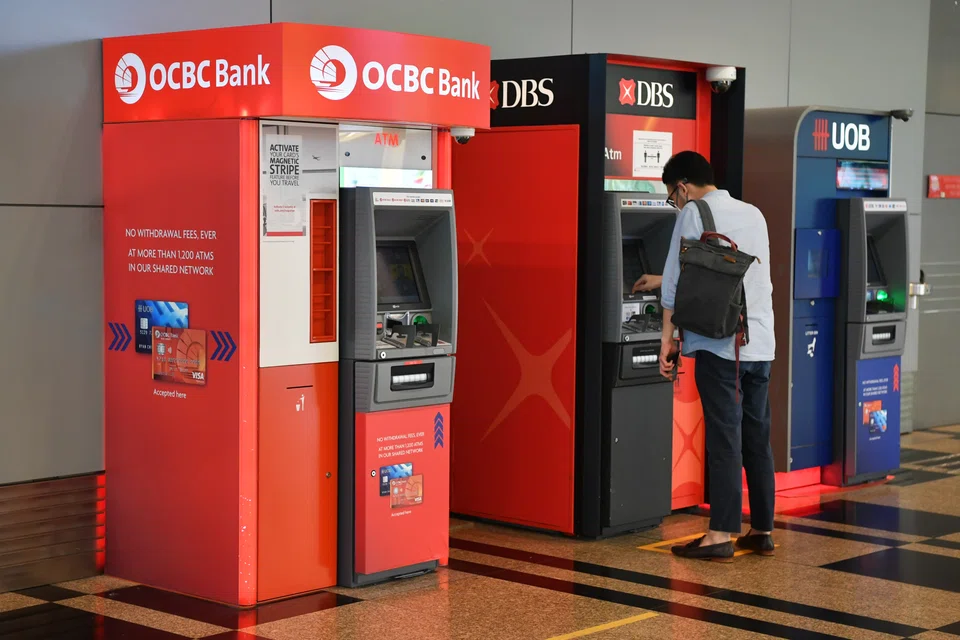

Singapore’s banking trio logged declines in net profits for the first quarter. But their loans and net interest income rose, offering hopes of increasing profitability in the coming quarters.
On Friday (Apr 29), DBS , OCBC and UOB each reported a 10 per cent fall in net profit for the quarter. Wealth and other non-interest income were the biggest drags, no thanks to market volatility amid geopolitical tensions.
The weaker earnings were also partly attributable to a high base effect - the trio had kicked off Q1 of 2021 with a stellar quarter on stronger fee income and lower credit costs, following a pandemic-struck 2020.
DBS and OCBC’s profits were in line with analysts’ estimates, while UOB’s fell short. The gap was reflected in their share prices: OCBC shares ended Friday up 3.6 per cent at S$12.39 while DBS closed 2.76 per cent higher at S$33.92; UOB shares, meanwhile, fell 0.5 per cent to S$29.99.
DBS and OCBC also reported bigger improvements in net interest margins (NIMs). DBS and OCBC both reported gains of 3 basis points in their NIMS to 1.46 per cent and 1.55 per cent, respectively, while UOB’s NIM improved by 2 basis points to 1.58 per cent.
Rising interest rates and improving lending momentum are expected to continue boosting margins this year, the banks’ chiefs said in their respective earnings calls even as they acknowledged headwinds in the macro environment.
DBS chief executive Piyush Gupta has guided for S$1.8 billion to S$2 billion of incremental net interest income for every 100-basis-point increase in the the US Federal Funds Rate.
UOB had earlier guided that a 25-basis-point rate increase would boost net interest income by S$150 million on an annualised basis. Its chief financial officer Lee Wai Fai said the bank sees “strong demand for loans, with a robust pipeline”, particularly for working capital.
OCBC guided in its latest annual report that a 100-basis-point parallel rise in the yield curves of major currencies it is exposed should translate into a S$699 million increase in net interest income.
Of the 3 banks, DBS is likely to be the biggest beneficiary of the United States Federal Reserve’s rate hikes. This is due to its higher share of low-cost current and savings accounts deposits, said Moody’s Investors Service vice-president and senior credit officer Eugene Tarzimanov.
This means the bank’s funding costs will not increase as much as those of its peers.
IG market strategist Yeap Jun Rong said tighter monetary policy could lift NIMs towards pre-Covid levels of around 1.7 to 1.8 per cent.
“Loan growth has also maintained its pace with a high single-digit year-on-year increase, reflecting improved lending momentum despite Covid-19 challenges in Q1. This comes along with loan loss provisions remaining at healthy levels,” he said.
DBS and OCBC have guided for full-year loan growth to be a mid-single digit percentage, while UOB has guided for a “mid- to high-single digit” percentage.
On the challenges ahead, OCBC’s Wong flagged headwinds in the form of global inflationary pressures - including rising energy and commodity prices. Rising interest rates may also deter consumption and investment growth, she said.
Pandemic lockdowns in China are expected to have a small direct impact on the bank, she added, as its onshore loan book within mainland China makes up 2 per cent of its total loan book. OCBC primarily serves Chinese companies’ operations outside China, especially in Asean, she said.
Lee of UOB said geopolitical tensions have added to market uncertainty, but was optimistic of a recovery in the region as well as the longer-term potential of the Asean market. UOB is keeping an eye on the Covid-19 situation in China, but Lee said the impact at this point is manageable.
DBS’s Gupta said the environment for investment banking will remain challenging if markets do not open up. He also noted that small- and medium-sized enterprises are likely to “face more pain”, but maintained that this portfolio has been seasoned by stresses in recent years and is largely secured.
All 3 banks reiterated that their exposure to Russia and Ukraine is minimal.
Jefferies equity analyst Krishna Guha said expenses were well managed across the banks and credit costs remain “very benign”. “Any impact of higher offshore credit spreads is not yet visible,” Guha said.
He noted, in particular, OCBC’s steep drop in credit costs. The bank’s total allowances were down 73 per cent year on year to S$44 million, which it said was largely due to a drop in allowances for impaired assets.
UOB's credit costs, on the other hand, were responsible for its weakness this quarter.
Both Guha and Kevin Kwek, managing director at Alliance Bernstein, noted that UOB’s loan growth was ahead of its peers. Its net interest income went up 10 per cent, compared with 4 per cent for both DBS and OCBC. But its credit costs were “not ultra low like its peers”, Kwek said.
Nevertheless, Kwek believes UOB is the bank to watch this year - for its cheaper valuation and greater upside potential for improvements in return on equity.
Tarzimanov of Moody’s Investors Service views DBS favourably. He expects the bank to post “superior growth” in income and said its balance sheet is better-positioned to reap benefits from higher interest rates.
TRENDING NOW

Philippine power giant First Gen rebuffs foreign offers, plans up to US$2.6 billion in expansion

Vietnam’s data-centre investment rush faces reality check on power and site constraints

Singapore should prepare for prolonged haze until November, says Grace Fu

Is stagflation returning? That mostly depends on the Iran war

