

After rally, emerging market bonds no longer cheap
Some say party can go on, citing stronger fundamentals, receding China fears and strong demand
Singapore
AS emerging markets (EM) bonds hang on to their remarkable rally in 2016, one thing is clear: They are no longer cheap.
Optimists say a domestic recovery within EM economies is taking hold. Fears are also receding over external threats to the EM story, such as a China crash or a brisk Fed rate hike.
But the attraction of these bonds is less clear when one examines spreads, or the extra yield one needs to hold EM bonds compared to yields of safer bonds.
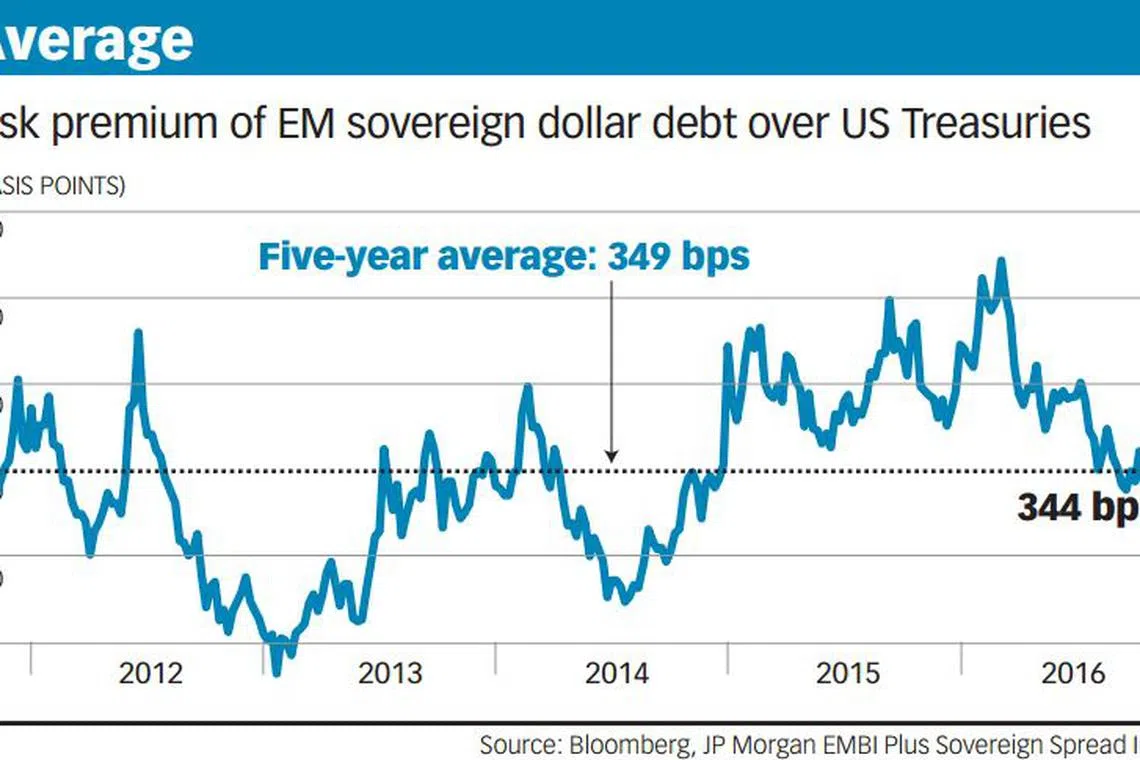
EM government US-dollar denominated debt is trading at a spread of 350 basis points (3.5 percentage points) relative to US Treasuries, said Abbas Ameli-Renani, global EM strategist at Paris-based asset manager Amundi.
"It's in the middle of the range of the past five years. The key question is whether 350 basis points can go to 250 basis points, which would be the bottom of the five-year range, taking us back to mid-2014 levels where oil prices were double," he said.
Mr Ameli-Renani falls within the optimist camp. He thinks spreads can narrow to 250 basis points, a level which he would consider EM bonds expensive. Judging by debt and trade balance indicators, EM fundamentals are much better now than they were in mid-2014, he said.
Emerging markets have rallied this year after many years of outflows. While sentiment remains cautious, investors are less preoccupied with fears over the commodity price crash or a brisk Fed rate hike. Flows notably accelerated from Europe into higher-yielding EM bonds in end-June after Britain's shock vote to leave the European Union.
Owi Ruivivar, Goldman Sachs Asset Management managing director of EM fixed income, uses another comparison to show that there is still room for EM bonds to rally.
From 2009 to 2013, investors were willing to pay similar spreads on EM investment-grade government debt as those on US investment-grade corporate bonds. This implied that debt of high-quality EM countries was just as risky as debt of high-quality US companies.
Since mid-2013, when a hint of US monetary policy tightening sparked a "taper tantrum", these highly-rated EM bonds started to trade at a bigger spread, indicating investors were more nervous about them relative to US corporate bonds.
This year, the difference between both spreads has narrowed from over 100 basis points to over 50 basis points at end-September. But the extra compensation for holding on to EM debt still remains.
"That's the argument we would use just from a high level perspective," Dr Ruivivar told The Business Times.
From a fundamental perspective, while some EM companies are taking on more and more debt, there is "nothing alarming", she said.
Current account deficits have narrowed for EM countries such as Brazil, India and Indonesia. EM watchers do not like big deficits, which suggest countries are borrowing and importing significantly more from the world than they lend, save and export. Deficits have traditionally raised competitiveness and debt sustainability worries.
Another worry is soaring China debt. But that is a medium term concern which will only come to the fore if economic growth decelerates sharply along with capital outflows. "Growth has found a floor, capital outflows found a floor," she said.
On China, Desmond Soon, Asia ex-Japan co-head of investment management at bond manager Western Asset, remains cautious.
He told BT he is buying just two out of every 10 new issues of Chinese debt in recent months, compared to three or three and a half. China has been issuing a lot of US dollar-denominated debt and might soon take up half of the Asian bond benchmark, he noted.
He has capped his China exposure and noted that most fund managers have also done so. With more potential defaults among weaker companies, the Chinese bond market is highly susceptible to bad news, he said.
Also wary on China was Claudia Calich, an EM bond portfolio manager with M&G Investments. She had sold off her Chinese developer positions a few months ago.
She prefers Latin America, citing new governments there, such as in Argentina, promoting orthodox economic policies. She also likes sovereign and oil company bonds in crisis-hit Venezuela.
In Asia, bonds are at historically average or slightly expensive levels, Mr Soon said.
Investors are paying 60 basis points more for Asian dollar-denominated investment-grade debt versus US counterparts, a level similar to history. For high-yield debt, investors are even assigning the same risks to Asia and the US this year, compared to 2013-15 when Asia was riskier by a few hundred basis points.
Mr Soon holds relatively larger or longer-tenured positions in India, Indonesia and South Korea, though he might trim some positions towards the end of the year. While currencies are volatile, high-yield countries such as India can still ensure a superior return over time, he said.
On the whole, there remains strong demand for Asian bonds despite pricey valuations, Mr Soon said. Chinese investors are snapping up dollar-denominated Asian debt to hedge against yuan depreciation.
External concerns in Europe and the US are also driving Asian investors to stay within the region and use their large pool of savings.
"You could remain overvalued for quite some time," he said.
"With that in mind, you don't just buy a bond because you believe technicals are going to drive the day. We have been quite selective."
READ MORE: Singapore dollar perpetuals soar amid global hunt for yield






