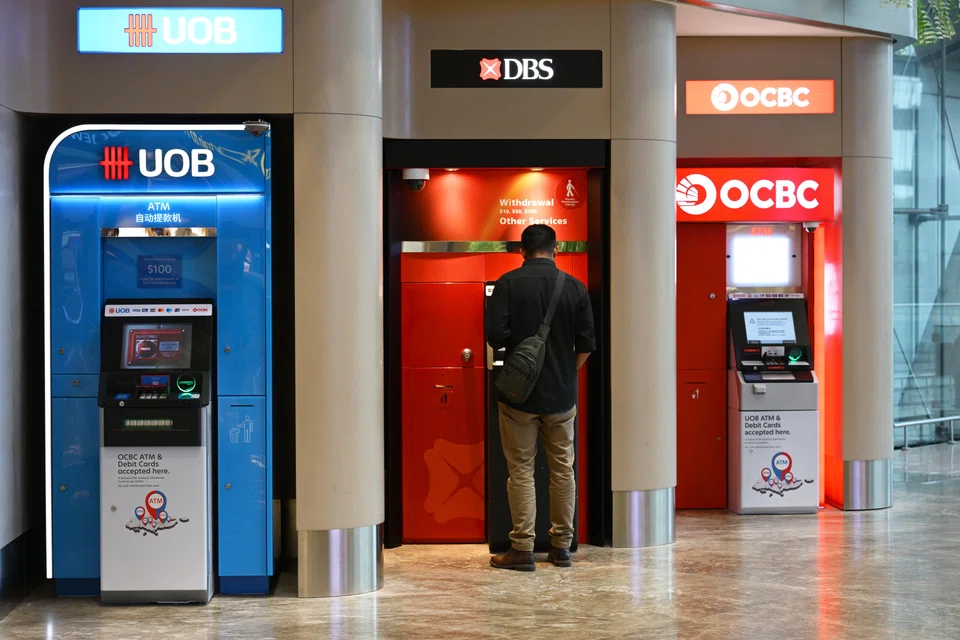
After a strong Q2, what’s next for Singapore banks? Analysts see DBS, OCBC ahead on wealth
UOB is overshadowed by weaker fee outlook and asset-quality concerns, but some analysts call it a ‘value play’

[SINGAPORE] Analysts are increasingly split on the outlook for Singapore’s three banks after their second-quarter results, as wealth management becomes a key differentiator in a lower interest rate environment.
They were more upbeat on DBS and OCBC as their strong wealth management performances were accompanied by a more positive broader earnings outlook.
UOB, meanwhile, faces questions over the execution of its wealth strategy, alongside persistent asset-quality concerns and a weaker fee income forecast.
Regardless, all three banks posted second-quarter net profits that beat market expectations. DBS had a 9 per cent on-year gain to S$3.08 billion, OCBC posted a 22 per cent increase to S$2.22 billion, while UOB’s net profit climbed 10 per cent to S$1.48 billion.
Higher non-interest income helped offset weaker net interest income across the trio. Even as wealth was a key driver for all three, UOB’s gains were boosted by a non-recurring asset divestment.
Different paths on wealth
Thilan Wickramasinghe, head of Singapore research and regional financials at Maybank Investment Banking Group, noted that DBS is “delivering on all fronts” and has managed to leverage growth engines across wealth, corporate banking, SME and trading, despite significant external uncertainty.
This gives “strong visibility” of the bank delivering more than 17 per cent return on equity in the medium term, which justifies the premium valuation, he said.
OCBC is also showing signs of strong execution in its pivot to capital-light led growth, said analysts.
“We like OCBC for the change in income mix,” said Phillip Securities Research analyst Glenn Thum.
Non-interest income is 44 per cent of first-half income and wealth makes up 41 per cent, both driven by customer volume rather than rates, he noted.
Wealth should carry income as net interest margins stabilises amid slower treasury asset growth and firm interest rates, he added.
Furthermore, OCBC’s private banking presence onshore in China may become its advantage against other global banks and fintechs, given current uncertainty surrounding China’s regulatory directives on onshore wealth, Wickramasinghe said.
Meanwhile, UOB’s execution of its wealth strategy is “still (in the) early days”, he added.
While Q2 earnings beat expectations, he noted that it would have been a slight miss if it excluded the non-recurring asset disposal of S$200 million.
“Operationally, UOB is at a building stage to extract deeper value from (its) consumer banking franchise,” he said. “This may take time to gestate, and carries execution risks.”
Growth in UOB’s wealth momentum was also likely offset by renewed concerns around Greater China commercial real estate and a weaker broader fee outlook.
Goldman Sachs analysts Melissa Kuang and Wayne Wang expect credit costs to remain at the higher end of the bank’s 25 to 30 basis point guidance for 2026, and be an overhang for the stock.
This comes as UOB’s management expects that a full recovery in the Greater China commercial real estate market could still take several years, they said in a note.
Kuang and Wang were also “disappointed” by the downward revision to fee income guidance, particularly as peers have generally maintained or upgraded their guidance.
“The pressure on card fees is notable, given that cards remain one of the bank’s largest fee income contributors and a key pillar of the Citi Asean acquisition story,” they said.
Valuations
Nevertheless, several analysts noted high valuations at DBS.
CGS International analyst Tay Wee Kuang downgraded DBS to “hold” from “buy” on Aug 6 following the results due to its share price outperformance year to date, even though yields remain attractive.
But many still kept their “buy” call on the counter. For Maybank’s Wickramasinghe, DBS will likely continue to grow absolute ordinary dividends, while the unutilised S$2.6 billion from the bank’s share buy-back mandate could be paid as a special dividend.
The Goldman Sachs team also noted that wealth and fee momentum – combined with benign asset quality, ample provisioning buffers and strong capital – keeps a supportive earnings outlook for DBS.
Meanwhile, some analysts expect UOB could be a “value play”, given its cheaper valuations.
The RHB Singapore research team said the valuation gap between UOB and the other two banks is “too wide to ignore”, and upgraded their call on the counter to “buy” from “neutral”.
Jayden Vantarakis, head of Asean equity research at Macquarie Capital, also noted in an Aug 7 note that UOB was trading at around a 48 per cent discount to peers.
Regardless, Vantarakis expects the bank needs to produce a clean quarter with improving wealth momentum and contained asset quality to start closing the gap.
As for OCBC, analysts noted the bank’s upbeat outlook.
Wickramasinghe, who has a “buy” call on the counter, expects OCBC could post return on equity of 14 per cent by 2028, from 12.6 per cent in 2025.
“An accelerating return on equity trajectory and a supportive yield deserves a higher valuation,” he said.
On Tuesday, shares of DBS closed 0.9 per cent higher at S$76.99, OCBC gained 3.5 per cent to S$31.36, while UOB was down 2.6 per cent to S$42.16.
TRENDING NOW
Temasek’s Wan Chee Foong to helm PIL, Lars Kastrup to be board adviser
Chagee, Mixue and Luckin won the market. Sustaining their edge is the harder part
He built the Vingroup empire. Now South-east Asia’s richest man is handing some key roles to his sons
One-third of Singapore-listed firms at risk in severe AI downturn: MAS