

Age of crisis leaves world’s big currencies out of sync
 Add BT as a preferred source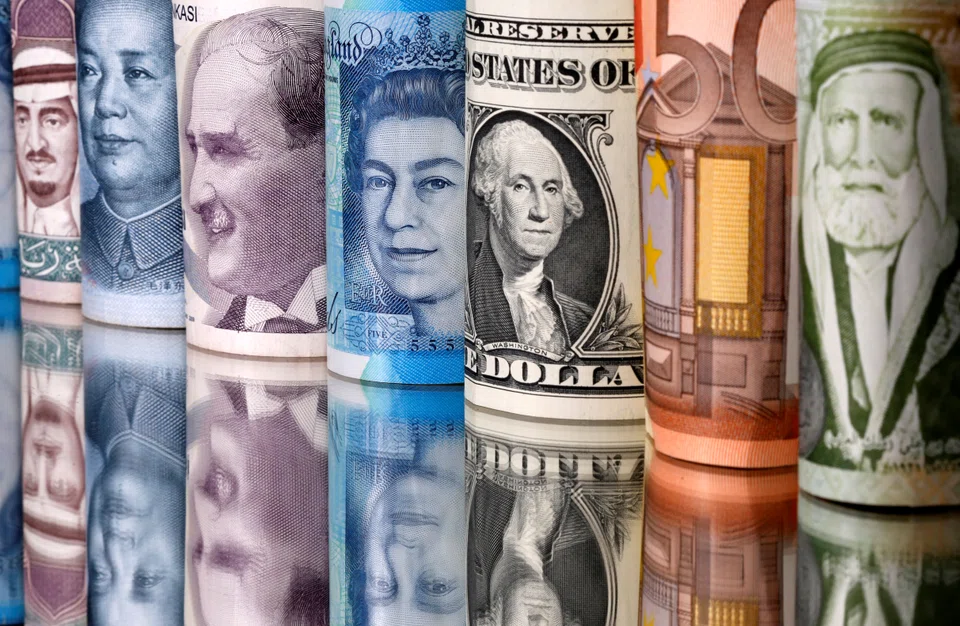
DeeperDive is a beta AI feature. Refer to full articles for the facts.
BIG global currencies are rarely on different paths. Yet Japan’s yen and China’s yuan are slumping against the US dollar while in Europe the euro is outperforming and sterling is on a tear.
With economic and monetary policy outlooks varying, currency moves are increasingly out of sync with each other. This is making the US$7.5 trillion-a-day global FX market – operating in the aftermath of Covid-19 and the face of war in Ukraine and an energy crisis – more volatile and more unpredictable.
“It used to be the case that if you got the direction of euro/US dollar right, you had a good chance of getting everything else right, but now it’s a bit harder,” said Nomura’s G10 FX strategist Jordan Rochester.
“You have to do your homework and the differences between currencies are widening.”
Last year alone, the euro fell to a 20-year low versus the US dollar, sterling hit its lowest on record and the yen its weakest in 32 years, as the greenback soared broadly on sharp increases in US interest rates to curb inflation that other major central banks lagged.
Fast forward and those moves are far less aligned.
Navigate Asia in
a new global order
Get the insights delivered to your inbox.
The Bank of Japan has dashed expectations that a change to its ultra-dovish monetary policy would come early in 2023, sending the Japanese yen down 9 per cent so far this year, on top of a 12 per cent decline in 2022. That has raised the chance of intervention to stem weakness.
More pain is also anticipated for the yuan, trading near seven-month lows, as well as smaller Asian currencies.
Meanwhile the euro is up 2.5 per cent this month against the US dollar and expected to rise further given a hawkish European Central Bank – and sterling has meanwhile risen over 5 per cent so far in 2023, leaving it set for its biggest annual gain since 2017.
Rochester said Nomura forecast the euro moving to US$1.12 over coming months, implying a further 2 per cent gain from US$1.095 now, and expected the yuan to weaken to 7.30 per US dollar versus 7.2 now.
The yuan has slid almost 5 per cent so far this year, hurt by a weak economy and a wide interest-rate gap with the US.
This week Chinese authorities set a stronger-than-expected trading band for the currency, a sign that Beijing is increasingly uncomfortable with its quickening slide.
Lee Hardman, senior FX strategist at MUFG, said the US dollar’s rebound against Asian currencies reflected a reversal of the trades put in place late last year with the post-lockdown reopening of China’s economy, as pessimism about the growth outlook there grew.
“But elsewhere the US dollar is not performing as well. It’s continuing to weaken against some European currencies and also Latin American currencies,” he said.
Hardman said that, as market volatility slows compared to recent years, investors were focusing more on carry trades, exploiting the variances in interest rates and monetary cycles between different central banks.
Multi-layered crisis
Kit Juckes, head of FX strategy at Societe Generale, said the focus on monetary policy differences was also a result of uncertainties elsewhere.
“What strikes me at the moment about FX markets is they are more short-term interest rate-sensitive than I can remember them being.
“Because we are so uncertain about so many things in this most unusual of economic cycles, we’re just going to focus on what the next central bank policy move is.”
This is not good news for the yen, near seven-month lows against the US dollar and 15-year lows versus the euro, as the Bank of Japan holds fast to its ultra-loose monetary policy.
In Scandinavia, Norway’s crown is under pressure, and property woes and a weakening economy have also battered Sweden’s crown, which last week hit a record low versus the euro amid a sense that rates there cannot climb much higher.
Morgan Stanley reckons there is a chance Sweden’s Riksbank could deliver a big rate hike at Thursday’s meeting or hint at further future rate hikes to help support the currency
Of course given what the world has endured in the past few years, it is maybe not surprising that currency markets have gone a little strange.
“We’ve got a one-in-a-100-years pandemic and once-in-75-years war and a-once-in-25-years energy crisis all thrown into the mix together,” said SocGen’s Juckes. “You’ve got to be 120 years old to have any understanding of this.” REUTERS
Decoding Asia newsletter: your guide to navigating Asia in a new global order. Sign up here to get Decoding Asia newsletter. Delivered to your inbox. Free.
Share with us your feedback on BT's products and services
TRENDING NOW

Shelving S$5 billion office redevelopment plan proved ‘wise’ as geopolitical risks mount: OCBC chairman

Eurokars Group introduces rental car franchises Enterprise Rent-A-Car, National Car Rental, and Alamo to Singapore

20 photos that show how dramatically Singapore has changed in two decades

Singapore’s key exports up 15.3% in March from electronics surge, exceeding forecasts

