

From everyday tasks to bigger ambitions: How two SMEs are growing with AI
At Hegen and DU Media Holdings, employees are finding their own uses for AI, while the businesses are turning those gains into stronger skills, new ways of working and opportunities for growth

ARTIFICIAL intelligence is changing more than simply the way tasks are done. It is prompting small and medium-sized enterprises (SMEs) to rethink what employees should spend their time on, the new skills businesses need and, in some cases, what a small team is capable of taking on.
At Hegen and DU Media Holdings, the technology is tackling daily bottlenecks and routine tasks, freeing employees to focus on strategy, creative judgment and customer engagement.
These two businesses operate in very different sectors, but their experience points to a similar lesson: The value of AI lies not in replacing people, but in helping teams do more with the skills and acumen they already bring.
Making more room for human connection
Can a brand built on empathy and care use AI without losing its personal touch?
For home-grown babycare brand Hegen, bringing the technology into a business centred on the emotional realities of parenthood may seem like a contradiction at first. Algorithms cannot feel or understand what parents go through.
Yet founder and chief executive officer (CEO) Yvon Bock saw a role for the technology – one that would support, rather than replace, the human connection at the heart of the brand.
The team’s first glimpse of that possibility came earlier this year while developing a limited-edition series of goat zodiac collectibles for a 2027 launch.
Designing the animal had proved harder than expected. Bock recalls: “It is not an easy character to make cute or look affectionate for parents.”
With AI, concept drawings, colour palettes and mood boards that normally required months of back-and-forth were on the table within hours.

“It was a starting point for us to realise how powerful AI could be in helping us,” says Bock, whose creative and marketing teams now use the technology more widely – from drafting email newsletters to finding fresh ways to engage customers.
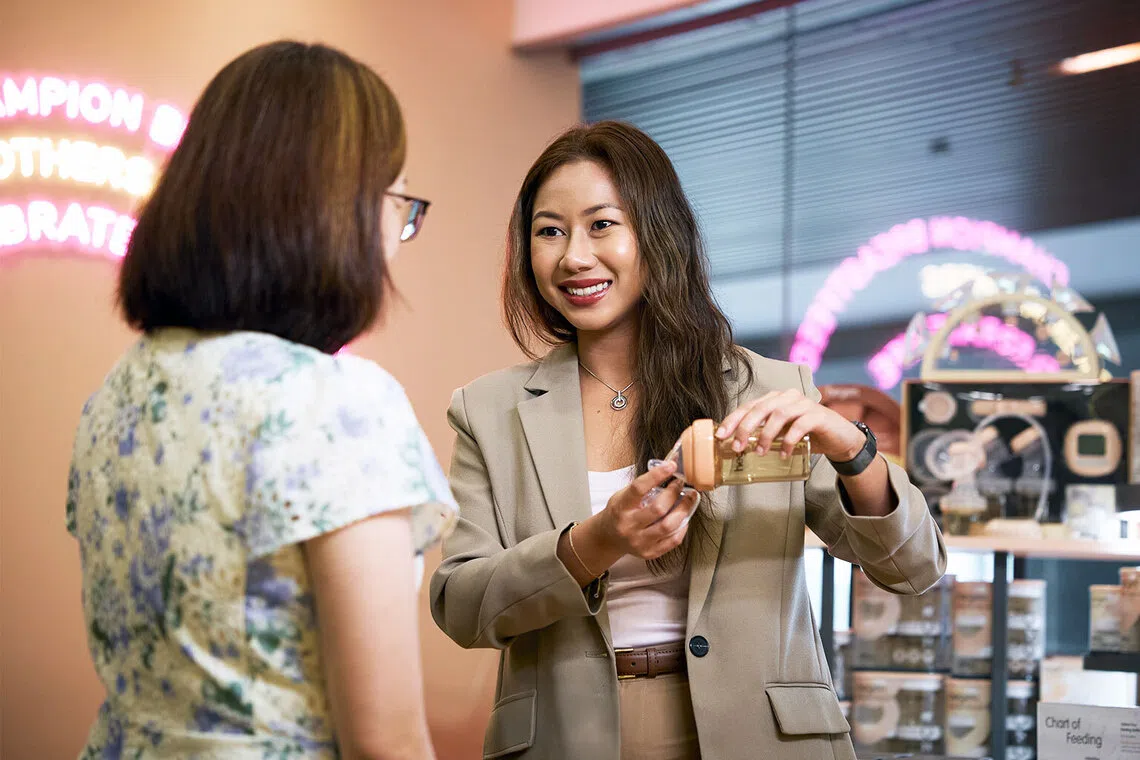
When AI shortens the journey from an idea to a workable piece of copy, employees like assistant marketing manager Valen Lim gain more room to make the calls AI cannot.
That could mean refining the tone of a campaign, judging whether an image evokes the right emotion or making sure the final execution still feels recognisably Hegen.
Lim says: “Understanding what will genuinely resonate with consumers still requires human context, sensitivity and judgment.”
AI has also helped Bock’s finance team with financial analysis. Employees turn dense spreadsheets into visually appealing presentation decks to spot patterns that might otherwise be buried in the rows of numbers.
These decks also make it easier to communicate their findings in a clear and engaging way.
Those insights could inform decisions about where the business should focus its efforts, including how it responds to what customers need.
Hegen’s adoption of AI is still at an early stage, but this experience has helped crystallise where the technology fits: taking on repetitive, time-consuming work while leaving employees to focus on strategy and building relationships with parents.
Says Bock: “The technology does not replace how we listen to our customers. The best ideas and concepts come to us when we talk to them.”
Building employee confidence in AI
As Hegen’s teams experimented more with AI, the next challenge was figuring out how to use it efficiently without stifling creativity and originality. This prompted the need for shared ground rules for AI use.
Bock says: “AI can generate concepts and ideas, but ultimately, we make the judgment on whether they serve what really matters.”
Rather than set the rules herself, Bock gathered the teams to work out the boundaries together – how much of an AI-generated idea employees should carry through and how to preserve Hegen’s own creative voice.
Lim, who joined those conversations, says finding clarity on key questions was important. What information was safe to put into an AI tool? Who remained accountable for the quality and originality of what is produced?
Agreeing on those boundaries gave employees room to experiment without having to work them out afresh each time, she adds. “They help ensure that the wider company is aligned on responsible AI use, while protecting both our employees and the brand.”

Encouraging employees to experiment also meant Hegen’s leaders had to show they were willing to learn alongside them.
Hegen’s co-founder and chief operating officer Leon Bock – initially a risk-averse AI sceptic – had spent months pushing back on the technology before attending a specialised AI workshop.
He came back with a notebook of ideas and, within weeks, was building custom financial dashboards to streamline how the finance team read the numbers.
According to CEO Bock, the change was significant because employees could see for themselves that adopting AI was not another instruction handed down from management. Leaders were learning, testing and changing how they worked too.
That willingness to keep learning, she adds, is only becoming more important as AI reshapes what employees are expected to know.
“You will not be replaced by AI, but you will be replaced by someone who is really good at AI,” she says.
For fellow SMEs still hesitant about the technology, Bock’s advice is to start small.
“Don’t focus on what AI can do overnight, but focus on one meaningful business challenge you want to solve, and then apply it, one step at a time,” she says.
Turning AI into an engine for growth
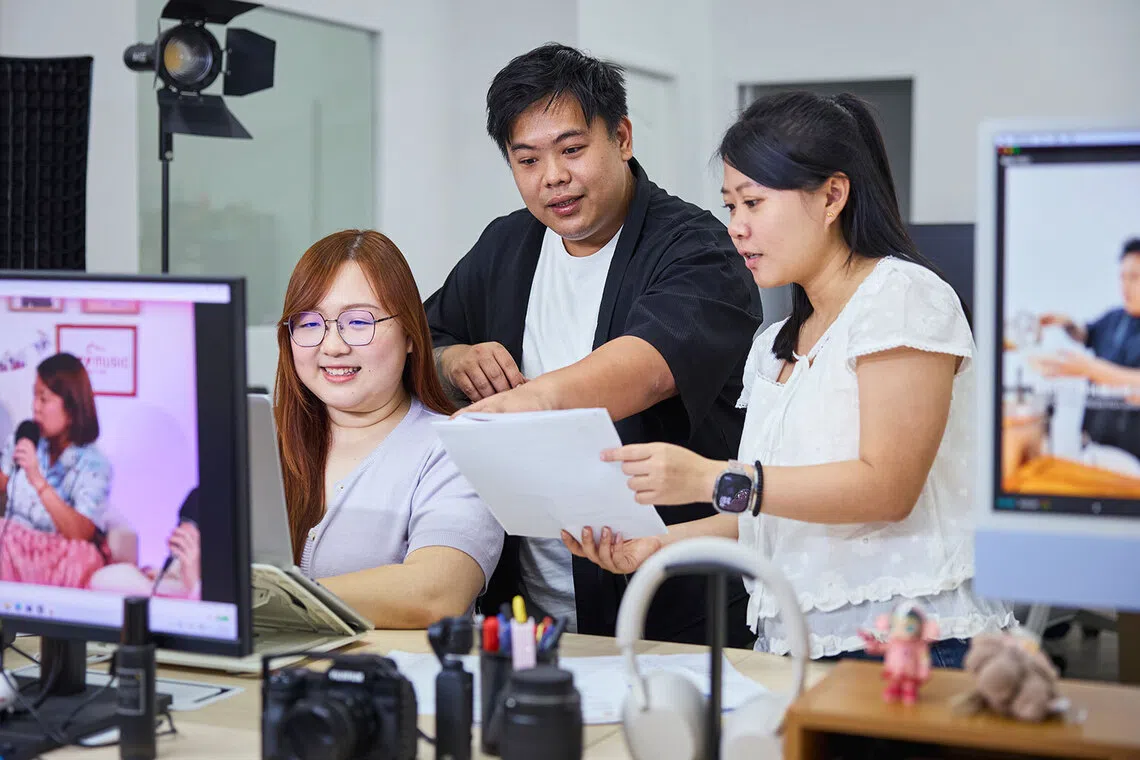
Not long ago, writers and producers would spend five to six hours working through plot holes in a film script, while video editors laboured frame by frame over motion graphics.
Today, AI can surface story problems before the discussion begins, and generate the same visual effects in minutes.
These are just some of the ways DU Media Holdings co-founder Kelvin Tan, better known online as content creator Mayiduo, is using AI to reshape day-to-day work at the home-grown media group.
Yet the efficiency gains did not result in job cuts. Since making a deliberate pivot towards AI-assisted operations in June last year, the company has grown its headcount by around 20 per cent.
It has also recently secured fresh funding, and is moving into its next phase – a Kuala Lumpur office slated to open next year, followed by Taiwan the year after.
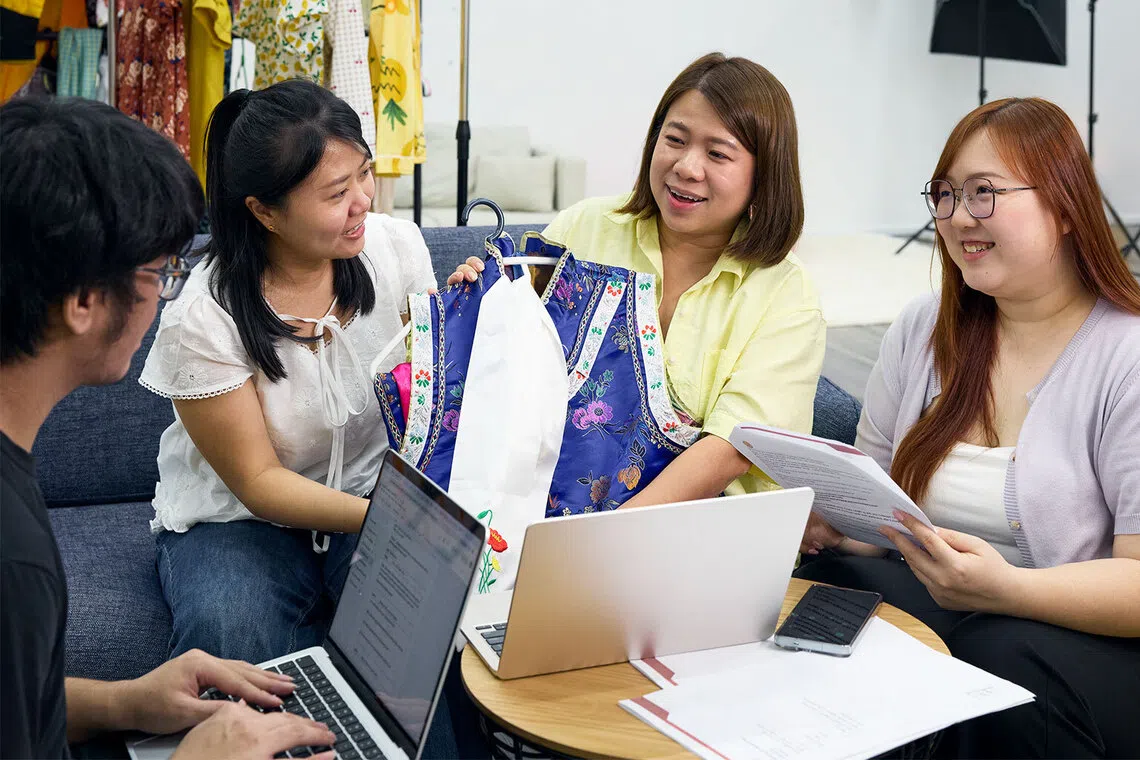
“AI has fundamentally altered the pace and shape of our daily operations,” says Tan, who co-founded the group with fellow content creator Charlene Huang.
Formed from the restructuring of their seven-year-old content business Double Up Media, DU Media Holdings now comprises three subsidiaries: DU Media, which handles talent management and intellectual property; DU Creatives, which runs brand campaigns; and DU Media Labs, its AI and media innovation arm.
However, speeding up execution and giving employees more room for creative judgment, was only the first step.
He believes if the technology were to support the company’s next phase of growth, it had to become a capability the business could build around, rather than a scattered collection of tools employees happened to use on the side.
Developing AI fluency for future workforce needs
That thinking helped drive the creation of DU Media Labs. Its most recent output is a proprietary live-streaming technology that can recreate a presenter’s voice and generate a corresponding avatar for branded content, which the group now licenses commercially to clients.
To lead the work, Tan brought in Muhamad Furqaan as chief technology officer, a role that had not previously existed in the company.
Tan wanted someone who could bridge traditional software engineering with fast-moving AI developments, decide which experiments were worth building on, and turn them into products that could be used repeatedly across the business or sold to clients.
“Once we started all these, I actually had the need to hire more people to do the things I want,” he says.
Having AI fluency, therefore, is increasingly an advantage in his hiring. Tan likens it to a shift an earlier generation of workers lived through.
“It’s like knowing how to use Microsoft itself; it’s a skill. And I feel that AI is going to become that,” he says. “I would very much prefer someone who is AI fluent.”
Existing staff are learning on the job. Furqaan runs hands-on sessions in which employees are introduced to new AI tools and shown how to apply them to their own work, from prompting to weaving the output into everyday tasks.
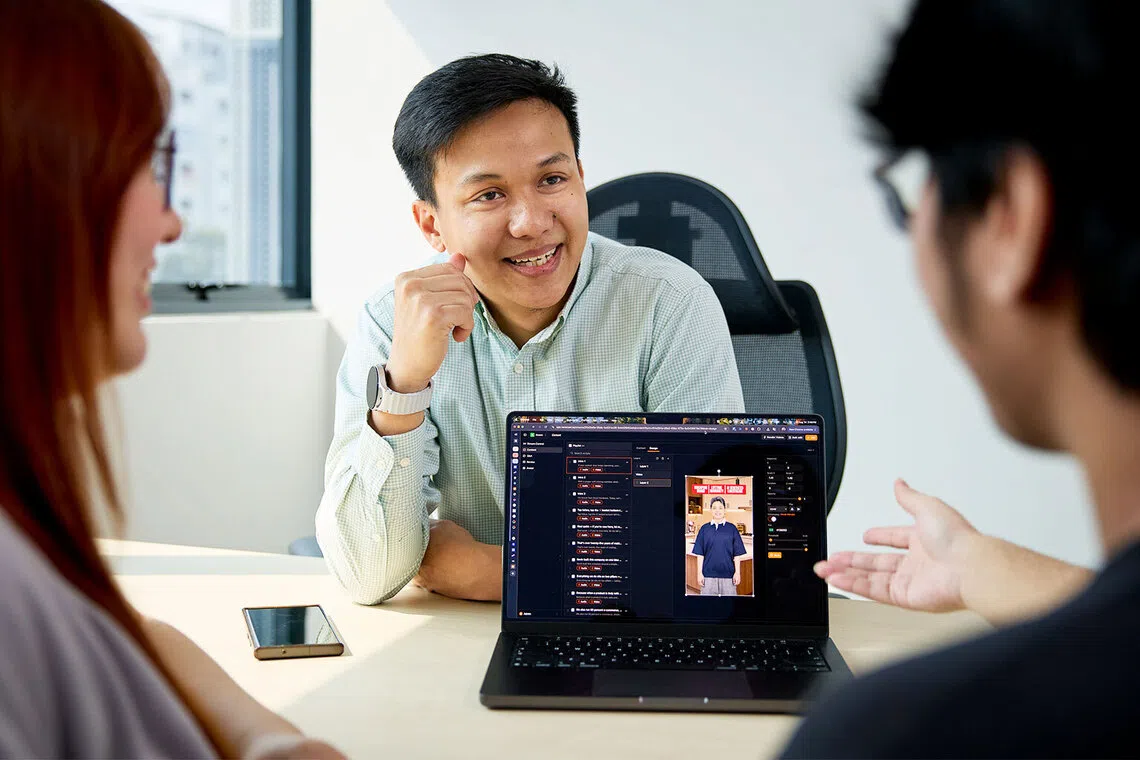
Video editor Kuby Tang says the hands-on approach made a difference. She began testing the tools on smaller editing tasks, learning through trial and error where they helped and where they fell short.
With more time on her hands, she could experiment more, from new visual techniques to faster ways of prototyping ideas.
“In a way, it has expanded the toolbox I have as an editor,” she admits.
For his upcoming film projects, Tan expects AI to play a bigger role behind the scenes. He expects the industry to move towards a hybrid model whereby real actors and real props are placed in front of AI-generated backgrounds.
As technology continues to reshape how audiences consume content and what small teams are able to produce, Tan says businesses have to keep reassessing which of their old ways of working still make sense.
“If we still hold on to what worked 20 to 30 years ago, it won’t do well in this age and time,” he adds. “Things are going to shift. And as per history, every shift sparks opportunity.”

Decoding Asia newsletter: your guide to navigating Asia in a new global order. Sign up here to get Decoding Asia newsletter. Delivered to your inbox. Free.
Share with us your feedback on BT's products and services
TRENDING NOW

He built the Vingroup empire. Now South-east Asia’s richest man is handing some key roles to his sons

Despite the de-dollarisation debate, demand for dollar liquidity in Asia is growing

Can a first-time homebuyer couple earning S$18,000 a month afford a new EC unit?

Asia needs new energy security architecture

