AI agents not something to be ‘let loose’ on customers’ life savings: UOB CFO
Widespread adoption of agentic payments depends on organisational and regulatory maturity


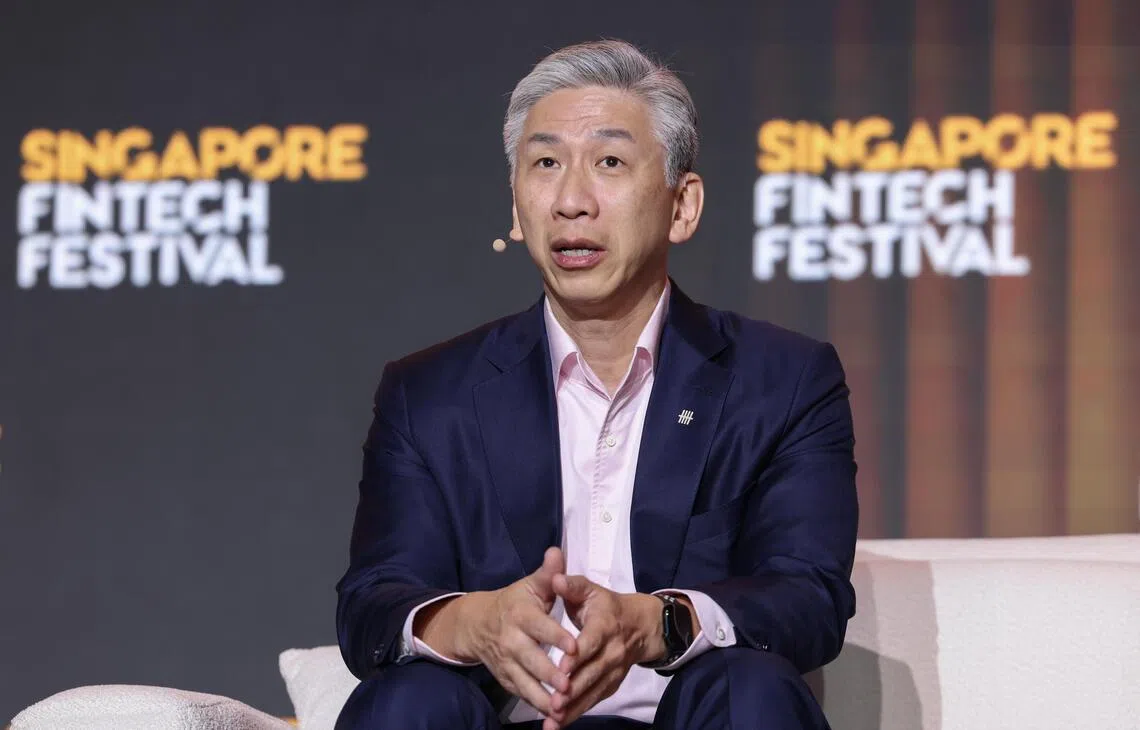
ARTIFICIAL intelligence agents that access financial services and execute payments on behalf of customers may eventually become the norm, but they should not be “let loose” on bank accounts without clear regulations and boundaries, said Leong Yung Chee, group chief financial officer (CFO) at UOB.
“It’s important for us to understand that the wealth that’s sitting in the bank account is your… life savings,” he said during a panel discussion at the Singapore FinTech Festival (SFF) on Nov 19.
Allowing AI agents to access customers’ accounts is “inevitable in due course, but within bounds”, he added.
Leong’s remarks come as AI agents such as Meta’s Muse, which arrived in Singapore’s app store on Oct 28, can independently carry out tasks from making reservations to purchases.
Against this backdrop, major US banks have blocked or restricted third-party AI agents from accessing bank accounts, while some are changing their user agreements to hold users responsible for their agents’ actions.
“One of the biggest challenges we face is that the technology is moving so fast today that before we have a chance to experiment and sandbox, something new is around the corner already,” he said.

The priority remains on identifying which technologies can be trusted and scaled, he added.
Speaking to The Business Times on the sidelines of SFF, Leong said guardrails and regulations for third-party AI agents acting on a consumer’s behalf have yet to catch up with those governing an organisation’s internal AI agents.
For example, the bank has around 300 data, analytics and AI use cases, including 30 live internal bots that function as AI agents.



These agents support staff in conducting know-your-customer and anti-money laundering screenings, fraud detection and customer service.
Leong, who also oversees UOB’s Innovation Group, recently built a personal agent using Microsoft Copilot to generate daily executive meeting briefs from his emails and calendar.
However, on agentic payments, he said: “I think (in terms of) the maturity of the population using such agents, and the maturity of the framework to protect consumers as well as banks, we’re not there yet.
“We are talking about an agent that is external, representing you… interacting with (the bank) to make a purchase… with your credit card details, authorising the payment, and letting the transaction go through.
“(With) that level of autonomy, I think we’ve got to be a bit more careful,” he said, adding that “accountability doesn’t go away, no matter which technology we adopt”.
Where does the liability fall?
The panel discussion, From Intelligence to Action: The New Architecture of Competitive Advantage, was moderated by Ronit Ghose, an industry fellow at Cambridge Judge Business School’s Centre for Finance, Technology and Regulation.
He posed a question to Mastercard’s Asia-Pacific president Richard Wormald: If a consumer delegates a flight booking to a third-party AI agent and wakes up to find it selected the wrong airport or timing, who bears the cost?
Wormald noted that while e-commerce liability generally sits with the merchant fulfilling the order, agents may eventually have to take on liability as well.
To help determine where liability falls, Mastercard co-developed an open, standards-based trust framework for agentic commerce with Google earlier in 2026.
The framework, Verifiable Intent, captures a user’s original instructions and passes them through the payment network alongside the transaction, so that liability can be assigned to different parties.
In the context of banking, UOB’s Leong told BT that “accountability cannot be outsourced”.
“Just because you automate something doesn’t mean your responsibility gets outsourced to the robot or the company that provided the tool to you,” he said.
He cited the example of a bank using a large language model to offer a customer autonomous advice that results in a transaction.
“If something goes wrong, it’s not the software company or the agentic company that will get sued – it’s the bank,” he said. “Whatever we roll out has to be something that we believe we feel (is) safe enough, that is governed and safeguarded for us to act responsibly for our customers.”
Measure returns on investment
The panel also discussed how financial and technology leaders measure the return on investment on AI use.
Tencent vice-president Richard Pu noted that the Chinese tech giant’s WorkBuddy AI agent, which was built in-house before being rolled out externally, processes 100 trillion tokens a day across 10 million daily users.
WorkBuddy has helped increase productivity at Tencent, noted Pu, citing how credit reports for due diligence can be generated within a day, compared with 10 days previously.
He added that Tencent’s consumer protection team designed a workflow involving agentic AI to handle customer support complaints for its payments business, which cut investigation turnaround times from more than 20 days to four days.
Meanwhile, Pu noted that after regulators opened more complaint channels last year, the company’s complaint volumes trebled. But with the use of agentic AI, the team has been able to manage the surge with the same headcount.
“Without an agentic AI platform, I think (we) would need to hire probably 50 per cent more people to do that,” he said.
Magnus Haglind, head of capital markets technology at Nasdaq, said the use of agentic AI tools by analysts to compile data has reduced the time taken for fraud investigations by 50 to 90 per cent.
On measuring the returns on AI investments, he added that it is not just about cost savings. “The complexity around key performance indicators is that you’re trying to do a lot of things at the same time,” Haglind said.
“You are mobilising the organisation, and that is basically usage and getting adoption. Then you’re building foundational capabilities to scale, and... you’re rewiring to build new products.”
Leong echoed that view, noting that returns on investment cannot be measured by a single metric.
“You look at it holistically across cost savings, productivity, avoidance of loss, better credit control, better collections, better customer experience (and) better journeys for your people.”
Ultimately, he added, scaling those returns hinges on maturity across the organisation, its controls and the regulatory environment.

Decoding Asia newsletter: your guide to navigating Asia in a new global order. Sign up here to get Decoding Asia newsletter. Delivered to your inbox. Free.
Copyright SPH Media. All rights reserved.