AI bubble may burst soon amid financing concentration, rising rates: Ray Dalio
The technology is a ‘classic bubble’ that begins to pop as rates climb, warns billionaire

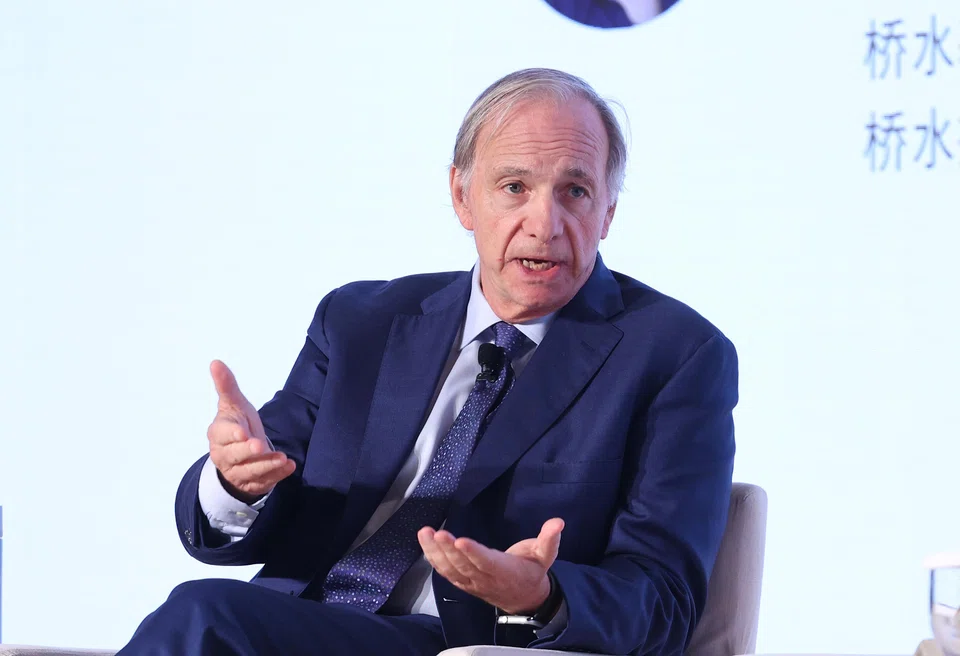
[SINGAPORE] Markets may be close to the point when the artificial intelligence bubble will burst, as debt grows while interest rates rise, said prominent investor Ray Dalio.
The AI boom operates like a “classic bubble”, given the concentration in the sector, as well as the increasing amount of debt that investors are taking in order to continue investing in the theme, said the founder of the world’s largest hedge fund Bridgewater Associates.
“There’s a lot of pressure from all the supply for much more rises in interest rates, and then you have the dynamic of when it starts to have an effect, and that is the point at which the bubble begins to burst,” he said.
“We’re in that part of the cycle that is before that, but (we’re) approaching that, I think we’re close to that.”
This comes as large tech companies increasingly take on debt to pile into AI investments, with equity markets being propped up by a few key tech players.
Dalio was speaking at a panel on Wednesday (Oct 7) at the Forbes Global CEO Conference, held at the Shangri-la Hotel in Singapore.
Also on the panel were Jenny Johnson, chief executive of asset manager Franklin Templeton; Dilhan Pillay, chief executive of Temasek Holdings; and Chartsiri Sophonpanich, president of Bangkok Bank. The panel was moderated by Moira Forbes, executive vice-president at Forbes Media and president and publisher of ForbesWomen.
Dalio noted the failure to distinguish money from wealth – he views money as a claim on goods and services that is separate from wealth, which is the capacity to produce or the productive output itself.
The bubble usually ends up being pricked when there is the desire to sell large amounts of wealth in order to get money to spend, he said.
SEE ALSO



There is also an important distinction between how terrific a technology is and how terrific an investment is, he added.
Johnson noted a common trend of overinvestment when big technological advances emerge – investors may be able to get short-term returns from hyperscalers running a lot of debt, but should be aware of risks in the longer term.
Especially with private credit, Johnson said it is getting increasingly difficult to understand the amount of money required to finance the AI trend.
“These capital-light businesses are now capital heavy; they’re now using creative financing and structuring and doing off balance sheet (financing)… You really have to build out the web of liabilities to understand it, and so I think that’s going to be a more difficult place,” she said.
All this is complicated by the current “period of great disorder”, as a result of high global levels of debt, growing political and social conflict, greater geopolitical conflicts, climate change and new technologies, Dalio said.
Nevertheless, investment into physical AI is critical because that is where companies can optimise existing hard assets, Pillay said.
Pillay noted that a large portion of Temasek’s portfolio is in companies that it owns, and there is a difference between how one would approach AI as an investor versus as an owner of businesses.
“As an investor, you can rotate your investments,” he said, “But when you are the bone of a business, you own the morning after; you own everything about that company in good times and in difficult times.”
Thus, it is important to ensure that AI is a continuous issue for discussion and viewed as a continuous business process without a finite expenditure, instead of as a typical capex strategic planning exercise.
But he also warned that so much capital is moving into AI infrastructure that it may drive up the overall cost of capital.
Investors may also need to reconsider whether there is more capital available for the adoption going forward, he said.
Where do opportunities still exist?
For investors, opportunities remain.
While new technologies look exciting, companies take quite a long time to adapt to them, Johnson said.
“I do not believe that any of the productivity gains that you’re seeing in the US companies has anything to do with AI yet,” she said.
In fact, Johnson said most people view new technologies in terms of what they think it can do today, because they “can’t possibly imagine what it can do” tomorrow.
Thus opportunities lie in tracking individual companies who can leverage such technologies, as well other technologies that are coming along, such as in 4D printing, space exploration and defence innovation, she said.
The key is to decide if it is at the right price to enter, she noted.
For Temasek, Pillay said it has to realistically look at companies which are already not at significant risk of AI disruption.
If they are at risk of disruption, it has to look at companies that can get ahead of the curve and look at AI as an enabler for success.
Dalio also said that as a global macro investor, it is important to have 10 to 15 uncorrelated return streams.
He noted opportunities in the Asean countries; in companies that have benefited from AI but remain undiscovered as they are not labelled as AI; as well as in commodities.
Being adverse to debt, he also sees value in having “anti-debt” as an asset, such as by taking a short position on debt.
“The power of diversification – it’s the free lunch,” he said.
Decoding Asia newsletter: your guide to navigating Asia in a new global order. Sign up here to get Decoding Asia newsletter. Delivered to your inbox. Free.
Copyright SPH Media. All rights reserved.