Air taxis, drones, green planes: What is advanced air mobility?

IMAGINE commuting from Jurong to the Central Business District during rush hour, but in a fraction of the time, at the same price as a taxi – and by air. That’s the promise of advanced air mobility (AAM), a new form of aviation that is expected to take off in the next few years.
Asia-Pacific civil aviation authorities are working on guidelines – expected to be ready by 2025 – to pave the way for commercial AAM operations.
The Business Times explains how AAM differs from conventional aviation, the state of play, and when you might be able to take a flight in an air taxi.
What is AAM?
AAM refers to new forms of aviation, distinct from existing commercial and business flights that use conventional aircraft such as jets and helicopters. It is an umbrella term covering almost any flying vehicle that uses new technologies. This includes, for instance, conventional take-off and landing craft that are similar to normal aeroplanes – but powered by electricity or hydrogen.
Also falling under AAM are aircraft that may not have a human pilot; these are unmanned aircraft systems (UAS) or drones, which can be remotely piloted or even operated autonomously.
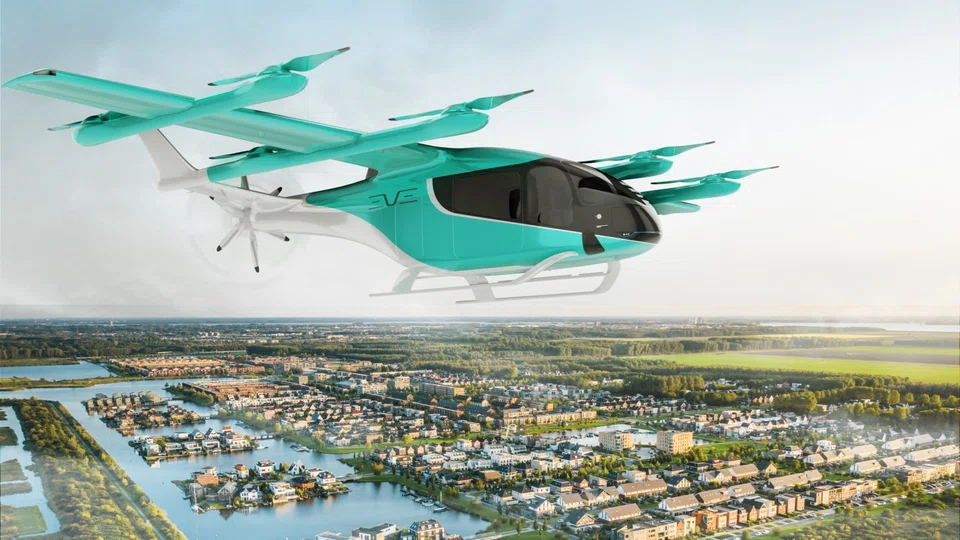
But the poster child of AAM is the electric vertical take-off and landing – or eVTOL – aircraft. These small vehicles, which may be used for passengers or cargo, are what will become air taxis.
Calling AAM “the next disruption” in aerospace, Deloitte Insights estimates that in the US alone, the combined passenger and cargo market for AAM involving eVTOL will grow from US$17 billion in 2025 to US$115 billion in 2035.
How do eVTOLs compare to aeroplanes and cars?
eVTOLs aim to cover shorter distances than aeroplanes, and could be faster, cleaner – and eventually, cheaper – than cars.
New York Stock Exchange-listed Joby Aviation says its eVTOL service could cost only US$3 per mile by 2026. Deloitte cites the same figure in a study, against US$2.80 for a standard taxi and US$5 for a premium taxi.
The Deloitte study estimates that the 40.2 km trip from John F Kennedy Airport to New York City, for example, would take 15 minutes by eVTOL and emit no carbon. A petrol taxi would take 44 minutes and put 8.9 kg of carbon dioxide into the air.
eVTOLs can also shuttle between cities. A 333 km eVTOL trip from New York to Boston would take 82 minutes and emit no carbon, compared to 236 minutes and 34 kg of carbon dioxide by plane, and 258 minutes and 87 kg of carbon dioxide by car, said the Deloitte study.
Would an electric vehicle be quieter too?
Considerably. In a noise test that the US National Aeronautics and Space Administration ran on Joby’s aircraft, a sound level of less than 65 weighted decibels (dBA) was registered at 100 m from the aircraft, in both normal flight and landing.
That’s the sound level of a busy office. It is also far quieter than a vacuum cleaner’s 75 dBA, let alone a conventional helicopter’s 97 dBA at take-off.
When do air taxis become a reality?
eVTOLs are expected to be phased in over the next decade.
Dennis Lau, consultancy services director at business and aviation consultancy Asian Sky Group, said: “Limited operations could begin in the mid-2020s, but wider use of AAM is unlikely until some time in the 2030s.”
Deloitte predicts the initial deployment of air taxis in 2025; operations in a few cities with limited automation by 2028; and operations in multiple cities with full automation by 2042.
The first commercial eVTOL flights are expected at showcase events in the next two years: the 2024 Paris Olympics and the World Expo 2025 in Osaka.
How do we know this isn’t just vapourware?
Besides many AAM startups, established aerospace players and big players in other industries have entered the scene.
Airbus is working on its own eVTOLs. Boeing bought over air taxi company Wisk. Embraer’s subsidiary Eve has been listed on the New York Stock Exchange. Major names from the car industry have joined the party: Honda, Hyundai, Stellantis and Toyota.
Around 350 companies around the world are in various stages of developing 600 eVTOLs, according to the Vertical Flight Society.
Seven companies with eVTOLs have gone public. Chinese company eHang was first in 2019, followed in 2022 by Blade, Joby Aviation, Archer, Lilium, Vertical Aerospace and Embraer-owned Eve.
Of the world’s 25 largest aerospace manufacturers and suppliers, 72 per cent and 64 per cent respectively are involved in AAM initiatives, up from 60 per cent and 48 per cent at the end of 2021.
In 2022, orders were placed for 6,700 AAM aircraft worth a total of around US$45 billion, noted research outfit McKinsey.
The US, China, Germany and South Korea have prioritised AAM as strategic and critical to their aerospace industries, said Deloitte.
Have eVTOLs faced any turbulence?
eVTOLs will need to overcome significant barriers, especially since the aviation industry requires stringent approval and safety processes. Certifying even a conventional aircraft can take a few years.
For entirely novel types of aircraft, regulatory bodies need to adapt existing rules or create entirely new ones – hence the initiative by regulators in the Asia-Pacific.
That is part of the reason some eVTOL manufacturers have pushed back their planned first-flight dates to past 2025.
“Certification is the biggest challenge for the AAM market,” said Asian Sky Group’s Lau. “With eVTOL technology being so new and unproven, authorities will enforce very strict certification requirements, which adds complexity and costs for the OEMs (original equipment manufacturers).
“Funding for eVTOL programmes will then also become an issue, considering the training, and supporting activities required.”
AAM will also require new infrastructure, including new types of air traffic management and landing sites.
TRENDING NOW
Grab CEO’s wife Chloe Tong on life with Anthony Tan and finding her purpose
What role can Japan play in Asean’s future?
He built the Vingroup empire. Now South-east Asia’s richest man is handing some key roles to his sons
Asean’s challenge is to become resilient against global geopolitics: former Indonesia trade minister