

All eyes on what course new OCBC chief will set
Ahead lies next stage of growth following global health crisis, with geopolitical tensions, pandemic uncertainties and upcoming digital bank entrants to watch out for
Singapore
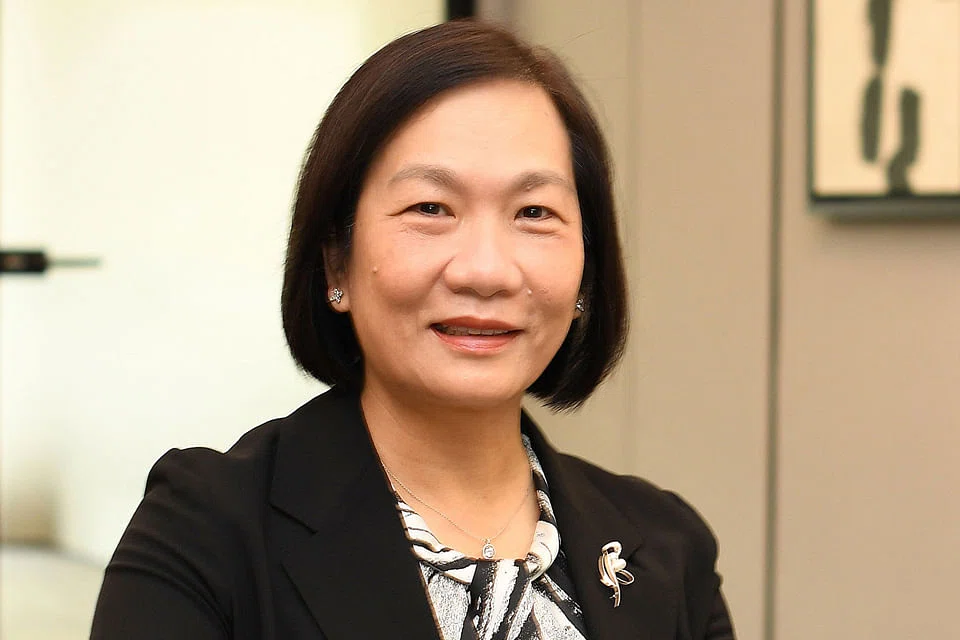
OCBC's new chief Helen Wong starts in her top role today, having been plucked from HSBC to steer Singapore's second-largest bank.
She will have her work cut out in pushing the lender to its next stage of growth following a global health crisis, with geopolitical tensions, pandemic uncertainties and upcoming digital bank entrants to watch out for.
But with the worst of Covid-19 behind and the majority of credit losses taken into account, the handover comes at an opportune time as the global economy is set to recover.
The 59-year-old will inherit a franchise that has emerged from the pandemic with strong fundamentals and capital levels well above requirements, on top of a wealth business that is well-positioned to capture flows from the region.
With common equity tier one ratio (CET-1) of 15.2 per cent, far higher than the optimal range of 12.5-13.5 per cent, it could also be seen as both a risk and an opportunity for OCBC, with the bank not ruling out potential mergers and acquisitions.
The bank is also expected to see a lift from higher net interest margins as interest rates rise and dividends likely to go up on higher profits compared with FY2020, as well as if the regulator should soon announce if it would lift dividend payout caps.
All these bode well for Ms Wong, who will have to prove that she has what it takes to bring OCBC to the next level amid the improved economic and credit conditions.
Her expertise and background in Greater China will be put to the test, as OCBC has said that China's Greater Bay area will continue to be a key focus segment. In its latest Q4 results briefing in February, Ms Wong had told the media that the bank is looking to put in more resources and also set higher targets for its businesses in Greater China. Greater China is OCBC's second largest market after Singapore since 2016.
Hong Kong-born Ms Wong was previously the chief executive of HSBC in Greater China, with decades of experience in the region. The banking veteran's experience in investment and corporate banking includes that of heading the debt capital markets business in Greater China.
She had joined OCBC in February last year as deputy president and head of global wholesale banking. She also led a new sustainability taskforce said to be in line with her keen interest in sustainability.
This is a homecoming of sorts for Ms Wong, as she started her career in banking with OCBC in 1984, and was its first China desk manager.
Kevin Kwek, managing director and senior banking analyst at Alliance Bernstein, said HSBC - where she was from - has strengths in commercial banking, and clients are likely to see the commitment from OCBC to the area. Commercial banking clients also tend to respect relationships over time and so the dedication to the area will be well regarded, he added.
But with Hong Kong uncertainties and strained US-China ties to navigate, Ms Wong will have to play her cards right as geopolitical tensions have emerged as the biggest risk after Covid-19 by many quarters.
US President Joe Biden and China are off to a rocky start, dashing hopes of warming relations between the two superpowers after the exit of the Trump administration.
Another challenge she will face is whether she can articulate the bank's strategy in digitalisation in retail banking. OCBC is the only one among the three listed Singapore banks to avoid a digital bank outfit.
DBS has digital banks in India and Indonesia, while UOB has its stand-alone digital bank TMRW (pronounced "tomorrow") in Thailand and Indonesia. Singapore has also awarded licences to four digital banks that will start operations in Singapore by 2022.
There is no denying that OCBC has ramped up its digital capabilities and pumped in investments on the tech front over the past few years. But it is still unclear whether its decision to avoid experimenting via a digital-only bank, will be its undoing.
To be fair, the digital-bank strategy is not clear-cut. The jury is still out on whether pure digital banks will prove successful, with profitability and costs of customer acquisition obstacles to overcome.
As banks move past the Covid-19 crisis, the next challenge will be in managing digitalisation trends that are here to stay. Tay Wee Kuang, research analyst at Phillip Securities, pointed to the "organisational effort" to remain competitive as digital entrants move in. But local banks with their operational know-how have a leg up against new players, he added.
While Ms Wong and outgoing CEO Samuel Tsien have similar backgrounds, it would be narrow thinking to assume that they lead in the same manner. The question is how Ms Wong would perceive the upcoming risks from digital upstarts, and how she would respond. Investors - many of whom are pouring money into tech firms such as Sea Ltd - may want something different.
It is also worthwhile noting that Ms Wong's appointment is particularly significant as she is the first female CEO among Singapore banks - paving the way for others to follow.
What underscores this achievement is that it was done without a sense of tokenism. Male or female, the new chief executive must show their mettle.
The greater hope in pushing through gender diversity here and abroad is that in time, there would soon be nothing headline-grabbing about a female CEO in a local bank.
Judging by Ms Wong's ascent and the new business environment, focus will rightly be on proving performance. As leadership goes, competency is the surest test.
TRENDING NOW

Once staunchly pro-China, Malaysian Chinese businesses are now distancing themselves from Beijing

Grab CEO’s wife Chloe Tong on life with Anthony Tan and finding her purpose

Could stablecoins be the future of money?
ST Engineering opens tech-focused aircraft maintenance facility in Changi; to create over 500 jobs

