

Amid global economic uncertainty, KSH Holdings doubles down on Singapore for growth
The construction and property group is eyeing more laboratory construction projects, given its strong track record in the sector

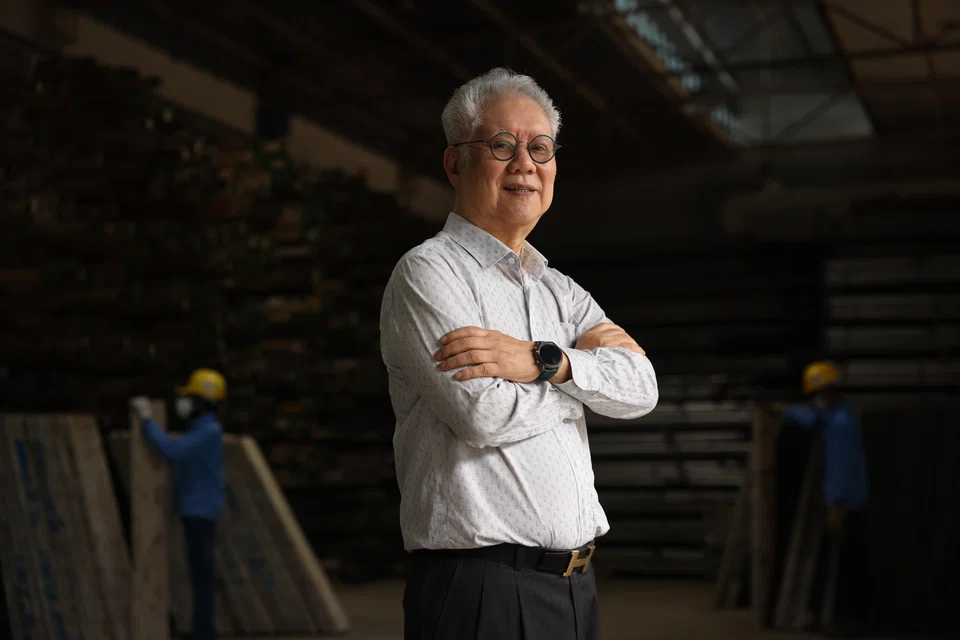
[SINGAPORE] In view of China’s prolonged economic slowdown and rising geopolitical tensions, construction and property group KSH Holdings is hedging its bets and doubling down on the Singapore market for growth.
Executive chairman and managing director Choo Chee Onn is banking on the Republic’s construction upcycle to drive the group’s topline, as he looks to dial back its overseas real estate development and investment activities over the next few years.
Currently, KSH is developing two residential properties in Gaobeidian, China with joint venture partners. Its portfolio includes stakes in a retail office asset in Tianjin, on top of several hospitality assets across the United Kingdom and Japan.
“There’s just too much uncertainty around the world,” Choo told The Business Times in an exclusive interview.
“With so many conflicts and trade tensions, it’s better for us to concentrate on Singapore at the moment.”
The group’s latest financial performance gives him good reason to look inwards.
Following two years of pandemic-induced losses, KSH returned to the black with a net profit of S$5.3 million for its latest half-year ended Sep 30, 2025. This reversed a loss of S$6.5 million in the year-ago period.
Revenue in H1 FY2026 rose 19.7 per cent on the year to S$63.1 million, driven by higher contribution from its core construction business in Singapore. Construction brought in 90 per cent of group revenue, with the rest from property investments.
“Our strategy was to finish all our loss-making jobs (during Covid-19),” said Choo, adding that the group took on new construction projects from 2024.
This included laboratory refurbishments and the construction of a hostel at the National University of Singapore as well as building the Founder’s Memorial at Bay East Garden, all of which contributed to profit margins.
As at November, its order book in Singapore exceeds S$500 million and is expected to contribute to the group’s financials up to FY2029.
Choo is currently working on securing more contracts, with the aim of adding an additional S$500 million – S$250 million by end-FY2026 and another S$250 million by Q1 FY2027 – to bring the total order book to S$1 billion.
Shares of KSH closed at S$0.36 last Friday (Dec 26), putting the company’s market capitalisation at S$205.1 million.
Leveraging on lab niche
While KSH has undertaken residential, industrial and other large-scale projects across public and private sectors, Choo aims to leverage the group’s particularly strong track record in laboratory construction in the near term.
He foresees more of such tenders to be launched as Singapore pumps increasing amounts of investment into research and development.
To date, KSH has completed nearly S$700 million worth of laboratory and research-related projects across industries, ranging from electronics to biomedical to livestock.
Said Choo: “Compared to condominiums or other industrial projects, labs are much more complex to construct due to stringent regulatory compliance requirements.”
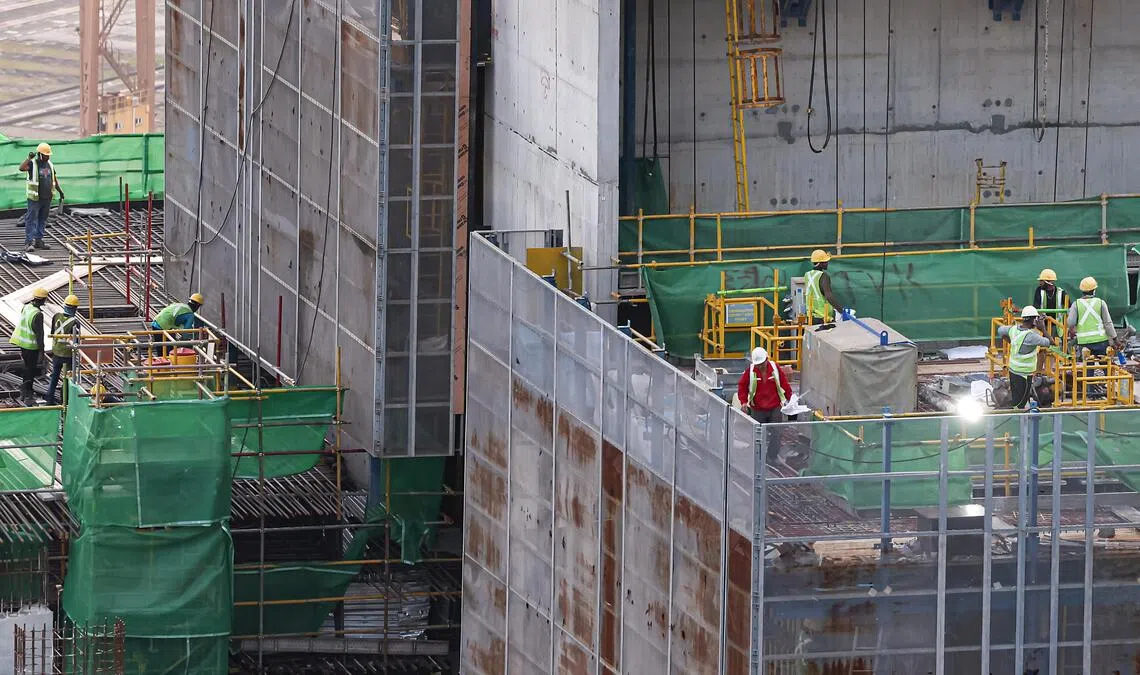
KSH has sought to strengthen its competitive advantage in this niche. In 2024, it expanded into design-and-build services for laboratories, beginning with its first such project for Changi Airport Group.
Under this model, it works directly with architects and consultants to design the facility to clients’ requirements, rather than being engaged solely for construction.
The group is also eyeing substation projects, alongside healthcare facilities; education and training institutions; and defence-related critical infrastructure.
To keep up with the expected uptick in construction activity, KSH has increased its headcount by 20 per cent over the past year. This includes bringing onboard more engineers, quantity surveyors and architect coordinators, said Choo.
Reducing overseas exposure
At the same time, Choo intends to scale back KSH’s real estate development and investment exposure abroad, at least for FY2026.
In China, KSH’s two ongoing residential developments under the Singapore Sino Health City project in Gaobeidian county have been hit by a downturn in the property market.
Acknowledging the challenging conditions, Choo said: “There are some sales, but they have been quite slow… the confidence level (for China) is not there.”
The group has therefore decided to slow down the pace of completion of the project, having already built 3,000 of 18,000 planned units. It owns an equity stake of 22.5 per cent and 33.75 per cent in both residential developments.
On the property investment front, KSH’s retail and office complex in Tianjin – of which it has a 69 per cent stake in – continues to chalk up an occupancy rate of 60 per cent. This is down from a rate of 80 per cent to 90 per cent pre-pandemic, Choo noted.
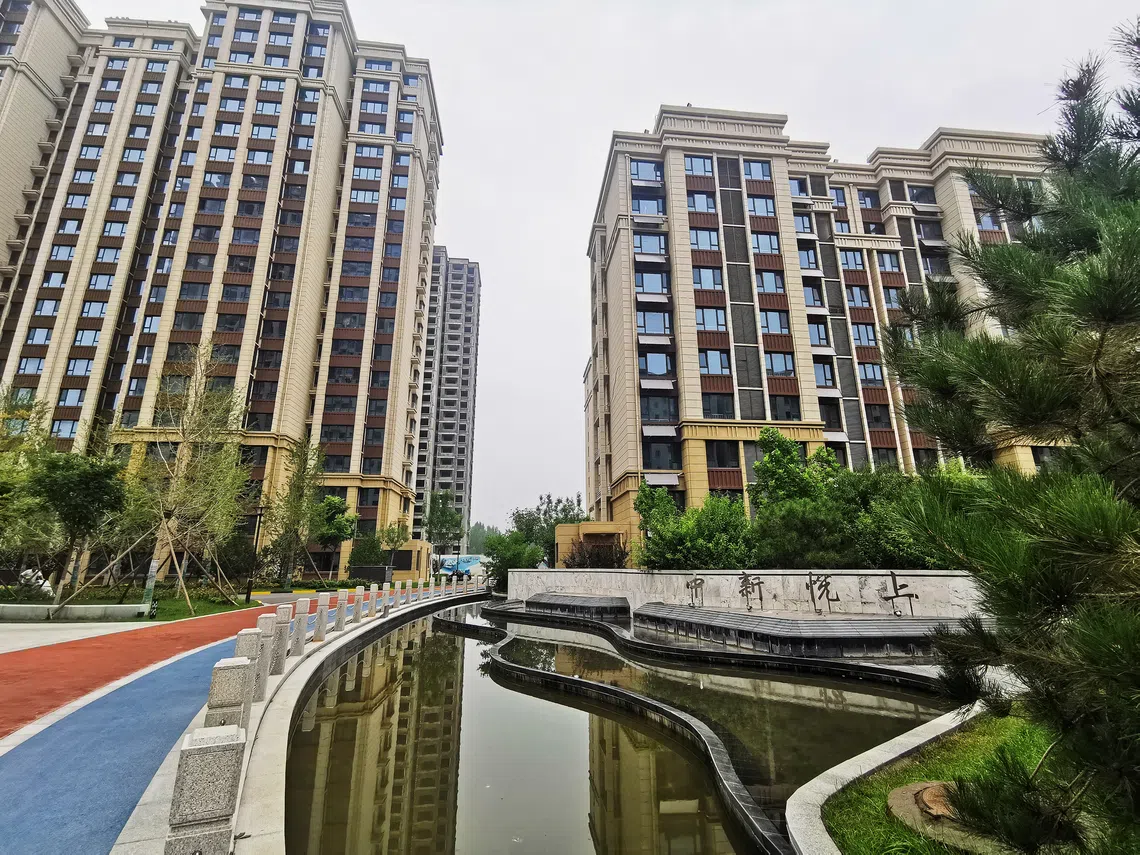
He observed that while the Chinese market has experienced downturns in the past, recoveries then were “very fast”, taking about “one to two years”.
But he is not optimistic for a similarly quick rebound this time. In fact, Choo is already preparing for a possible exit from China, should economic conditions fail to improve.
“If the economy doesn’t turn around in the next three to four years, we have a plan to exit China,” he said.
The outlook is also uncertain for the group’s other overseas investments, which comprise hotels and resorts across the UK and Japan.
Choo noted that the UK tourism industry has been impacted by geopolitical tensions such as the ongoing trade war, while Japan’s tourism sector has taken a hit from its recent diplomatic rift with China.
Stronger domestic focus
Accordingly, KSH will stay grounded in Singapore in tandem with the recovery of the construction and real estate sectors.
Between 2026 and 2029, the Building and Construction Authority expects total construction demand to range between S$39 billion and S$46 billion per year.
Said Choo: “At this moment, we don’t have plans to look at overseas markets… Singapore is our homeground, we know it much better than any other markets.”
Still, he intends to take “calculated risks” to prevent a repeat of KSH’s pandemic-era losses. This means taking on projects that can be completed in a shorter timeframe, within two to three years.
For instance, the group “is not very keen” to enter joint ventures for the construction of Changi Airport’s Terminal 5, even though it has been approached by foreign contractors.
“If we can avoid risks, we will,” said Choo, noting that the primary risk for Terminal 5 lies in the long-term nature of projects.
“If another Covid-19 happens, we have nowhere to run.”
As for property development, KSH is currently involved in four joint ventures to develop three residential projects and one mixed-use development in Singapore. All have recorded steady sales since their respective launches.
However, with the “hot” residential market, Choo is concerned that the government could introduce more cooling measures that could put a dent on sales.
He is thus leaning towards the development of industrial properties, noting that the group’s healthy cash position provides it with a war chest to pursue “good opportunities” that may arise.
As at end-September, KSH had fixed deposits, cash and bank balances of S$114.5 million, slightly down from S$120.7 million in the year-ago period.
Total loans and borrowings stood at S$61.1 million for the half year, down from S$65.9 million in FY2025, while gearing ratio improved to 20 per cent from 22 per cent.
“We hope to expand our property development (portfolio) in Singapore over the next two to three years, if the market is still going strong.”
TRENDING NOW

Once staunchly pro-China, Malaysian Chinese businesses are now distancing themselves from Beijing

Britain’s mansion tax shows the difficulty of targeting wealth
Three hats, one goal: How Ng Kian Swan runs sustainability at NUHS
COE review: The gap between luxury and mass-market cars isn’t the only one worth bridging

