Anti-money laundering bust that seized S$1 billion could be ‘tip of the iceberg’

Yong Jun Yuan
Megan Cheah
Yong Hui Ting
Published Thu, Aug 17, 2023 · 04:36 PM
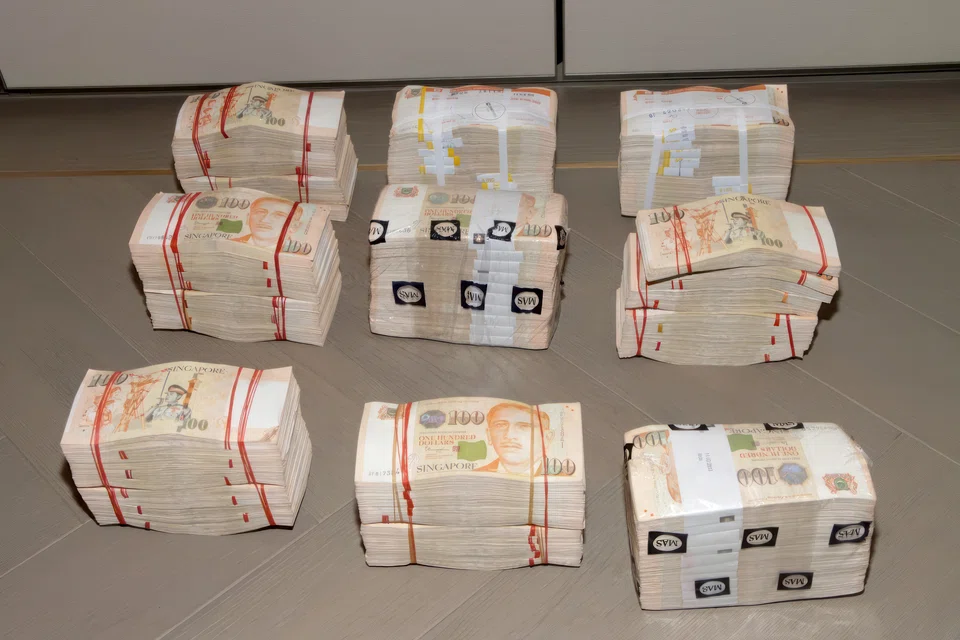
    • The crackdown on Tuesday, which was conducted across several Good Class Bungalows and high-end condominiums simultaneously, nabbed 10 individuals.
    • The crackdown on Tuesday, which was conducted across several Good Class Bungalows and high-end condominiums simultaneously, nabbed 10 individuals. PHOTO: SINGAPORE POLICE FORCE

    AS A major financial hub, Singapore must remain vigilant as criminal networks continue to seek out loopholes around anti-money laundering safeguards, industry watchers said.

    A large-scale anti-money laundering operation was conducted by the Singapore Police Force on Tuesday (Aug 15) in which S$1 billion in cash and assets were seized from a group of foreign nationals.

    The crackdown was conducted across several Good Class Bungalows and high-end condominiums simultaneously, in areas including Tanglin, Bukit Timah, Orchard Road, Sentosa and River Valley.


    Ten people were charged in court on Wednesday over their suspected involvement in offences including forgery and money laundering. Another 12 are assisting in investigations, while eight more are currently on the run and have been placed on a wanted list.

    Athreya H D, partner for financial services consulting at Mazars in Singapore, said the crackdown could be just the “tip of the iceberg”. 

    Questions remain, he added, about how the group managed to set up their operations in Singapore and carry out so many transactions. 

    “Financial crime has been evolving. These criminals are using sophisticated networks and innovative technologies, trying to always one-up the system,” he said. 

    He added that there could be further scope for more public and private collaboration with companies such as jewellery or luxury goods retailers, to flag suspicious transactions. 

    “Especially if (transactions are) done in purely cash, that needs to probably be scrutinised further to understand what were the source of funds and why is it that these transactions are being done in cash and not electronically,” he said. 

    Victoria Ting, associate director at Setia Law, said luxury items such as handbags, watches and liquor fall outside of the scope of the “usual AML/CFT (anti-money laundering/countering the financing of terrorism) regimes”.

    This incident then highlights the “possible need to extend regulations already in force as against precious stones and precious metals dealers, to other luxury items like bags and watches which can be equally valuable, easily commoditised and highly transportable”, she added.

    Stefanie Yuen Thio, joint managing partner of TSMP Law Corporation, noted that dealers in luxury items such as handbags and liquor are generally not required to be licensed or registered. She added, however, that all business activities should comply with general anti-money-laundering laws in Singapore.

    Corporate governance advocate and professor of accounting at the NUS Business School, Mak Yuen Teen, questioned if banking safeguards, which put the onus on banks to prevent money laundering, have been effective. 

    “If we want truly effective safeguards, we need to make sure there is accountability at the top of these organisations, including boards and senior management, and penalties must be severe enough,” he said. 

    He added that the crackdown is “long overdue” as there have been suspicions about the sources of funds of many wealthy foreigners from certain countries. 

    “The scale of this operation involving multiple agencies is impressive but one wonders why it took so long for the authorities to act,” he said. 

    Still, EY Asean forensic and integrity services leader Ramesh Moosa said that it may be premature to speculate on what loopholes were exploited in this case.

    With the publicly available information so far, he said that financial institutions, property developers and agents, as well as luxury goods distributors and retailers should take heed of red flags. These include when individuals hold multiple passports, and when they possess large assets in cash and in bank accounts.

    Yuen Thio said the scale of the alleged crimes was “eye opening”. 

    She noted that Singapore’s status as a major financial hub meant that criminal networks would try to take advantage of that. 

    Such a bust surfacing also indicated that Singapore’s Suspicious Transaction Reporting system “appears to be working”, she added. 

    “Let me put it this way: I would say that a major financial centre that is constantly surveilling and catching bad actors is a much safer system than one where no criminal activities are ever spotted.”

    Among the assets seized are 94 properties and 50 vehicles – estimated to be worth more than S$815 million in total – for which the police issued prohibition of disposal orders.

    The Urban Development Authority recently included new rules that required developers to conduct due diligence checks on transactions of uncompleted properties and subsequently flag suspected illicit activities through the Suspicious Transaction Reporting Office of the police’s Commercial Affairs Department (CAD).

    Nicholas Mak, chief research officer of property portal Mogul.sg, said the large amount that was involved was “surprising”, as real estate is an immovable asset. 

    He noted that once buyers got through the first hurdle of purchasing property with laundered money, they would be “in the clear”. “When they sell the property, the money made will appear to be ‘clean’,” he said.

    Huttons Asia chief executive Mark Yip said that real estate salespersons have a critical role to play to counter money laundering and corruption threats, but there is no “fool-proof” way to ensure all transactions are legal as documents can be forged. 

    For this case in particular, “there is no visibility on what transpired” and it would be “speculative” to say that there are loopholes to be tightened.

    Singapore’s central bank on Wednesday said that it will take “firm action” against financial institutions (FIs) found to have breached its requirements on anti-money laundering and countering the financing of terrorism.

    The Monetary Authority of Singapore (MAS) said that it worked closely with the CAD to identify potentially tainted funds and assets in Singapore’s financial system and prevent their dissipation.

    “MAS takes this case seriously, and has been in touch with the FIs (financial institutions) where the potentially tainted funds have been identified. Supervisory engagements with these FIs are ongoing,” MAS said.

    It added that it will also act against FIs with inadequate controls against money laundering and terrorism financing.

    At least one of those charged as part of the money laundering raid is also understood to have ties to locally-listed companies as well.

    Cypriot national Su Haijin, who was a non-executive director of Catalist-listed No Signboard Holdings, was charged in court with one count of resisting lawful apprehension on Wednesday.

    According to its latest annual report, which was filed in September 2022, he holds a 20 per cent stake in the company.

    The Association of Banks in Singapore has declined to comment.