ARA Logos minorities may support merger with ESR-Reit, but not because it's a good deal
Gross exchange ratio disadvantages ARA Logos unitholders, but scramble for assets could spur support for merger with ESR-Reit

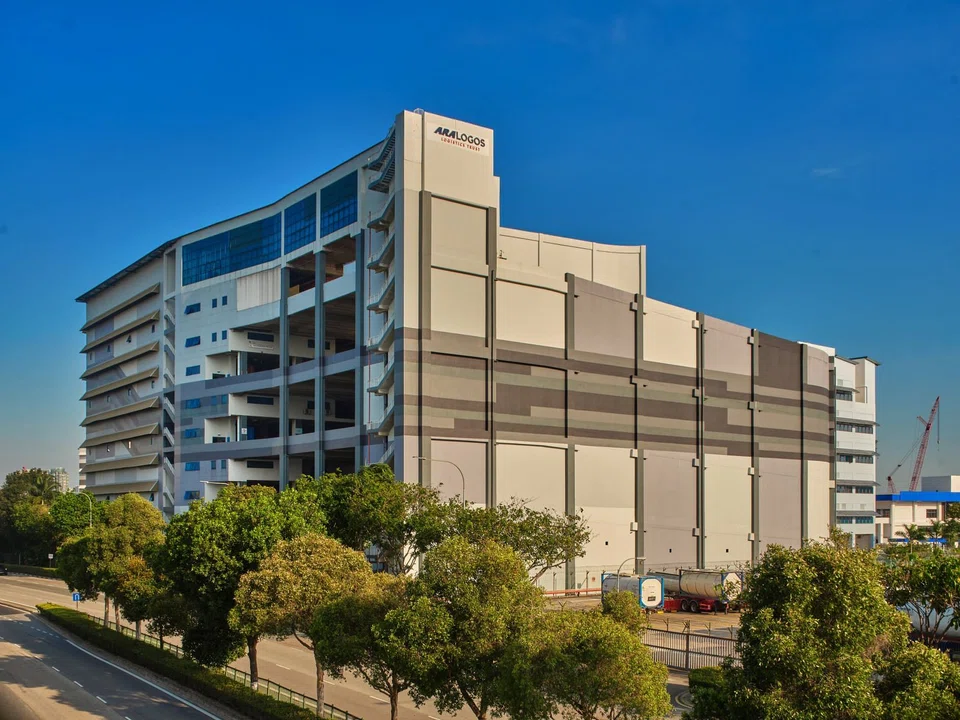
UNITHOLDERS of ARA Logos Logistics Trust have no compelling reason to vote in favour of the proposed merger with ESR-Reit.
ARA Logos' market capitalisation just prior to the merger announcement stood at nearly S$1.4 billion - not that much smaller than ESR-Reit's S$1.9 billion, and sufficiently large to independently pursue acquisitions.
More importantly, ARA Logos was trading at a lower yield than ESR-Reit (5.1 per cent versus 6.1 per cent); and a higher premium to its book value (39 per cent versus 21 per cent).
In short, ARA Logos is arguably in a better position than ESR-Reit to aggressively tap the market for funds and expand its property portfolio.
If ARA Logos were to be subsumed by ESR-Reit, its ability to compete for in-demand assets on terms that would be immediately accretive to its distribution per unit (DPU) might be blunted.
The combined entity, being much larger and more diversified, may well have a wider range of options when it comes to capital raising. But it would have to execute much larger acquisitions in order to move the needle in terms of delivering growth.
The proposed merger also seems to benefit unitholders of ESR-Reit at the expense of unitholders of ARA Logos by a number of quantitative and qualitative considerations. Not least among them is the pricing of the new ESR-Reit units that will be swapped for existing ARA Logos units.
Questionable exchange ratio
Under the proposed merger, ARA Logos unitholders will receive a consideration of S$0.95 per ARA Logos unit - comprising S$0.095 in cash and 1.6765 new ESR-Reit units priced at S$0.51 each.
ARA Logos had closed at S$0.935 just before the merger announcement, and ESR-Reit had closed at S$0.465.
So, while ARA Logos was being valued at a 1.6 per cent premium to its closing price before the announcement, ESR-Reit is being valued at a much larger 9.7 per cent premium.
Since the merger announcement, the market prices of the two Reits have naturally moved towards the implied gross exchange ratio of 1.863 times.
ARA Logos closed Friday at S$0.885, down 5.3 per cent since the merger announcement.
ESR-Reit closed at S$0.475, up 2.2 per cent since the merger announcement.
Why was the exchange ratio implied by the merger terms so out of whack with the prevailing market prices of the two Reits?
In a list of "frequently asked questions" about the deal, the manager of ESR-Reit said the issue price of the new ESR-Reit units and the offer price for the ARA Logos units took into consideration the respective 52-week highs of the two Reits and their trading volumes on those days.
Looking at their price charts, both Reits clearly spiked on Sep 2. This appears to have been fuelled by news reports at the time that 11 Singapore-listed Reits - including ARA Logos and ESR-Reit - would be added to the FTSE EPRA Nareit Global Developed Index.
ARA Logos closed at S$0.95 on Sep 2, while ESR-Reit closed at S$0.51 - the very same prices used in the merger proposal.
If I were a unitholder of ARA Logos, I would be inclined to question the premise of considering the 52-week highs of the two Reits.
Shouldn't the merger terms be based on market prices that reflect the micro fundamentals of ARA Logos and ESR-Reit?
Why use their market prices on a day when trading activity was heavily influenced by index changes?
New economy focus
The gross exchange ratio implied by the terms of the merger is all the more galling for unitholders of ARA Logos given that ARA Logos's portfolio has a higher concentration of new economy-oriented properties than ESR-Reit.
In fact, ARA Logos draws all of its gross rental income from logistics properties. It holds 29 properties and has some S$2 billion in assets.
ESR-Reit, with 58 properties and some S$3.4 billion in assets, draws only 47 per cent of its gross rental income from logistics and high-spec industrial properties.
The combined entity - which will be called ESR-Logos Reit - will have 87 properties and some S$5.4 billion in assets. Nearly 66 per cent of its gross rental income is projected to come from new economy-oriented assets.
ESR-Logos Reit will also have lower exposure to business parks than ESR-Reit (16.3 per cent versus 25.2 per cent), where the work-from-home trend is creating uncertainty.
On top of that, ESR-Logos Reit would have a higher portfolio occupancy rate than ESR-Reit (94.5 per cent versus 91.7 per cent); greater exposure to freehold properties (10.7 per cent versus zero); and longer weighted average lease expiry (3.2 years versus 2.8 years).
Win-win narrative
The managers of ARA Logos and ESR-Reit see things differently. Their narrative is that the proposed merger is a win-win deal for unitholders of both Reits.
For starters, the merger is expected to be immediately accretive in terms of DPU for unitholders of ARA Logos as well as ESR-Reit.
On a pro forma basis, assuming the merger had been completed at the beginning of 2020, unitholders of ARA Logos would have seen an 8.2 per cent improvement in DPU; unitholders of ESR-Reit would have benefited from a 5.8 per cent increase in DPU.
With a larger pool of assets, ESR-Logos Reit will also have greater flexibility to actively manage its portfolio and enhanced capacity to raise funds for acquisitions.
Then, there is ESR Cayman's acquisition of ARA Asset Management - the reason ARA Logos and ESR-Reit are proposing a merger in the first place.
The expanded ESR Cayman group will have some US$131 billion in assets under management, of which some US$50 billion will be new economy-oriented properties.
Intriguingly, some US$2 billion worth of these new economy assets are said to be "visible and executable".
The proposed merger of ARA Logos and ESR-Reit removes the problem of their overlapping mandates, and positions ESR-Logos Reit to tap ESR Cayman's abundant asset pipeline.
Could ARA Logos and ESR-Reit remain separate entities and tap their sponsor's asset pipeline individually? Perhaps. But ever-present concerns about potential conflicts of interest faced by their common sponsor could put investors off.
ESR-Reit's mandate already overlaps with that of Sabana Industrial Reit, whose manager is also owned by the ESR Cayman group. But Sabana Reit's depressed market valuation makes it an unviable asset securitisation vehicle for now.
By contrast, ARA Logos and ESR-Reit need to make hay while the sun shines by taking advantage of their lofty market valuations to raise capital and tap their sponsor's asset pipeline.
In the end, even if they are unimpressed with the merger terms, many unitholders of ARA Logos might well support the deal (or, at least, not oppose it) in order to avoid any risk of being treated unfairly by the sponsor.
If the merger of ARA Logos and ESR-Reit succeeds, it might not be because it was an attractive deal for all minority investors.