Asean energy cooperation ‘more crucial than before’ with global disruption: EMA chief
This year’s edition of SIEW will feature an event by the International Atomic Energy Agency for the first time

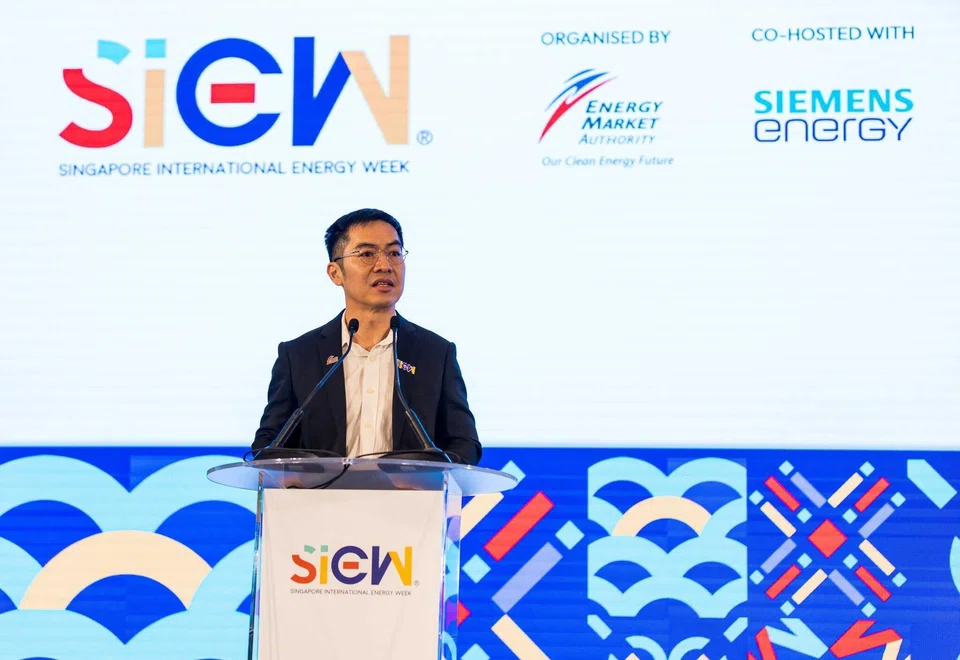
[SINGAPORE] Energy cooperation between South-east Asian nations is “more crucial than before” with recent disruptions to global supply chains, the chief of Singapore’s energy regulator said on Wednesday (Mar 25).
“The supply disruption may last for months. If there are damages to energy infrastructure, the repair and full restoration of supply may take years,” said Puah Kok Keong, chief executive officer of the Energy Market Authority (EMA).
He was speaking at Conrad Singapore on this year’s Singapore International Energy Week (SIEW), which will be held from Oct 26 to 30.
Puah noted that South-east Asia is one of the world’s fastest-growing regions for electricity demand, due to a push into higher-value add and more energy-intensive industries.
“Yet the grids remain largely fragmented, leaving countries exposed to the supply shocks that we are witnessing today,” he said.
The closure of the Strait of Hormuz since Feb 28, amid conflict in the Middle East, has sent oil and gas prices soaring. Asian spot prices for liquefied natural gas – which Singapore imports for power generation – have surpassed US$20 per million British thermal units, double the prices earlier this year, Puah noted.
The conflict has reignited conversations about clean energy. South-east Asia’s renewable energy potential stands at 20 terawatts – about 55 times the region’s present power generation capacity, according to the International Energy Agency (IEA).
While such potential is an “extraordinary asset”, it can only be realised if the region’s grids are built to move energy where it is needed, said Puah.
The Asean Power Grid – the effort to connect the energy systems of member countries by 2045 – will allow sharing of renewable energy resources and reliable supply. It will also reduce the region’s dependency on imported fuels and exposure to global fuel price volatility, said Puah.

He also called for broader transformation of energy systems. This year’s edition of SIEW will centre on the theme “Connecting Energy Systems, Powering Tomorrow”.
It will spotlight next-generation technologies, including an event by the International Atomic Energy Agency for the first time, on advancing nuclear energy readiness.
The forum will also include the Singapore-IEA Forum – in its 10th year – and a high-level forum between the city-state and the International Renewable Energy Agency on energy investments in South-east Asia.
Other focus areas include biomethane, geothermal power, as well as carbon capture utilisation and storage.
Decoding Asia newsletter: your guide to navigating Asia in a new global order. Sign up here to get Decoding Asia newsletter. Delivered to your inbox. Free.
Copyright SPH Media. All rights reserved.