Asean gains in the near term amid US-China tensions, but beware of escalations: MAS’ Chia Der Jiun
A key risk is a rapid increase in protectionist policies, which will negatively impact global growth and inflation tariffs, the managing director warns

THE South-east Asia region has benefited in the near term from a shift in trade and investment flows, amid growing geopolitical tensions globally.
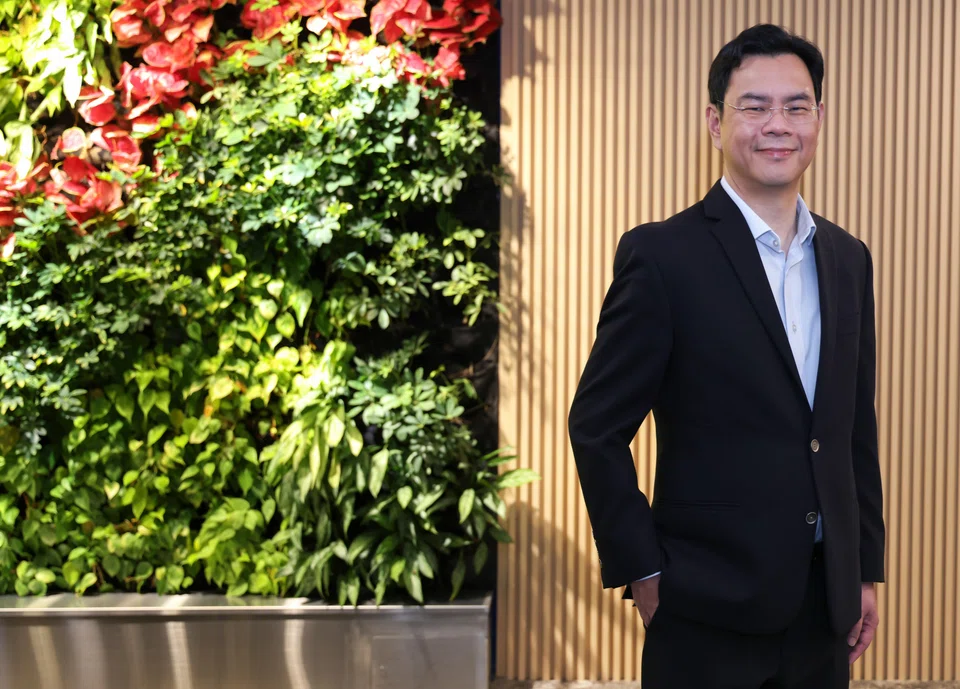
But Chia Der Jiun, managing director of the Monetary Authority of Singapore (MAS), warns that the medium and long- term impact is less clear, especially amid risks of escalation.
“In the near term, growth seems to be quite well supported, with the base case for continuous stability and growth outlook,” Chia said.
“But there are risks where policies can be escalated, especially protectionist policies,” he added.
Chia was speaking in a wide-ranging interview with The Business Times, ahead of the Singapore FinTech Festival.
The annual event is organised by the MAS, Elevandi and Constellar in collaboration with The Association of Banks in Singapore. Elevandi has been replaced by the Global Finance & Technology Network, which was set up last week.
This was also Chia’s first media interview since he took over the role of MAS managing director on Jan 1 this year.
Chia noted that South-east Asia as a region has benefited from being “economic connectors” – markets that stand to benefit from the reshuffling of supply chains amid US-China tensions.
Trade tensions have not affected the share of global trade in relation to global gross domestic product, he said.
Yet, its composition has changed globally – for example, there has been a rise in China trade with the emerging world, and there is increased US trade with Mexico and Vietnam.
In fact, corporates are increasingly diversifying and placing more manufacturing capacity into South-east Asia. This bodes well for the region and for Singapore, which has become regional headquarters to support some of these regional activities, Chia said.
But he noted several risks to watch for in the longer term, a key being the escalation of protectionist policies, which will negatively impact global growth and inflation tariffs.
“There’ll be key elections that we’re all watching out for, on whether there’ll be substantial changes in policy and new protectionist measures, and counter measures by others in response,” he said. The US heads to the polls on Nov 5.
Escalation of the conflict in the Middle East may also cause more severe disruptions to policies, commodity prices and shipping. This can cause some inflationary consequences, given that it has happened from time to time at a lower scale.
Competition for wealth
Turning his attention to wealth management, Chia noted Singapore’s strong position in the sector globally.
Singapore’s assets under management rose 10 per cent on year to S$5.41 trillion as at Dec 31, 2023, exceeding the AUM growth in Asia of 8 per cent.
According to the Singapore Asset Management Survey 2023, Singapore is a key gateway for global asset managers and investors to tap the region’s growth opportunities, with 77 per cent of AUM sourced from outside Singapore, and 89 per cent of total AUM invested outside the country.
While he noted competition among the international financial centres in Asia – Singapore, Hong Kong and Dubai – he said the different centres serve different needs and markets
He added that while there could be some overlaps, the focal areas are, by and large, different.
Singapore is more focused on South-east Asia, and to some extent, South Asia – Chia noted that global banks are increasingly putting their coverage for these two regions in Singapore.
A key way to keep Singapore competitive would be to maintain its capabilities, its support for innovation and its conducive environment, he said.
This includes supporting developments in sustainability, artificial intelligence and digitisation, which have been named as the latest areas that financial institutions want to build up.
Overall, Chia expects Singapore’s near-term economic trajectory to be positive. The projection is for a base case of a 2 to 3 per cent growth this year. Advance estimates for the third quarter this year showed that Singapore grew at a better than expected 4.1 per cent compared to a year ago.
He also expects relative stability for the global economy to continue to be supported, especially as interest rates are being cut and inflation is edging down.
“For now, in the near term, it looks like South-east Asia has gained some from this, but it’s too early to see how it will pan out in the longer term, because there are risks of escalation,” he said.