Asia markets end lower as risk aversion returns
Sentiment affected by oil price war and doubts over expected US fiscal measures; Straits Times Index falls 1.7% to 2,783.72, Dow plunges 4% in mid-morning trading
Singapore
THE relief rebound in Asian stocks failed to hold up on Wednesday as Wall Street stocks fell further in mid-morning trading amid rising signs the coronavirus outbreak could slow the US economy, posing significant recession risk.
After recovering some ground on Tuesday, the Dow Jones Industrial Average lost about 1,000 points or 4.0 per cent near 1450 GMT Wednesday and stood at 24,013.13. The broad-based S&P 500 slumped 3.6 per cent to 2,777.34, while the tech-rich Nasdaq Composite Index dropped 3.3 per cent to 8,071.02.
Early in Wednesday's session, most of the region's benchmarks did show signs of extending the rally. However, hope eventually faded as risk aversion returned, with investors growing more worried over the increasing number of Covid-19 cases globally.
Doubts over whether expected US fiscal measures would be sufficient in curbing the economic fallout from the virus also surfaced.
Furthermore, sentiment in Asia was again affected by oil markets as Saudi Arabia quashed hope of a sustained rally in oil prices after announcing plans to increase oil production to 13 million barrels per day.
As a result, the West Texas Intermediate and Brent gave back early gains during the Asian session to trade around US$33 a barrel and US$36 a barrel, respectively.
On Wednesday, Singapore's Straits Times Index (STI) fell 1.7 per cent to 2,783.72.
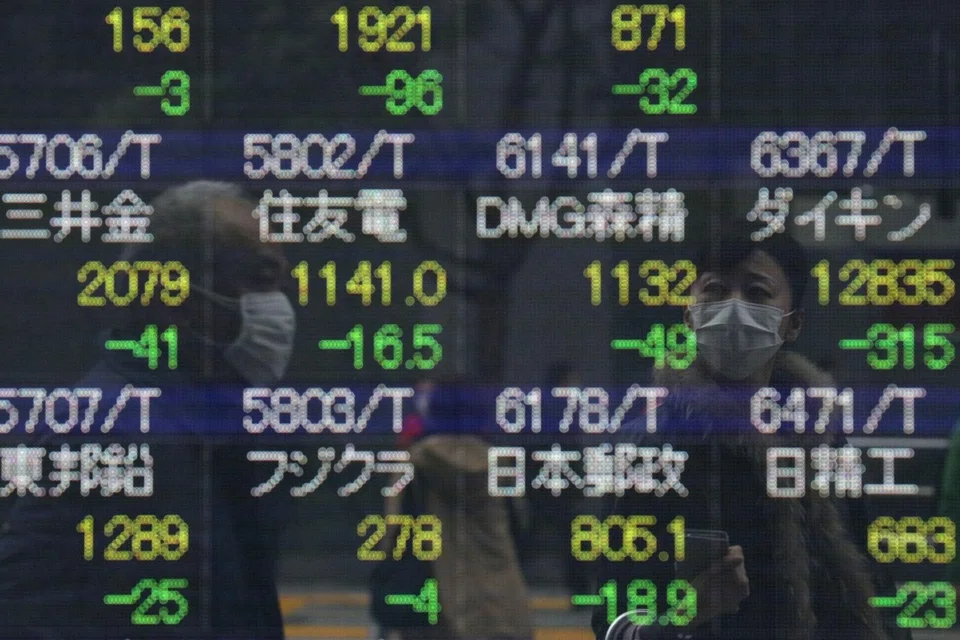
In North Asia, South Korea's Kospi index fared worst, losing 2.8 per cent as Covid-19 cases there recorded their first increase in 11 days. Japan's Nikkei 225 index shed 2.3 per cent.
Meanwhile, Greater China markets fared better with mainland China's Shanghai Composite Index losing 0.9 per cent and Hong Kong's Hang Seng Index down 0.6 per cent.
Among South-east Asian markets, Indonesia's Jakarta Composite Index dropped 1.3 per cent to a three-year low after the country reported its first death from Covid-19. Thailand's SET Index was down 1.7 per cent.
Elsewhere in the Asia-Pacific, Australia's commodity heavy S&P/ASX 200 index was 3.6 per cent lower.
Going forward, analysts believe there are ample reasons for markets to remain jittery.
FXTM market analyst Han Tan believes that "risk assets are expected to have a hard time hanging on to recent gains as investors adjust to the new reality of the economic threat from (Covid-19), and the global implications from depressed oil prices".
For AxiCorp global chief markets strategist Stephen Innes the rising cases in Europe and especially the US, could cast a further pall on outlook.
He said: "There is no escaping that inevitable headline as the Covid-19 headcount numbers will climb rapidly higher from current levels, possibly in an explosive way."